How Crypto Miners Rethink Strategy Amid BTC Volatility: Pivots, Profit, Diversify
Summary
Executive overview
The Bitcoin mining sector is at an inflection point. Rapid BTC price swings, rising energy debates and capital scarcity are forcing miners to rethink everything from asset mix to corporate governance. Some companies are literally repurposing racks; others are tightening operations to restore miner profitability. For institutional investors and corporate strategists, the key questions are: which pivots are tactical versus structural, how durable are mining margins, and where should capital be deployed to manage cycle risk?
Macro dynamics that make pivots necessary
Bitcoin’s price volatility compresses and expands mining margins quickly. When BTC sells off, margins evaporate and cash burn rises; when it spikes, miners face hardware shortages and renewed capex temptation. That boom-bust dynamic has amplified three imperatives: diversify revenue sources, reduce fixed-cost exposure, and accelerate decision-making. These drivers now shape strategic choices across the sector—from energy contracting to non-mining workloads and M&A.
Bitfarms’ AI pivot: industrial reuse as strategy
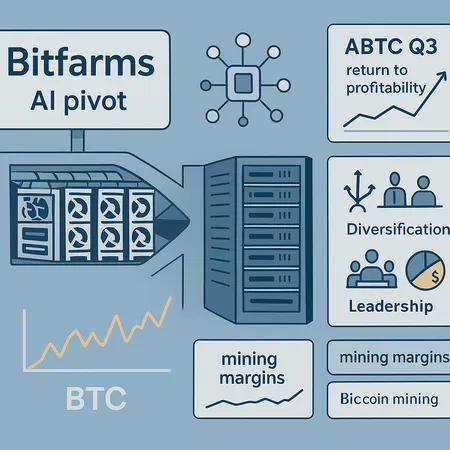
One of the clearest examples of structural response is Bitfarms’ announced plan to wind down some bitcoin mining operations and convert certain sites to AI workloads. The company framed the move as a pragmatic reuse of energy-hungry facilities to capture more durable demand from generative AI compute. This is not just branding; it’s a capital redeployment play that reduces single-commodity exposure while monetizing existing infrastructure and power contracts. See the company update for details on the conversion rationale and site plans.
The Bitfarms case highlights a broader point: miners possess a mix of attributes valuable beyond hashing power—land, power contracts, cooling, and grid interconnects. Converting to AI workloads or cloud compute can raise average revenue per megawatt and smooth cash flows when BTC-driven mining margins compress. For risk-averse investors, such industrial flexibility changes the expected return and volatility profile of a mining play.
Profitability under pressure: ABTC’s Q3 as a case study
Not every miner needs to pivot away from mining to survive. American Bitcoin (ticker: ABTC) reported turning a profit in Q3, showing how disciplined operations and cost management can produce positive cash flow even in challenging environments. The ABTC example underscores that optimizing hash efficiency, negotiating favorable power rates, and timing equipment deployment still matter immensely to miner profitability.
Rather than abandoning mining, some firms choose surgical changes: decommission older rigs, repurpose capital into higher-efficiency machines, and hedge revenue. The ABTC result is a reminder that margin restoration often starts with the basics—ops discipline, balance-sheet management and a calibrated growth posture—before pursuing structural diversification.
Governance and leadership changes: the BitMine signal
Beyond asset strategy, governance matters. Recent leadership revamps at firms like BitMine show miners are upgrading board and management skills to navigate a more complex market. New leadership often brings expertise in capital markets, energy contracting, M&A and alternative compute markets—skills critical for executing pivots or pursuing disciplined consolidation.
For institutional investors, leadership changes are a leading indicator: they tell you a company recognizes the market’s new demands and is positioning to respond. Active boards can accelerate pivots like Bitfarms’ AI conversion or operational fixes like ABTC’s cost discipline, reducing execution risk for shareholders.
Diversification playbook: options beyond hashing
Miners are adopting a menu of diversification strategies to stabilize revenue and protect margins:
- Convert facilities to alternative compute (AI/ML training, HPC) to capture higher-utilization enterprise demand. This is the route Bitfarms is pursuing.
- Offer colocation and hosting services to cloud and enterprise customers, monetizing physical infrastructure and recurring contracts.
- Vertical integration into power generation or long-term PPAs to lock in lower energy costs and reduce exposure to spot prices.
- Financial hedging—forward-selling a portion of BTC production or using derivatives to cap downside while retaining upside exposure.
- Strategic M&A and consortiums to pool scale, reduce per-unit costs, and share best practices on operations and regulatory compliance.
Each pathway has trade-offs. AI workloads may require different cooling or networking architectures. Power contracts can introduce long-term obligations. Hedging reduces upside potential. Decision-makers must quantify trade-offs in scenarios tied to BTC price paths and power cost trajectories.
Capital allocation, margins and scenario planning
Mining margins hinge on three levers: BTC price, hash-price (difficulty-adjusted reward per TH), and energy cost. Strategic capital allocation should therefore prioritize actions that change the margin equation most efficiently: upgrading to higher-efficiency rigs, securing cheaper power, or redeploying facilities to higher-margin compute.
A simple scenario table—stress, base, upside—can help boards allocate capital: which capex yields IRR across scenarios, which projects preserve liquidity in stress, and which structural pivots (e.g., AI conversion) materially lower downside volatility. For many institutional investors, the preferred profile will be tilted toward lower downside and steadier cash flow even if that means ceding some upside during BTC rallies.
Practical recommendations for stakeholders
For corporate strategists and miners:
- Map asset optionality. Audit sites for alternative compute suitability and quantify conversion costs and timelines.
- Prioritize power strategy. Long-term PPAs and on-site generation can be differentiators for mining margins.
- Tighten operational KPIs. Hash-efficiency, downtimes, and cost-per-TH should be tracked in real time and benchmarked.
- Revisit capital structure. Flexible debt and contingency liquidity are essential through BTC drawdowns.
For institutional investors evaluating miner exposure:
- Look for evidence of strategic optionality (e.g., power contracts, multi-use facilities) and governance capable of executing pivots.
- Value firms on risk-adjusted cash flows, not just peak hash-rate guidance—Bitfarms’ conversion plan and ABTC’s profitability show two very different paths to resilience.
- Use scenario-driven valuation that models both mining and non-mining revenue streams alongside margin sensitivities.
Where this leaves the industry
The mining sector is consolidating around a new truth: scale and flexibility win. Some companies will double-down on mining and win by operational excellence; others will diversify into AI, hosting or energy, creating hybrid infrastructure businesses. These shifts are already visible in public filings and leadership moves—watch for more companies to follow Bitfarms’ industrial reuse logic or ABTC’s operational tightening.
For those tracking broader crypto markets, remember that mining strategy changes feed back into network economics—hash-rate distribution, decentralization and capital flows. Traders and allocators should watch clustered pivots carefully because they can alter supply dynamics and investor sentiment.
Final thoughts
Volatility in BTC is not just a short-term trading problem; it is forcing structural change in how miners think about assets, margins and governance. Whether through direct pivots to AI workloads, disciplined cost management that restores miner profitability, or leadership upgrades that enable faster strategic shifts, the industry is evolving. For strategists and institutional investors, the smartest allocations will favor firms that blend operational rigor with real optionality—those that can survive the next drawdown and capture upside when BTC rebounds.
Bitlet.app users and market participants will benefit from monitoring these developments closely: the next cycle will separate commodity miners from diversified infrastructure operators.
For more on corporate pivots and margins in the space, see coverage of Bitfarms’ plans, American Bitcoin’s quarterly results, and leadership changes at BitMine.
- Bitfarms’ AI conversion announcement: Bitfarms to wind down bitcoin mining operations, announces AI pivot
- American Bitcoin’s Q3 profit report: American Bitcoin turns profit in Q3
- BitMine leadership revamp analysis: BitMine revamps leadership
For many market participants, the next 12–24 months will be a test of who can adapt: those that do will trade at a premium; those that don’t will face consolidation pressures. And for macro-aware investors, monitoring signals like power deals, leadership changes and facility optionality will be as important as raw hash-rate growth.
For context on broader market drivers, remember that Bitcoin price action and regulatory shifts remain proximate catalysts to miner strategic choices.