When Miners Pivot: Bitfarms' Move to AI Infrastructure and the New Energy Math
Summary
Executive overview
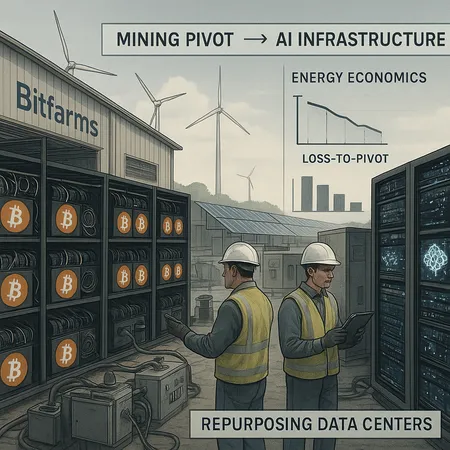
A recent announcement by Bitfarms to wind down parts of its BTC mining operations and explore AI infrastructure has crystallized a conversation many mining CEOs and analysts have been having privately: when low BTC prices compress miner economics for long periods, what are the viable pathways for capital and power assets? This piece uses Bitfarms as a focal case study to examine the timeline and financial drivers behind such pivots, the technical and energy-economics implications of converting mining assets to AI workloads, and the practical decision framework companies should apply when evaluating repurposing data centers.
Bitfarms, as a publicly watched miner, is instructive not because its choice will be universal, but because its asset mix — long-term PPAs in some jurisdictions, onsite and grid-constrained facilities in others, and a large fleet of ASICs — mirrors the options facing many firms. The dynamics discussed here apply broadly to the miner ecosystem as the industry grapples with prolonged bear cycles and rising non-crypto demand for compute.
Timeline and financial drivers behind the pivot
Bitfarms’ decision to shift strategic focus grew from a sequence of financial and operational pressures common to miners after extended BTC weakness. The proximate drivers often include:
- Sustained revenue compression from lower BTC prices and difficulty adjustments that reduce short-term BTC yield per TH/s.
- Elevated cash burn and balance-sheet strain from financing hardware refreshes, servicing debt, or maintaining power contracts when spot electricity markets are volatile.
- Hardware life-cycle economics: aging ASIC fleets deliver lower hash-per-dollar than new-generation machines, and the used-ASIC resale market can be thin in down cycles.
In these environments, managements often face three basic options: hold through the cycle (hoping for price recovery), consolidate (sell or merge with peers), or redeploy capital and infrastructure into higher-return non-crypto compute use cases. Bitfarms’ announcement — formally signaling a wind-down of certain mining operations and exploration of AI infrastructure opportunities — reflects the third path. The move is symptomatic of miner economics under stress: margins are tight, and unlevered returns on core ASIC operations can become unattractive relative to alternative uses of power and real estate.
From mining racks to AI racks: technical and power-usage implications
Repurposing a Bitcoin mining site for AI workloads is not a simple gearbox swap. There are multiple technical, electrical, cooling, and network considerations that materially affect cost, timeline, and risk.
Power delivery and density
ASIC-based mining farms are optimized for very high aggregate power consumption but comparatively low per-rack density and minimal networking needs. By contrast, modern AI training and large inference clusters use GPU servers that require substantially higher per-rack power density, often in the range of 10–30 kW or more per rack depending on server mix and liquid-cooling adoption. Practical implications:
- Transformers, switchgear, and PDUs originally sized for miner loads may need upgrades to support concentrated rack densities. Upgrading may require new permits and longer lead times.
- Site electrical rooms and cable pathways might need rework to route denser, higher-voltage feeds.
Cooling and thermal management
ASICs are air-cooled and engineered for constant thermal profiles; GPU-heavy AI servers produce different heat signatures and higher peak rack heat flux. Options include enhanced air-cooling, hot-aisle containment with much higher airflow requirements, or retrofitting for liquid cooling (direct-to-chip or rear-door heat exchangers). Each path involves trade-offs:
- Retrofitting liquid cooling is capital-intensive but delivers superior PUE and enables higher densities per square foot.
- Air upgrades can be faster and less risky but may hit practical limits on density and PUE improvements.
Structural and physical constraints
Floor loading, ceiling heights, and fire-suppression systems designed for mining container farms may not meet colocation or hyperscale data-center standards. Rack footprint and raised-floor requirements can differ. Real-world consequences:
- Some sites will be naturally attractive for “edge” or inference workloads where latency matters; others are better suited for training or batch workloads if network latency to core clouds is acceptable.
Networking and latency
Mining operations often require modest networking — primarily to push block submissions and telemetry. AI clusters demand high-bandwidth, low-latency fabrics (10/25/40/100GbE and NVLink/InfiniBand for distributed training). Upgrading a site’s network backbone and cross-rack interconnects can be costly and may require new fiber builds.
Power economics: PUE, time-of-use, and flexibility
Energy economics is the fulcrum of any repurposing decision. Important considerations:
- Power usage effectiveness (PUE): AI workloads can achieve competitive PUE only with appropriate cooling investments. If the PUE remains materially higher than hyperscale peers, the site will struggle to compete on cost-per-GPU-hour.
- Time-of-use pricing and demand charges: AI workloads—especially training—benefit from steady, predictable power pricing, but flexible workloads can be scheduled into low-price windows. Miners accustomed to running 24/7 can leverage the same flexibility, but contractual constraints with utilities (minimum demand clauses, curtailable rates) may limit options.
- Curtailable and stranded capacity: Sites in regions with curtailment-prone renewables can monetize otherwise-wasted capacity for compute if workloads are flexible or implement rapid power-shifting orchestration.
Broader industry trends: consolidation, offshoring, and diversification
Bitfarms’ pivot exists within larger sectoral shifts that are re-shaping miner strategy.
- Consolidation: Prolonged bear markets accelerate M&A as weaker operators sell balance-sheet stress to larger players who can better optimize fleet operations, secure better power contracts, or access low-cost capital.
- Geographic arbitrage and offshoring: Miners continue to chase jurisdictions with surplus base-load energy or attractive PPA terms. But geopolitical, permitting, and grid stability considerations now weigh more heavily as non-crypto compute demand competes for the same capacity.
- Diversification into hosting and colocation: Some miners expand into hosting third-party compute (cloud offload, AI inference, edge services), converting their energy contracts and real estate into recurring revenue streams rather than BTC production alone.
- Strategic partnerships with cloud and AI firms: Hyperscalers and AI startups are pragmatic partners, offering a potential buyer pool for repurposed capacity or long-term offtake agreements for GPU hours.
These trends reflect a structural bifurcation: firms that double down on hyper-efficient ASIC operations (seeking scale and lower cost per BTC) versus firms that evolve into energy-centric compute providers offering a broader menu of services beyond BTC mining.
Questions miners should ask before repurposing assets
For mining executives and board members evaluating a pivot, these are the core questions to structure due diligence and capital allocation decisions:
- What is the true marginal cost of power and the full PUE post-retrofit? Can upgrades push the site’s cost-per-GPU-hour below market alternatives?
- What capital expenditure and timing are required for electrical, cooling, and networking upgrades? What permitting or interconnection lead times exist?
- How liquid are used ASIC markets? Is selling the fleet and recycling capital more attractive than repurposing?
- Are there existing commercial relationships (cloud partners, AI firms) to underwrite demand, or will the site rely on merchant markets?
- How do existing power contracts (PPAs, curtailable rates, demand charges) constrain operational flexibility? Can renegotiation or creative load-shifting be achieved?
- What regulatory, tax, or reporting consequences follow from changing the business model (e.g., energy use reporting, local employment rules, export controls on compute hardware)?
- What skills and hiring will be required? AI/colocation operations require different talent than ASIC operations: datacenter engineers, high-performance networking experts, and sales teams for enterprise clients.
Answering these questions with site-level economic models allows comparison of expected returns on repurposing versus alternatives (hold, sell, or consolidate).
Practical conversion playbook (step-by-step)
Below is a pragmatic sequence miners can follow to de-risk a pivot from ASIC mining to AI infrastructure.
- Rapid site triage: Conduct a 30–60 day technical assessment of electrical, cooling, structural, and fiber assets to categorize sites as "low friction," "moderate friction," or "high friction."
- Financial run-rates: Build bottom-up models for key scenarios — sell ASICs; upgrade and host GPU clusters; operate hybrid ASIC+GPU; lease to third-party operator — including CapEx, expected utilization, and PPA sensitivity.
- Pilot deployment: Convert one cluster or container to a GPU pilot (mix of inference and training workloads) to validate cooling, PUE, and network assumptions. Use pilot to test commercial appetite (short-term contracts, spot market demand).
- Partnership strategy: Engage hyperscalers, AI firms, and colocation operators early to pre-sell capacity or secure long-term offtake. Consider joint-venture models to share upgrade costs.
- Capital allocation and timeline: If pilots validate the case, segregate capital for phased rollouts and establish exit triggers if market conditions change.
- Workforce transition: Upskill operations teams, hire datacenter networking talent, and rework O&M playbooks for GPU/server firmware, orchestration, and security.
Risks and mitigants
- Market risk: The AI compute market can be cyclical and competitive; pre-selling capacity or contracting long-term helps reduce exposure to spot-price swings.
- Execution risk: Retrofitting electrical and cooling systems is disruptive. Phased pilots and modular upgrades mitigate operational impact.
- Regulatory and social license risk: Local permitting, community impact (noise, water usage for cooling), and employment shifts can create friction. Early stakeholder engagement and transparent environmental assessments reduce surprises.
Conclusion: a pragmatic lens for miner economics
Bitfarms’ public pivot underscores a basic truth: mining pivot decisions are ultimately capital-allocation decisions driven by energy economics. Where ASIC returns fall below a firm’s cost of capital, alternative uses for power and real estate — especially AI infrastructure and hosting — become competitive. But conversion is neither simple nor universally optimal: it requires careful technical surveys, PUE and power-cost modeling, off-take channels, and often material CapEx.
For industry analysts and mining executives, the right framework is empirical and site-specific. Rapid triage, pilot validation, and a partnership-first commercialization strategy reduce risk. Firms that can master the energy stack — securing flexible, low-cost power and optimizing thermal efficiency — will have optionality, whether that means scaling BTC production when markets recover or becoming repeatable, reliable suppliers of GPU-hour capacity to the AI economy.
Bitlet.app’s broader ecosystem and merchant-finance tools illustrate one example of how capital and payment rails are adapting to bridge compute demand and energy supply; miners that combine technical discipline with prudent capital allocation will define who survives the next phase of crypto and compute market evolution.