How Ethereum Smart Contracts Are Revolutionizing Corporate Treasury Management in 2025
Published at 2025-08-09 17:28:50
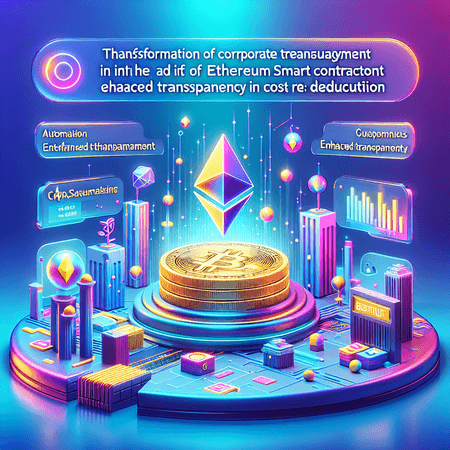
How Ethereum Smart Contracts Are Revolutionizing Corporate Treasury Management in 2025 – cover image

In 2025, Ethereum smart contracts are set to revolutionize corporate treasury management by introducing automation, transparency, and efficiency into financial operations. Traditional treasury functions, often slowed by intermediaries and manual processes, are increasingly managed through blockchain technology, which ensures faster settlements and secure transaction recording.

Smart contracts on the Ethereum blockchain automate routine tasks such as payments, asset management, and compliance checks. This automation reduces operational risks and lowers administrative costs, enabling treasury teams to focus on strategic financial planning.

Furthermore, Ethereum’s decentralized nature enhances transparency and immutability of financial records, which helps prevent fraud and ensures auditability. Organizations can implement programmable rules within smart contracts to enforce policies and regulatory compliance seamlessly.

Bitlet.app plays a significant role in this evolving landscape by offering crypto installment services that empower companies to acquire digital assets easily. With Bitlet.app, corporate treasuries can invest in cryptocurrencies without the need for a lump sum payment, spreading out costs monthly while gaining immediate exposure to digital assets.

The integration of Ethereum smart contracts and platforms like Bitlet.app heralds a new era of digital finance, where corporate treasury functions are streamlined, secure, and much more adaptable to the dynamic demands of the global market.
Share on:

Related posts

Ethereum's Locked Staking Supply in 2026: Liquidity, Derivatives, and Price Discovery – cover image
Ethereum's Locked Staking Supply in 2026: Liquidity, Derivatives, and Price Discovery

By 2026 a near-half of ETH supply sits locked in the staking contract, reshaping liquidity, derivatives pricing, and validator incentives. This analysis unpacks the mechanics, trader positioning, MEV dynamics, and scenarios that could trigger a liquidity-driven pullback versus durable structural support.

Published at 2026-01-17 14:16:22
After the $280M Heist: Social-Engineering, THORChain and New Custody Rules for HNW Holders – cover image
After the $280M Heist: Social-Engineering, THORChain and New Custody Rules for HNW Holders

A deep-dive into the ~$280M hardware-wallet theft that routed funds into Monero via THORChain, the attack vectors used, and actionable custody and policy steps security officers and family offices should adopt.

Published at 2026-01-17 13:53:43
Why Solana Is the Preferred On‑Chain Infrastructure for Stablecoins and Tokenization in 2026 – cover image
Why Solana Is the Preferred On‑Chain Infrastructure for Stablecoins and Tokenization in 2026

Solana’s combination of high throughput, sub‑cent fees, and recent upticks in on‑chain activity make it a strong candidate for USD stablecoin issuance and tokenization rails in 2026. Product and treasury teams should weigh technical advantages against regulatory, custody, and market risks before choosing Solana for high‑volume payment rails.