Altcoin Technical Roundup: ARB, OP, SUI, UNI, HBAR — RSI, MACD, Support/Resistance and Rule-Based Trades
Summary
Quick note and approach
This piece is aimed at intermediate traders who want actionable, rule-based setups on mid-cap altcoins. I synthesize the latest technical snapshots — primarily RSI, MACD, and discrete support and resistance levels — and convert them into scenario targets for a near-term (1 week) and a medium near-term (4–6 weeks) horizon. Where useful I reference momentum (trend-following) and mean-reversion entries and give explicit stop/position-sizing rules to limit risk.
I cite the latest technical write-ups for each token to anchor levels and indicator context (links in each coin section). For correlation context, remember that many altcoins still track moves in Bitcoin during risk-on/off rotates, though individual token structure can diverge—especially where protocol-specific catalysts or liquidity shifts matter.
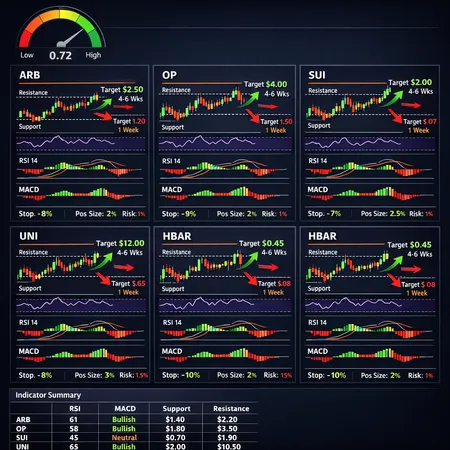
Comparative snapshot: indicators and short-term targets
Below is a compact comparative table of headline indicators and scenario targets. Use it as a map; each coin receives a deeper take later.
| Ticker | RSI (short) | MACD bias | Key Support | Key Resistance | 1‑week scenario | 4–6 week scenario |
|---|---|---|---|---|---|---|
| ARB | Low/Recovering | Neutral → bullish if MACD turns | ~0.07 | ~0.12 | Bounce to 0.10 if momentum returns | Target 0.12 on sustained breakout (source) |
| OP | Midrange | Potential breakout if MACD flips | ~0.08 | ~0.13 | Test 0.10—watch volume | Breakout target ~0.13+ if resistance holds (source) |
| SUI | Testing oversold band | Mixed — Bollinger signal | ~0.83 | ~1.10 | Rebound possible to 1.00 on band squeeze | If structure holds, continuation to 1.10+ (source) |
| UNI | Oversold | MACD showing oversold convergence | ~2.80 | ~3.85–4.00 | Mean‑reversion pop to ~3.25 | Recovery target 3.85–4.00 if momentum returns (source) |
| HBAR | Neutral | Neutral → bullish on res. break | ~0.06 | ~0.10 | Chop between 0.06–0.09 | Upside if 0.10 resistance breaks (source) |
Notes on reading the table: RSI denotes short‑term (daily or intraday context used by the cited technical write-ups). MACD bias is the current slope and histogram behavior — use it as a trend confirmation, not a trigger in isolation. Support and resistance are approximate USD levels from recent technical snapshots.
Coin-by-coin technical synthesis and scenario targets
Below each token I cover: indicator takeaways, one-week and 4–6-week scenarios, correlation notes, and a practical trade template.
ARB — bounce candidate if RSI stabilizes
Analysis: ARB’s short-term RSI has been on the weak side but shows signs of flattening; MACD is close to a neutral cross where a rising histogram would confirm momentum resumes. Recent technical commentary frames 0.12 as a meaningful resistance target in a recovery scenario. See the ARB technical snapshot for the detailed read.
1‑week scenario: If buying volume appears and RSI moves off oversold, expect a bounce into the 0.09–0.11 range; intraday scalps can target 0.10 with tight stops.
4–6‑week scenario: A sustained MACD turn and break above 0.12 would open a larger reversal to higher resistance clusters and re-test levels noted in the source analysis. Failure beneath the ~0.07 support risks a deeper test.
Trade template (momentum): Enter a breakout above 0.12 on confirmation (daily close + >25% volume above 20‑day average). Stop: 8–12% below entry. Position size: 1–2% portfolio risk (see position-sizing section).
Trade template (mean reversion): Buy 0.07–0.08 support band with a 5–8% stop below support and a target at ~0.10. Lower per‑trade allocation due to higher tail risk.
(Source: ARB technical forecast)
OP — watch the breakout structure and support flip
Analysis: OP shows clearer structural levels: a critical resistance near ~0.13 and a nearby support band around ~0.08. MACD is watchful — a bullish cross with follow‑through volume creates a classic momentum breakout. The technical write-up highlights the breakout as the key regime change.
1‑week scenario: Choppy action between 0.09–0.11. A clean close above 0.11 with volumetric confirmation would increase odds of a run to 0.13.
4‑6‑week scenario: If 0.13 yields to buyers, the next extension targets are materially higher. If the 0.08 support fails, expect accelerated downside to lower structural supports.
Trade template (momentum): Buy on daily close above 0.11 with stop at 0.095 (8–10% risk). Scale out 50% at 0.13 and trail the rest.
Trade template (mean reversion): Enter near 0.082–0.09 only with a tight stop (6–8%) and small size; mean-reversion is asymmetric here because of the potential for fast downside.
(Source: OP technical forecast)
SUI — critical support test, watch Bollinger squeeze
Analysis: SUI is currently testing a critical support near ~0.83 and price is interacting with lower Bollinger bands — a classical mean-reversion area if volatility compresses. The cited note flags a potential Bollinger-band bounce if support holds.
1‑week scenario: If support holds and we see band contraction, expect a bounce into ~0.95–1.05. If support breaks decisively, downside could accelerate and invalidate short-term longs.
4–6‑week scenario: A successful band bounce plus MACD recovery leads to a run toward prior resistance near ~1.10; a failure brings deeper drawdowns and requires re-evaluating risk.
Trade template (mean reversion): Enter 0.83–0.88 with stop 7–10% below; take profits first at 1.00 and then scale out. Use tight position sizing as the support is a cliff-edge.
Trade template (momentum): Only consider momentum buys above 1.00 on volume-confirmed breakout with stop below 0.90.
(Source: SUI support test and Bollinger note)
UNI — classic oversold mean-reversion with defined recovery targets
Analysis: UNI is reading oversold on RSI and shows convergence in MACD that often precedes a relief rally. The technical note targets recovery around 3.85–4.00 if bulls regain control.
1‑week scenario: A relief rally toward ~3.20–3.40 is plausible on a short-term bounce. Watch BTC correlation—broad crypto strength amplifies the move.
4–6‑week scenario: If buyers hold and momentum returns, target 3.85–4.00; conversely, loss of the 2.80 support risks deeper downside.
Trade template (mean reversion): Enter on signs of RSI recovery near 2.80–3.00 with stop ~6–9% below entry and targets staggered (3.3 then 3.85).
Trade template (momentum): Use breakout entries above 3.85 with stop 8–12% below and scale out portions as price approaches 4.00.
(Source: UNI recovery targets and RSI argument)
HBAR — neutral bias, asymmetric upside on 0.10 break
Analysis: HBAR’s momentum is neutral; technical commentary points to a clear resistance near 0.10. If that level is taken on conviction, upside becomes more plausible. Conversely, current structure suggests a range until a catalyst arrives.
1‑week scenario: Expect range trading 0.06–0.09. Small momentum trades inside the range can work but keep tight stops.
4–6‑week scenario: A daily close above 0.10 with volume would change the regime and justify larger positions; failure to break continues the neutral drift.
Trade template (range/momentum): Trade the range with micro‑positions: buy near 0.06–0.065 with a 5% stop and target 0.085–0.095. For momentum, position above 0.10 on confirmation and follow the momentum rules.
(Source: HBAR technical snapshot)
Correlation notes and execution context
- BTC correlation: All five tokens show medium positive correlation with BTC in risk-on environments. That means broad BTC strength can catalyze breakouts; conversely BTC weakness can invalidate breakout trades quickly. Keep an eye on daily BTC trend and implied vol.
- DeFi and on‑chain flows: UNI and OP (as protocol tokens) can respond to router volumes and staking/news; SUI, ARB and HBAR may respond more to developer activity and liquidity shifts. For DeFi context see DeFi.
Practical platform note: Use limit+stop OCO orders where possible to reduce slippage, and consider smaller entries scaled with confirmation. Bitlet.app can be used to manage installment-based buy strategies alongside execution platforms.
Rule-based trade-management framework (apply to each coin)
Below are explicit rules that you can apply to craft disciplined trades. They are written so you can copy them into a trading checklist.
Position sizing and portfolio risk
- Max portfolio risk per trade: 1–2% of total equity for intermediate traders. Conservative traders should target 0.5–1%.
- Risk per trade (dollar): Determine by (Entry price - Stop price) × Position size = desired risk dollars.
- Example: For a $100k portfolio, 1% risk = $1,000. If stop distance equals 10% of entry, position size = $1,000 / (0.10 × entry price).
- For mean-reversion trades on lower-liquidity alts, halve the position size relative to momentum trades to account for tail risk.
Stop placement rules (practical and non‑emotional)
- Momentum trades (breakouts): Place stops 8–12% below entry or below a clear swing low or the breakout candle low. Trail the stop as price confirms higher highs.
- Mean-reversion trades: Place tighter stops of 5–9% below entry and use smaller sizes. If trade violates support with strong volume, close immediately.
- Use ATR as a volatility-aware stop: Stop = entry - (1.0–1.5 × ATR(14)). This adapts to token volatility.
Entry rules and confirmation
- Momentum entry: Wait for a daily close above resistance + volume >20‑day average or a MACD bullish cross with rising histogram.
- Mean-reversion entry: Enter into a predefined support band only after a 1–2 bar stabilization or intraday reversal candle; complement with RSI reversal off oversold.
Profit-taking and scaling
- Scale out: Take 30–50% off at first target, trail the remainder by X% (e.g., 6–10%) or below moving averages as momentum holds.
- Re-entry: Only re-enter after a confirmed pullback to a new support or after indicator reset (e.g., RSI re-tests neutral zone).
Trade examples (concise)
- ARB breakout: Entry 0.125 (daily close >0.12), stop 0.11 (12% risk), targets 0.16 then 0.20. Position sized to risk 1% of portfolio.
- SUI mean reversion: Entry 0.86, stop 0.78 (9% risk), first target 1.00. Position size = 0.5% portfolio risk given support test nature.
Checklist before pulling the trigger
- Does BTC trend support risk-on entries? If BTC is breaking down, reduce size or wait.
- Does the entry conform to momentum or mean-reversion rules above? (daily close + volume for momentum; candle + RSI bounce for mean-reversion)
- Is the dollar risk per trade within your preset portfolio risk? (1–2% rule)
- Do you have an exit plan if support fails quickly? (pre-placed stop or OCO orders)
Final thoughts
Technical indicators like RSI and MACD are most useful when combined with price structure (support and resistance) and volume confirmation. For intermediate traders the edge comes from disciplined position sizing and a rule-based approach that separates momentum breakouts from mean-reversion plays. Use the scenario targets above as conditional guides: they are not guarantees but structured hypotheses you can trade against with clear stops and predefined risk.
Sources
- ARB technical forecast: https://blockchain.news/news/20260405-arb-price-prediction-targets-012-recovery-by-may-2026
- OP technical forecast: https://blockchain.news/news/20260405-op-price-prediction-targets-013-breakout-by-may-2026
- SUI support test: https://blockchain.news/news/20260405-price-prediction-sui-critical-083-support-test-could-trigger
- UNI recovery targets: https://blockchain.news/news/20260405-uni-price-prediction-targets-385-400-recovery-by-may-2026
- HBAR technical snapshot: https://blockchain.news/news/20260405-price-prediction-hbar-hedera-targets-010-resistance-break-by