Bitcoin miners under pressure: MARA, Marathon and TeraWulf — markdowns, mining revenue and the AI pivot
Summary
Executive summary
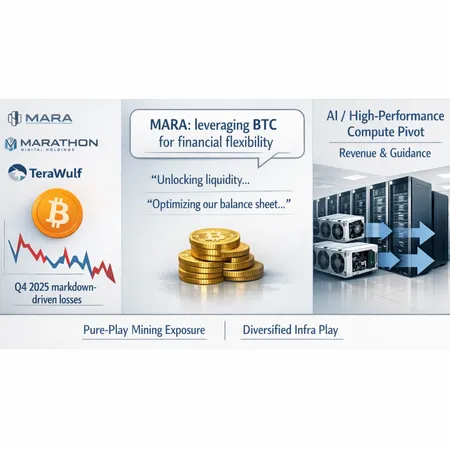
Publicly traded Bitcoin miners have never looked more like hybrid businesses. Q4 2025 earnings exposed that accounting-driven fair‑value markdowns can swamp operating results: Marathon reported a roughly $1.7 billion quarterly loss tied to BTC markdowns while TeraWulf missed mining revenue estimates and outlined AI/HPC contract plans. MARA’s leadership has signaled a tactical use of balance‑sheet BTC as a liquidity lever rather than a static treasury position. For equity investors and crypto funds evaluating miner stocks, the choice is increasingly between a leveraged BTC play or an enterprise infrastructure story — each with distinct valuation and execution risks.
Why fair-value markdowns matter (and how they differ from mining revenue)
Public miners report two very different but related things: cash mining revenue (coins mined and sold, plus hosting or services) and non‑cash fair‑value adjustments to held BTC. The former ties to operational metrics — hash rate, uptime, energy cost and miner efficiency. The latter swings with BTC price and accounting rules, and it can create large GAAP losses even when mining cash flow is positive.
That distinction matters because an investor interested in leveraged BTC exposure may tolerate headline losses if the underlying inventory remains intact, while an investor focused on cash yield and dividend potential must dig into realized sales, operating margins and free cash flow. For many traders and portfolio managers, Bitcoin remains the primary market bellwether that explains the direction of both line items, but the balance‑sheet framing changes how you value a miner.
Marathon: large markdowns, liquidity pressure and operational focus
Marathon’s Q4 2025 filing made headlines: a roughly $1.7 billion quarterly loss attributed to BTC markdowns forced a reappraisal of the stock as a volatile, mark‑to‑market vehicle. While Marathon still operates at scale and continues to mine BTC, that headline figure underlines how sensitive public P&L is to crypto price swings and inventory accounting.
What Marathon’s situation signals to investors is twofold. First, GAAP losses driven by markdowns do not necessarily indicate operational failure — they reflect timing and price marks. Second, persistent markdowns can limit access to capital if lenders or counterparties use equity metrics as covenants. For shareholders seeking exposure to BTC through a listed vehicle, Marathon is a high‑beta play on BTC price with operating leverage; trading or holding the stock requires active risk management around headline volatility. The Marathon case also highlights the importance of disclosure on inventory, realized sales and hedging programs when building a thesis.
MARA: treating BTC holdings as a liquidity lever
MARA’s CEO Fred Thiel has publicly framed the company’s BTC holdings as a source of financial flexibility — a deliberate stance as markdowns bite into earnings. Thiel’s comments suggest management sees on‑balance BTC not just as a speculative asset but as an option to raise liquidity or shore up funding if markets tighten. See the coverage of his remarks here.
That approach changes the investment lens. If MARA can monetize or borrow against BTC selectively, shareholders gain optionality: the company can conserve or deploy capital without immediate equity issuance at depressed valuations. The tradeoff is governance and signaling risk; repeatedly using treasury BTC as financing collateral may compress long‑term upside per share if investors expect management to monetize opportunistically. For funds wanting a direct, balance‑sheet‑based lever to BTC exposure, MARA’s explicit playbook will be attractive — provided the company preserves transparent rules and capital‑allocation discipline. For background on Thiel’s comments, read this report.
TeraWulf: revenue miss and an enterprise pivot into AI/HPC
TeraWulf’s Q4 2025 results showed a mining revenue shortfall versus expectations and prompted management to accelerate conversations about diversification: specifically, AI and high‑performance computing (HPC) contracts that reuse data center capacity and power relationships. The company has pitched AI/HPC as a way to smooth revenue seasonality and better monetize existing site footprints.
This is a classic infrastructure pivot. Repurposing racks and power for AI workloads can raise utilization and average revenue per site, but it demands new sales cycles, engineering capabilities, and potentially higher capital intensity for GPU procurement and cooling upgrades. For investors, the appeal is revenue diversification and less direct correlation to BTC price. The execution risks are tangible: contracting latency, margin dilution during transition, and competition from large cloud providers and specialized colo operators. For more on TeraWulf’s guidance and contract plans, see the coverage here.
Rationale for the AI/high‑performance compute pivot
Why are miners talking about AI and HPC? Three pragmatic reasons:
- Underutilized real estate and power. Many mining sites were built or contracted with future growth in mind; when miners under‑deploy ASICs, that capacity can be marketed to other compute buyers.
- Stable, multi‑year contracts. AI/HPC work can be sold under multi‑year service agreements, converting lumpy mining revenue into more predictable ARR.
- Higher per‑MW yields (in some cases). For certain workloads, especially inference or non‑peak training, per‑MW revenue can exceed spot BTC mining yields when BTC prices are depressed.
That said, converting a mining site into an AI play is not plug‑and‑play. GPU supply chains, network density, latency requirements, and cooling infrastructure differ from ASIC mining. The companies that can bridge operations and sales will command a premium; the rest risk being stuck with stranded assets.
Valuation framework: pure‑play miners vs diversified infra plays
For investors, the first step is defining the exposure you want.
- Pure‑play BTC exposure: if your thesis is “I want leveraged exposure to BTC price via listed equities,” prioritize companies with high BTC inventory, straightforward disclosures, and minimal non‑mining revenue. Metrics: BTC per share, cost to mine per BTC, realized sell rates, and net cash/(debt + financing adjusters). Expect headline earnings volatility from fair‑value markdowns.
- Diversified infra (AI/HPC) exposure: if you want to lean into long‑term secular demand for compute and less BTC correlation, evaluate revenue mix, contracted ARR, customer concentration, and transition CAPEX needs. Metrics: utilization rate per MW, revenue per MW, margin on hosted AI contracts, and break‑even payback times for GPU investments.
Accounting also matters. Fair‑value markdowns will remain a GAAP quirk for BTC inventory owners; for infrastructure revenues, traditional revenue recognition and recurring contract math give cleaner comparables with non‑crypto peers. As a valuation rule: apply a two‑pronged multiple — one set of comps for mining economics (hash‑rate per dollar, cost per TH/s, BTC per share) and a second for enterprise infra (EV/ARR, enterprise gross margins). Companies straddling both need blended assumptions, which increase model complexity and forecast error.
Risk checklist for investors
- Balance‑sheet visibility: BTC inventory, pledge status, hedges, and any loan covenants tied to equity metrics.
- Cash vs non‑cash: quantify realized mining cash flows separately from mark‑to‑market impacts.
- Capital intensity: planned ASIC/GPU purchases, expected dilution, or debt raises.
- Execution risk on AI/HPC: signed contracts, counterparty credit, and evidence of successful workload migration.
- Regulatory and energy risk: grid agreements, environmental considerations, and jurisdictional stability.
Practical takeaways for funds and equity investors
- If you want a pure btc‑leveraged equity: favor miners with large BTC treasuries, transparent monetization plans, and conservative financing terms. Expect volatility and plan position sizing accordingly.
- If you want durable infrastructure returns: target miners that show credible, contracted AI/HPC revenue streams and can demonstrate unit economics on a per‑MW basis. Be prepared to underwrite additional capex and integration risk.
- Monitor disclosures: Q4 2025 showed how a single markdown can change market perception. Track realized sales, inventory financing, and any shifts in asset use.
Conclusion
MARA, Marathon and TeraWulf exemplify the crossroads miners face: lean into balance‑sheet BTC and accept headline volatility, or reinvent as infrastructure providers with different but real execution risks. Neither path is inherently superior — the right choice depends on an investor’s time horizon, risk tolerance, and conviction about BTC’s near‑term path. For those building models, separate cash flow drivers from accounting marks, stress test for BTC drawdowns, and price in the execution premium required for any successful AI/HPC pivot. Platforms like Bitlet.app can help track miner exposures and compare realized vs unrealized metrics when constructing theses.
Sources
- MARA CEO comments on leveraging BTC holdings for flexibility: Fred Thiel says MARA Holdings will leverage Bitcoin holdings for financial flexibility
- Marathon quarterly loss tied to BTC markdowns: Marathon posts a $1.7B quarterly loss tied to Bitcoin
- TeraWulf Q4 2025 mining revenue miss and AI/HPC plans: TeraWulf Q4 2025 miss, mining revenue drop and AI/HPC contract plans