Polymarket's 'POLY' Trademark: What a Native Token Would Mean for Prediction Markets
Summary
Why the 'POLY' trademark matters now
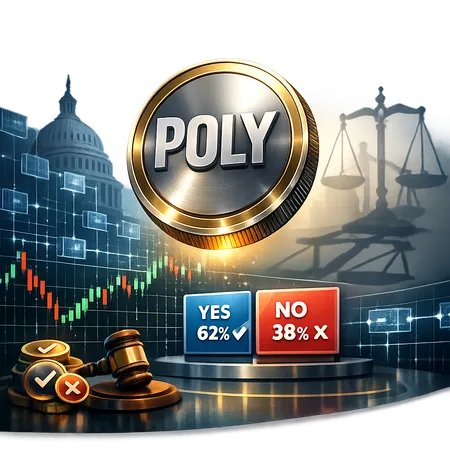
Polymarket's parent has filed trademark applications for the name POLY, a step that, while not a token issuance itself, is often a precursor to broader branding and product plans. The filings were covered in industry reporting and should be read as a strategic signal rather than a completed launch — trademarking a ticker gives a company optionality: to issue a token, to protect a future utility brand, or to reserve a marketing identity.
Industry reporting on the filings provides the immediate factual touchpoint for this analysis: see the News.Bitcoin coverage of Polymarket's trademark activity for the filing details and public context. Polymarket's parent filed trademark applications for 'POLY'.
For product leads and legal teams, the trademark step should trigger two parallel workstreams: (1) sharpen token economics and utility definitions, and (2) map regulatory paths and mitigants. Both streams must inform each other — design choices materially affect legal classification and enforcement risk.
What a native POLY token could practically enable
Prediction markets have a handful of recurring needs where a native token maps cleanly to product features. Below are plausible utility and use-case buckets for POLY, with short implementation notes.
Core utility & market functions
- Fee payments and discounts: POLY could be accepted for market creation and trading fees, with tiered discounts for holders. Simple to implement, but token-as-discount alone is weak as a legal moat.
- Staking for dispute resolution and reporting: Like Augur's REP model historically, POLY could be bonded by oracles/reporters who stake tokens to attest to outcomes or to challenge markets. This gives economic skin in the game for data integrity but raises questions about transferability and profit motive.
- Liquidity incentives / rewards: Distribute POLY to traders and liquidity providers to bootstrap volume. Common in DeFi, effective for growth but often the clearest signal of profit expectation.
- Bonding for market makers or market creators: Require creators to post POLY as collateral to reduce spam/abuse; collateral could be slashed for bad-faith behavior.
- Governance for protocol parameters: On-chain voting using POLY — market fees, dispute windows, oracle selection — is a repeatable use-case that aligns incentives but concentrates decision-making in token holders.
Each utility has different economic narratives and compliance implications. If POLY's main purpose is governance and small utility tweaks, it may be easier to articulate a non-security story than if the token is marketed as an investment that will appreciate as the platform succeeds.
Monetization and governance models: tradeoffs and examples
Designing monetization and governance together is essential. Here are common architectures, their benefits, and drawbacks for prediction-market platforms.
Fee-based + token wrapper
- Model: Protocol charges fees in stablecoin or ETH; token grants fee discounts or revenue-sharing rights.
- Pros: Maintains a clean fee stream; token can be used to align power with active contributors.
- Cons: Revenue-sharing language can attract SEC scrutiny if holders expect profit tied to company efforts.
Staking / reporting economy
- Model: Reporters stake POLY and earn reporting rewards; slashing enforces correctness.
- Pros: Strengthens oracle security and decentralization, mirroring earlier market protocols.
- Cons: Rewards create a potential profit expectation; how rewards are funded matters (inflationary token issuance vs. fee-funded rewards).
Liquidity mining + governance
- Model: Large token emissions to traders/LPs and on-chain voting for roadmap/parameters.
- Pros: Rapid growth and community-building; decentralizes decisions.
- Cons: High token emissions complicate long-term token value and invite labels of speculative “airdrop” economics.
Historical parallels: Augur used REP as a reporter/stake token; Gnosis (GNO) and Uniswap (UNI) showed how governance tokens can bootstrap communities and later become the focal point of regulatory and economic debates. Learnings from these launches are directly relevant as Polymarket considers POLY distribution, vesting, and narrative.
Parallels with other token launches and what they teach us
A quick comparison helps surface patterns product and legal teams should avoid or replicate.
- Augur (REP): REP tied to reporting; distribution and early governance questions informed later debates about whether reporters had profit motives tied to market outcomes. Augur's model highlights how staking for outcomes can blur the line between utility and speculative investment.
- Gnosis (GNO): GNO's use cases and governance evolution show the importance of clear token roadmaps and measured emission schedules to avoid perception of uncontrolled dilution.
- Uniswap (UNI): UNI illustrated how retroactive distribution and governance framing can shift community sentiment and reshape regulatory questions; airdrops attract retail and regulatory attention alike.
These precedents show three recurring risk factors: high early emissions, revenue linkage to token value, and public messaging that positions holders as beneficiaries of the platform's success.
Regulatory spotlight in the U.S.: likely questions and authorities
The U.S. enforcement and regulatory landscape is fragmented, with the SEC, CFTC, state regulators, and potentially consumer-protection bodies having overlapping interest. That fragmentation — and the slow pace of comprehensive legislation — was recently noted in coverage about delayed U.S. crypto lawmaking and how that affects tokens like XRP and broader markets. See commentary on regulatory drag and its market effects for context. Regulatory delays and enforcement dynamics have pressured token markets and shaped legal risk for launches.
Key legal questions teams should expect:
- Is POLY a security under Howey? The classic test focuses on an investment of money, a common enterprise, and a reasonable expectation of profits derived from the efforts of others. Token messaging, distribution and secondary-market narratives matter here. If POLY is marketed as a way to "share protocol revenues" or "benefit from Polymarket's growth," it increases SEC risk.
- Is it a commodity or derivative? The CFTC may view prediction markets as derivatives or event contracts. Historically, some prediction-market activity intersects with betting and commodities regulation — raising potential for CFTC or gambling-law scrutiny.
- Gambling and market design: Many U.S. states have strict gambling prohibitions; design choices (e.g., who can participate, types of questions allowed, bettor protections) affect whether markets are lawful as gambling or regulated as financial derivatives.
- Money transmission and AML/KYC: If POLY is custodyable or used for value transfer, money transmitter laws and AML/KYC obligations can be triggered at both federal and state levels.
- Consumer protection and advertising: Language in whitepapers, social media, and influencer campaigns influences whether tokens are framed as investment opportunities.
Given current legislative uncertainty and enforcement activity, a conservative compliance posture — including geofencing, strong KYC, audited smart contracts, and clear token economics — reduces exposure.
Strategic scenarios: utility token vs. security token
Below are simplified scenario frameworks legal teams can use to stress-test POLY designs. Each row includes expected enforcement risk and operational mitigants.
Scenario A — POLY as a narrowly scoped utility token
- Design signals: Used only for fee discounts, governance votes without monetary rewards, non-tradable initially or strong transfer restrictions in U.S. markets.
- Enforcement risk: Lower on SEC Howey risk, but still faces state money-transmitter and gambling inquiries depending on market mechanics.
- Mitigants: KYC/AML, enforceable geofencing, non-transferability in U.S. for a defined period, clear documentation that POLY is not an investment vehicle.
Scenario B — POLY as an incentive/governance token with distributions
- Design signals: Rewards, liquidity mining, and staking yields paid in POLY or other tokens; broad tradability.
- Enforcement risk: Higher SEC interest due to expectation of profit tied to protocol success and token appreciation.
- Mitigants: Careful messaging that stresses utility and network participation, conservative emission schedules, legal opinions, and possible registration or Regulation D style private placements if funds are raised.
Scenario C — POLY framed and operated like a security
- Design signals: Explicit revenue sharing, dividends, or sale of tokens to fund a corporate roadmap.
- Enforcement risk: High; triggers securities laws, and likely requires registration or an exemption, plus investor disclosures and compliance regimes.
- Mitigants: If this is the chosen path, prepare to operate with securities-compliant infrastructure: accredited investor checks, audited financials, and disclosures.
These scenarios underscore the point: design choices drive legal classification more than labels. Two tokens both called "utility" can be judged differently if one is marketed and distributed to emphasize profit.
Practical checklist for product leads and counsel
To move from trademark to launch while managing risk, teams should treat the process as product + legal co-design. Practical next steps:
- Define explicit token-use cases and write them into product requirements so legal can test the narrative against Howey and money-transmission frameworks.
- Model token distribution and emissions with multi-year projections and stress tests showing who benefits and how.
- Draft public messaging carefully; avoid retail-facing promises about token price appreciation or revenue-sharing unless fully prepared to meet securities rules.
- Prepare technical mitigants (geofencing U.S. addresses, pausing transfers, whitelisting accredited investors) and operational mitigants (KYC, AML, custody arrangements).
- Obtain multiple legal opinions across SEC/CFTC/state law axes and document deliberations. A single opinion is not a shield; the facts and marketing matter.
- Consider staged launches: test governance and staking modules off-chain or in limited-scope pilot markets before a wide public distribution.
- Audit smart contracts and operational processes; vulnerabilities invite regulatory and civil risk.
These steps are operationally intensive but will materially reduce downstream enforcement and market risk.
Conclusion: optionality, discipline, and the path forward
Trademarking POLY signals optionality and momentum, not destiny. A native token could unlock meaningful product improvements — more robust oracle economics, decentralized governance, and stronger incentives for liquidity and truthful reporting — but those benefits come with regulatory complexity. The chief lesson from other token launches is clear: a token's architecture, distribution and public messaging together determine regulatory posture.
Product teams should treat token design as a cross-functional program: economics, legal, engineering, and growth must iterate together. And for investors or counsel evaluating early-stage tokens, focus on the mechanics — who gains economically, how value is created and distributed, and how the issuer communicates that story.
Polymarket's trademark filing is an inflection point that should prompt both creative product thinking and rigorous legal planning. As the market evolves — and as broader crypto legislation remains delayed and uneven — platforms that couple thoughtful token economics with conservative compliance design will have the best chance to scale without courtrooms or emergency geofences.
Bitlet.app and peers will be watching how Polymarket frames POLY, because the choices made here will ripple across prediction markets and the broader crypto market narrative.
Sources
- News.Bitcoin — Polymarket's parent filed trademark applications for 'POLY': https://news.bitcoin.com/polymarket-signals-new-crypto-token-with-poly-trademark-filings/
- FXEmpire — Coverage of regulatory delays and market effects: https://www.fxempire.com/forecasts/article/xrp-news-today-tradfi-vs-defi-clash-pressures-xrp-near-1-4-1578036
For comparisons and precedent reading, teams should also review public token whitepapers and enforcement actions related to past prediction-market and DeFi tokens. Prediction markets intersect frequently with broader DeFi trends and macro crypto narratives — and for many traders, Bitcoin still sets broader sentiment cycles.