Will the 21Shares Dogecoin ETF Trigger a Memecoin Rally? A Practical Guide for Traders and PMs
Summary
Why the 21Shares Dogecoin ETF matters for institutional access
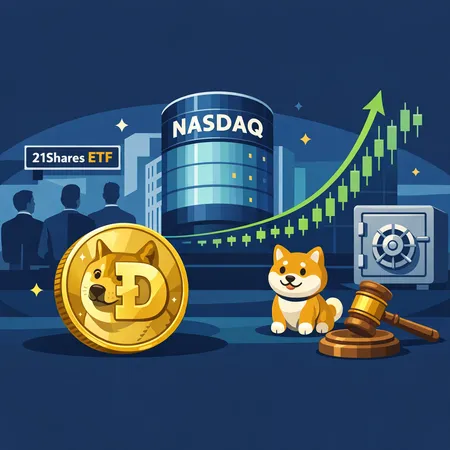
The launch of a Nasdaq‑listed, Dogecoin Foundation‑backed spot Dogecoin ETF (branded 21Shares DOGE in market chatter) is a structural milestone. For the first time a mainstream exchange will list a spot product whose sponsor explicitly ties to the Dogecoin community, and that reduces two major frictions for institutions: custody and regulated market access. The ETF gives wealth managers, family offices and certain institutional desks a familiar product wrapper to gain exposure to DOGE without holding keys or building bespoke custody and trading infrastructure.
But a regulated ETF is not identical to holding the underlying token. Custodians forward‑store the asset, authorized participants (APs) and market makers handle creation/redemption, and exchanges provide a centralized venue for price discovery. The net effect: lower counterparty frictions, easier compliance checks and a path for more capital to participate—if the product attracts flows.
ETF structure, custody and market‑making considerations for DOGE
Spot ETFs rely on several moving parts that determine how capital translates into on‑chain buys. Key elements to watch with 21Shares DOGE:
Custody: The custodian must securely hold DOGE in cold wallets and support proof‑of‑reserves and reconciliation. Dogecoin is a UTXO‑style chain (like Bitcoin), so custodians need mature tooling to manage large‑scale, auditable holdings. That reduces a key operational barrier—but does not erase on‑chain concentration or exchange withdrawal risks.
Creation/redemption mechanics: Authorized Participants create ETF shares by depositing DOGE (in‑kind) or cash, and redeem in kind. When APs can deliver DOGE directly, arbitrage keeps the ETF price close to NAV and forces on‑chain rebalancing. If the product is primarily cash‑settled, then paper flows may have a weaker immediate on‑chain impact.
Market‑making and liquidity: Market makers quoted on Nasdaq will provide two‑sided markets in ETF shares; however, because DOGE liquidity is shallower than BTC/ETH, large ETF inflows could cause meaningful price slippage when custodians acquire the underlying on spot markets. Conversely, efficient AP networks can smooth some of that pressure by sourcing liquidity across venues.
Custody/compliance optics: Institutional allocators often shop for regulated custody and clear audit trails. The ETF addresses that preference and could convert marginal buy appetite (e.g., family offices that previously avoided noncustodial tokens) into flows.
The NewsBTC announcement of the Dogecoin Foundation backing the ETF framed the launch as a potential catalyst for a DOGE run; practically, the ETF reduces frictions, but it doesn't remove market‑depth constraints that determine how large flows move the token on‑chain newsBTC announcement.
Historical precedent: BTC and ETH spot ETFs — what happened and why memecoins might differ
When spot Bitcoin ETFs launched and later when spot Ethereum ETFs appeared, several patterns emerged:
- Improved price discovery and narrower spreads as institutional orderflow re‑rated the assets. ETFs provided a conduit for persistent inflows that reduced volatility and created permanent demand pressure.
- Greater correlation with risk assets as institutions allocated via model portfolios, but also a steadier demand floor as more participants entered.
- Reduced custody hurdles and compliance objections, which translated to allocation changes by pension funds and asset managers.
Memecoins like DOGE and SHIB differ along critical dimensions:
Liquidity depth: BTC/ETH markets are deep across centralized and decentralized venues. DOGE and SHIB can have thinner on‑chain and exchange liquidity; a relatively modest ETF‑linked buy program could produce outsized price moves simply by exhausting nearby liquidity.
Supply mechanics: BTC has a capped supply and a predictable issuance schedule; DOGE has an uncapped, inflationary supply, and SHIB was issued with enormous nominal supply concentrated in a few wallets. These supply characteristics make sustainable price discovery harder for memecoins.
Market participants: BTC/ETH adoption skewed early toward institutions and protocol builders; memecoins remain retail‑heavy and narrative‑driven. That means a social media wave or celebrity endorsement can still outweigh fundamental buying from an ETF.
The net: spot ETFs for major layer‑1s produced structural tailwinds. For memecoins, a product like 21Shares DOGE can be a catalyst for access but not a guarantee of a durable re‑rating. Expected outcome: higher baseline liquidity and easier institutional access, plus intermittent parabolic moves when retail narratives ignite.
Can a Dogecoin ETF spark a parabolic DOGE rally?
Short answer: possible, but improbable as a sole driver. Here's why.
The ETF reduces institutional frictions and may attract meaningful flows from model‑portfolio allocations and retail investors buying ETF shares on Nasdaq. That can raise the floor for DOGE prices.
However, parabolic rallies usually require both sustained buying and a compelling retail narrative that mobilizes retail FOMO. The ETF supplies the former; the latter still depends on social momentum, meme cycles, and macro sentiment.
Liquidity feedback loops can amplify moves. Because DOGE order books are shallower, a week of consistent ETF net inflows could produce large percentage moves. But those moves will be more volatile and easier to reverse than BTC/ETH rallies because supply can quickly come back from large wallets or listings on derivatives venues.
Market structure nuance: If APs handle creations in‑kind efficiently, ETF flows will convert into on‑chain DOGE buys and exert upward pressure. But if creations are often cash‑settled (less transparent), ETF share demand might not translate to immediate underlying purchases and thus limit on‑chain impact.
So yes, the ETF makes a memecoin rally more plausible by broadening the buyer base and simplifying institutional access, but it does not by itself engineer parabolic price mechanics—retail mania and liquidity dynamics still matter most.
Shiba Inu: technical outlook, price targets and path dependency
Shiba Inu (SHIB) occupies a different risk profile from DOGE despite being a fellow memecoin. Analysts and technicians have laid out aggressive targets off recent support zones; a recent technical note collated by Coinpaper outlines scenarios where SHIB could rally materially—sometimes 100–200%—if key levels hold and momentum returns Coinpaper analysis and price targets.
Important context for SHIB:
Supply and tokenomics: SHIB launched with a massive supply and has had burn mechanics introduced sporadically. Large concentrated wallets (and multisig holdings) can create path dependencies: if a whale sells, price action can be brutal; if whales burn or remove supply, rallies are easier.
On‑chain indicators: Look at exchange inflows/outflows, whale concentration, and burn rates. A technical breakout that aligns with reduced exchange supply and rising on‑chain transfer outflows is more credible.
Correlation and lead/lag: SHIB often follows broader crypto risk‑on episodes rather than leading them. Its upside is usually multiples of BTC/ALT rallies because of low market cap, but only if liquidity and narrative follow.
Analyst price targets for SHIB are useful guardrails but not forecasts—think of them as conditional scenarios: if SHIB clears resistance X, with BTC risk‑on and favorable on‑chain metrics, then a 100–200% move is possible. Without those conditions, targets are improbable. The key word is path dependency—SHIB’s probability of hitting a target depends heavily on sequence: BTC/crypto market sentiment → exchange flows → social momentum → liquidity execution.
Practical portfolio placement and risk limits for speculative memecoin exposure
For speculative retail traders and crypto PMs considering bumping memecoin allocations after the 21Shares DOGE productization, here are practical rules and sizing frameworks.
Keep allocations small. For retail traders: 0.5–3% of total investable crypto capital for highly speculative memecoins (DOGE, SHIB). For professional PMs: tactical allocations of 1–5% max inside a broader alt or thematic sleeve, with explicit stop‑loss and concentration caps.
Position sizing and stop rules: Use fixed‑fraction sizing (e.g., 1% of portfolio risked to a 30% stop) or volatility‑adjusted sizing (reduce notional when realized volatility spikes). Don’t let single memecoin exposure exceed a pre‑defined cap (for many funds that’s 5% of strategy NAV).
Time horizon and liquidity plan: Treat memecoin trades as short‑to‑medium term (weeks to months). Because bid/ask can blow out in stress, predefine exit plans and ensure you can liquidate within acceptable market impact limits.
Hedging and pair trades: Consider hedging with inverse exposure to BTC or using small short/hedge positions if memecoins show outsized correlation to broader risk assets. For PMs, pair SHIB or DOGE vs a basket of altcoins to neutralize market beta.
Custody and execution: An ETF lowers custody friction but does not eliminate execution risk. If your allocation is for passive exposure, an ETF share may be easiest. If you want on‑chain utility or direct staking/burning mechanics (where applicable), holding the underlying token is necessary and requires secure custody.
Stress testing: Model scenarios where a single large wallet sells 10–20% of circulating supply overnight, and test portfolio drawdowns under that stress. That will calibrate maximum position sizes.
Governance of narrative risk: Create rules for trading on social signals. If you trade memecoins, have objective triggers (exchange inflows, on‑chain transfer spikes, options skew) rather than purely social noise.
Trading and execution considerations post‑ETF
Watch AP flows and ETF NAV premium/discounts. A consistent premium to NAV implies retail appetite and potential on‑chain buying pressure; persistent discounts could indicate outflows or weak physical demand.
Monitor derivatives and options markets. Large options positioning can amplify rallies (gamma squeezes), and memecoin options markets can be illiquid—use caution.
Be aware of tax and regulatory nuances. An ETF may simplify taxes for some investors (easier reporting) but jurisdictional tax rules still vary; direct holdings have different tax treatments.
Use a mix of instruments. For some investors, a small allocation via the Nasdaq ETF plus a smaller direct on‑chain position gives both regulated access and the upside of token utility or DeFi interactions. For many traders, using a regulated ETF for size and spot tokens for optionality is a balanced approach.
Bottom line: the ETF is meaningful, but memecoin rallies still need more than productization
The 21Shares Dogecoin ETF is a material step toward institutional access and improved custody for DOGE. It reduces operational barriers and can import a new buyer base, which in turn raises the probability of sizable price moves. That said, a parabolic DOGE rally is not automatic—memecoin markets remain governed by shallow liquidity, supply quirks, and retail‑driven narratives.
For Shiba Inu, analyst price targets paint a tempting upside, but the path is conditional: SHIB needs supportive macro and on‑chain signals to convert technical setups into realized gains. Keep allocations small, enforce strict sizing and stop rules, and choose the vehicle that matches your objective—ETF shares for regulated exposure, direct tokens for on‑chain utility.
For traders and PMs assessing whether to increase allocations after productization, think in terms of probabilities and scenarios rather than certainties: the ETF improves the odds for a memecoin rally, but it does not rewrite the fundamental rules that make memecoins both attractive and risky.
Remember that access has improved—via ETFs and exchanges—but execution remains the bottleneck. For those looking to participate, platforms like Bitlet.app can be part of a broader toolkit for trading and settlement, but always align size with stress‑test outcomes and liquidity plans.
Sources
- NewsBTC — Dogecoin Foundation‑backed ETF announcement and commentary: https://www.newsbtc.com/news/dogecoin-foundation-backed-etf-launches-on-nasdaq-as-analysts-call-for-massive-doge-rally/
- Coinpaper — Shiba Inu technical analysis and price targets: https://coinpaper.com/13978/shiba-inu-price-prediction-can-shib-rally-200-from-current-support-zone?utm_source=snapi
For perspective on institutional productization in crypto, also watch how earlier spot ETFs moved flows in Bitcoin and how retail narratives intersect with DeFi liquidity dynamics.