Privacy-Coin Renaissance: From Anonymity to Selective Disclosure in Web3
Summary
The privacy revival: what changed and why it matters
After a quiet few years on the sidelines, privacy coins reentered conversations in late‑2025. A sharp XMR rally centered attention back on Monero’s durable privacy model; at the same time Zcash and Dash recorded renewed inflows and speculation. That market behavior is not just about cyclical risk appetite — it’s a signal: investors and builders want on‑chain privacy but increasingly framed through the lens of utility and compliance, not absolutist opacity.
This is the beginning of a mindset shift. Where the early crypto era fetishized maximal anonymity, the current narrative favors selective disclosure: ways to keep data private by default while giving targeted, auditable access when necessary. The trend is visible across research and trade press, which argue privacy tech must evolve from raw anonymity toward controlled, verifiable disclosure to reach institutional rails and mainstream DeFi integrations (more context on the resurgence of privacy coins and selective disclosure).
For many traders and institutions the question is practical: can privacy survive a world of KYC, AML, and regulatory scrutiny? The short answer is yes — but only if projects adopt composable privacy models that support selective evidence sharing without wholesale de‑anonymization.
Selective disclosure explained: audit keys, view keys, and compliance rails
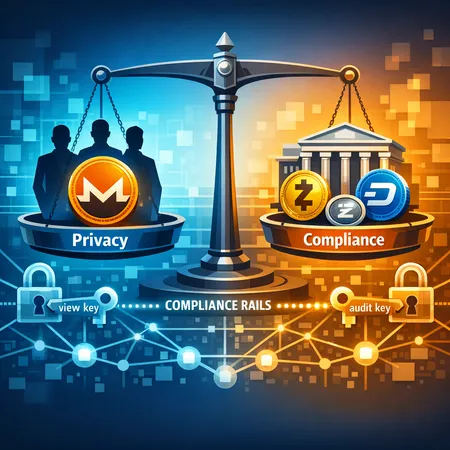
Selective disclosure is not a single technology; it’s a design pattern that gives stakeholders controlled access to otherwise private data. The three dominant approaches you’ll encounter are audit keys, view keys, and compliance rails. Each balances privacy, verifiability, and risk differently.
Audit keys
Audit keys are cryptographic credentials that permit a designated auditor to verify transaction history or balances without exposing that data to the public. An audit key is typically generated and issued off‑chain or via a multi‑party protocol so it doesn’t become a global backdoor. For institutions, audit keys are attractive because they allow a custodian or compliance officer to prove provenance and integrity to regulators.
Tradeoffs: audit keys can centralize trust if not engineered carefully, and losing an audit key or mismanaging access can leak bulk privacy. Implementations need hardware security modules (HSMs) or distributed key management to reduce central points of failure.
View keys
View keys (or read keys) are more familiar in projects like Zcash, where shielded transactions can be revealed to a key holder without revealing private spending keys. A view key enables someone to observe transaction details for a single address or shielded pool. This model maps well to individual compliance requests or corporate accounting needs.
Advantages include fine‑grained disclosure and minimal changes to privacy primitives. However, view keys require secure off‑chain handling and clear audit trails to prevent abuse. The recent discourse around Zcash’s positioning shows how view‑key models are being marketed as enterprise‑friendly privacy that can still interoperate with existing financial controls (see coverage on Zcash’s evolving narrative here: Could Zcash be the next Bitcoin?).
Compliance rails
Compliance rails are a broader set of integrations — APIs, attestation protocols, and on‑chain checkpoints — that tie privacy layers to regulatory workflows. They can include selective disclosure standards (e.g., verifiable credentials that assert AML checks), sanctioned address lists encoded as privacy‑preserving attestations, or zero‑knowledge proofs that demonstrate compliance properties without revealing raw data.
The beauty of compliance rails is they make privacy actionable for regulated entities. The risk is complexity: building rails that regulators trust without undermining cryptographic assurances is nontrivial.
Technical tradeoffs: privacy guarantees vs. auditability and UX
Designers face a three‑way tension: cryptographic robustness, operational security, and user experience. Stronger privacy often means higher computation, larger proofs, and more complex wallet UX. Conversely, easier disclosure mechanisms can introduce new attack surfaces.
At the protocol layer, technologies diverge:
- Ring signatures and bulletproofs (Monero‑style) focus on untraceability and plausible deniability, but can leak metadata through timing and network heuristics. XMR’s on‑chain model is resilient, but integrating selective disclosure requires carefully designed side channels or additional protocol fields.
- zk‑SNARKs/zk‑STARKs (common in shielded pools like Sapling and in some new L2s) let you prove properties about transactions without revealing them. They’re ideal for buildable selective disclosures, but proof generation costs and trusted setup tradeoffs matter for adoption.
At the systems level, metadata leakage — IP addresses, transaction graph patterns, and wallet clustering — is frequently a bigger threat than exposed ciphertext. That means privacy tooling must pair cryptography with network‑level defenses: wallet heuristics, circuit‑based transaction batching, and secure broadcast layers.
Lastly, operational design — key management, multisig auditor flows, and legal governance for audit key issuance — determines whether a selective disclosure model will be acceptable to banks and compliance officers.
Case studies: XMR, ZEC, and DASH — different routes to the same demand
Monero (XMR) remains the canonical private currency: strong defaults, fugitive transaction graphs, and a loyal community. The late‑2025 XMR rally reflected both scarcity narratives and renewed demand for native privacy. For Monero, the path to institutional use is likely tooling outward: wallets and custodian integrations that enable controlled disclosures without altering XMR’s core ring‑signature model.
Zcash (ZEC) offers a different philosophical stance: opt‑in shielded transactions with native view key mechanics. Projects like Zcash have long pitched shielded pools as a bridge to compliance because they can selectively reveal transaction data to auditors. Recent coverage highlights Zcash’s repositioning in that enterprise‑friendly direction, underscoring how privacy projects can aim for broader acceptance by offering verifiable disclosure paths (see the analysis in The Motley Fool linked above).
Dash (DASH) historically focused on payments UX, with optional PrivateSend. Renewed interest in Dash suggests some market participants view hybrid privacy — optional privacy plus fast settlement — as a pragmatic product fit for payments rails. Unlike XMR’s default privacy, Dash’s approach is opt‑in and easier to map into compliance flows, but offers weaker guarantees when used without careful protocol improvements.
These examples show two viable product strategies: preserve default privacy and build external selective disclosure tooling (Monero), or bake opt‑in disclosure primitives into the protocol (Zcash/Dash variants). Both are valid paths depending on target users and threat models.
Implications for DeFi, institutions, and regulation
DeFi designers must assume privacy will be demanded by users and required by counterparties. Private trades, confidential asset transfers, and on‑chain market making can benefit from privacy primitives — but DeFi composability complicates things: private states make composable automated market makers and lending protocols harder to audit.
Institutions need deterministic, auditable privacy: they want to demonstrate compliance to regulators without exposing customer secrets. That’s where standardization of selective disclosure (interoperable audit key formats, verifiable credential attestations, and standardized proof schemas) will matter.
Regulators will be skeptical but not binary. The most constructive regulatory path recognizes privacy as a public good that can coexist with AML/CFT goals if projects provide targeted evidentiary mechanisms. Policy‑minded investors should favour projects that invest in governance and transparent disclosure policies: who can request an audit key, under what legal process, and how key compromise is mitigated.
Practical implications:
- DeFi protocols should design modular privacy primitives so a lending pool can accept shielded collateral without exposing other users. That calls for zk proofs that assert collateralization without revealing amounts.
- Custodians will build HSM‑backed audit workflows that let regulators verify inflows/outflows without seeing every transaction.
- Market infrastructure (oracles, relayers) must avoid leaking sensitive metadata and should offer privacy‑preserving interfaces.
Product paths and recommendations for builders and privacy engineers
Prioritize privacy-by-default UX with opt‑out disclosure, not the reverse. Most end users will not want to toggle complex settings.
Build standardized selective disclosure primitives early: interoperable audit/view key formats, proof schemas for AML properties, and lawyer‑friendly attestation logs. Interop reduces bespoke integrations that increase centralization risk.
Combine cryptography with operational safeguards: HSMs, MPC key custody, and revocation schemes for audit keys. Consider threshold disclosure protocols so no single party can unilaterally expose user data.
Invest in metadata mitigation: transaction batching, cover traffic, discrete network channels. Strong cryptography without these remains porous in practice.
Engage regulators proactively. Provide transparent transparency policies and red‑team your selective disclosure process so legal teams and auditors understand when and how data is revealed.
Favor composable zk primitives for DeFi use cases. Zero‑knowledge proofs that assert “this user passed AML checks” or “this loan is collateralized” without revealing amounts are where practical DeFi privacy will accelerate.
As builders in the Bitlet.app ecosystem and beyond think about privacy, the strategic choice is less about whether privacy will persist and more about how it will be packaged for real‑world actors.
Conclusion — a balanced future for privacy in Web3
The privacy‑coin renaissance is less a return to 2017‑style secrecy and more an evolution: stronger cryptography combined with accountable disclosure. The market interest in XMR, ZEC, and DASH shows demand; selective disclosure models are the technology bridge to institutions and regulated commerce. Success will require thoughtful tradeoffs — protecting users against mass surveillance while providing narrowly scoped, cryptographically verifiable access for legitimate audits.
For policy‑minded investors and engineers, the key is scrutiny: prefer projects that bake in key‑management best practices, open disclosure policies, and cryptographic proofs that minimize data revelation. DeFi protocols that can prove compliance properties without leaking state will unlock new liquidity and institutional participation.
Privacy in Web3 will not be a single protocol or a single coin. It will be an ecosystem of primitives — view and audit keys, standardized compliance rails, and privacy‑preserving proofs — that together let Web3 be private, usable, and legally interoperable.
Sources
- “From anonymity to selective disclosure — the next era of privacy coins” (Bitcoin.com): https://news.bitcoin.com/from-anonymity-to-selective-disclosure-the-next-era-of-privacy-coins/
- “Could Zcash be the next Bitcoin?” (The Motley Fool): https://www.fool.com/investing/2026/01/18/could-zcash-be-the-next-bitcoin/