2026 Altcoin Narratives and Red Flags: Kaspa, Sui, Hyperliquid, CHEX and Meme-Scam Risks
Summary
Why this matters in 2026
Altcoin narratives rotate fast: a technical innovation here, a liquidity-driven breakout there, and suddenly retail FOMO outpaces fundamentals. For active retail investors and research analysts, the task is to separate durable projects from transient pumps and scams. This article walks through five high-profile 2026 stories — Kaspa (KAS), Sui (SUI), Hyperliquid (HYPE), Chintai/CHEX (CHEX) and Shiba Inu (SHIB) meme activity — and gives a repeatable framework for spotting real adoption versus dangerous noise.
For many traders, Bitcoin remains the market bellwether, but altcoins now produce outsized returns and outsized losses; understanding tokenomics, on‑chain adoption signals, and rug/scam indicators is essential.
A compact evaluation framework
Before digging into each token, use a consistent checklist: catalyst durability, tokenomics and supply dynamics, measurable on‑chain adoption, liquidity and exchange distribution, and explicit red flags (centralized control, opaque teams, sudden wallet clustering). Below is a practical set of due‑diligence steps you can apply repeatedly.
Practical due‑diligence steps
- Read the whitepaper and recent protocol upgrade notes; confirm the upgrade was implemented and that on‑chain metrics reflect usage (blocks, transactions, active addresses).
- Inspect token distribution: top holders, vesting schedules, and on‑exchange concentration. Large, unlocked allocations controlled by a tiny number of wallets are a red flag.
- Track developer activity and governance: GitHub commits, upgrade proposals, and grant flows. Stagnant dev activity after a price surge should raise concern.
- Watch on‑chain flows and liquidity sources: are whales moving tokens to exchanges? Is there evidence of smart‑money accumulation distinct from retail hype?
- Cross‑check external reporting and social chatter for consistency; verify contract addresses from official channels to avoid impersonation.
Use these steps before committing capital and revisit them after major rallies. Also consider a toolset (block explorers, token‑holding dashboards, and DEX trackers) and keep track of announced partnerships versus real integrations.
Kaspa (KAS) — PoW BlockDAG as a long‑term narrative
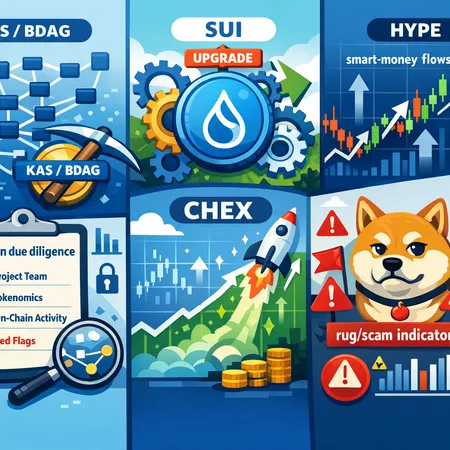
Kaspa’s claim is architectural: a PoW BlockDAG (block‑directed acyclic graph) aims to combine PoW security with very high throughput and low finality times. Advocates point to a fixed supply and the potential to scale while remaining permissionless, which some see as a 2026 altcoin differentiator. Coverage arguing Kaspa’s PoW BlockDAG edge and fixed supply positions it as an alt contender has circulated in trade press and community threads.
Catalyst durability: The narrative depends on sustained real‑world use — not just faster blocks. A BlockDAG is interesting only if applications or users exploit the throughput. Without developer teams building wallets, infra, and integrations, the architecture alone isn’t enough.
Tokenomics and concentration: Fixed supply can help value capture, but distribution matters. If early miners, insiders, or foundation wallets control large percentages, price action can be fragile when those holders rotate out. Run a holder distribution check and examine whether mining rewards or staking (if any) create centralized accumulation.
On‑chain adoption signals: Look for growing unique active addresses, steady fee revenue, and diverse node operators. If activity is dominated by faucet‑driven transfers or test traffic, the growth is cosmetic. Also watch for real merchant or dApp integrations.
Due diligence tips: verify official KAS/BDAG contract addresses from primary channels, check mining pool concentration, and follow upgrade proposals and node diversity. If you want a comparative view of layer‑1 shifts, also scan DeFi trends on DeFi platforms to see whether liquidity and composability follow throughput promises.
For more reading on the PoW BlockDAG argument, see this profile of Kaspa’s narrative and technical edge: Kaspa touted as 2026 altcoin standout.
Sui (SUI) — upgrade‑driven token thesis
Sui’s 2026 story centers on a cadence of network upgrades and growing institutional interest. When upgrades materially reduce developer friction or add primitives that unlock new use cases (e.g., asset composability or cheaper state changes), the token narrative can shift from speculative to utility‑backed.
Catalyst durability: Upgrades are only catalysts if they change developer economics and lead to sustained dApp launches. Track developer onboarding, active monthly deployers, and whether applications build defensible revenue models.
Tokenomics and economic design: SUI’s token dynamics must align with network utility. Look for mechanisms that encourage long‑term staking or fee burning versus purely speculative trading incentives.
On‑chain adoption signals: meaningful metrics include transaction composition (payments vs. smart contract interactions), gas fee capture by the protocol, and increasing non‑trivial contract deployments. Institutional interest is promising, but verify it by watching custody inflows and regulated exchange listings rather than PR headlines.
For a more technical and fundamental read on how Sui upgrades affect price thesis, see analysis tying network upgrades to bullish token prospects: Sui price analysis: token eyes $20 target.
Practical test: if an upgrade claims to attract institutions, confirm by monitoring on‑chain custody addresses and whether trading desks are providing liquidity rather than transient market‑making that disappears during drawdowns.
Hyperliquid (HYPE) — breakout, smart‑money flows and momentum risk
Hyperliquid’s 2026 narrative is a classic momentum play: technical breakout from a bearish channel combined with reported smart‑money inflows. Breakouts that follow genuine liquidity rotation — where long‑term addresses accumulate and exchanges see lower sell pressure — can be durable.
Catalyst durability: Momentum is fragile by itself. The key question is whether the breakout corresponds with protocol upgrades, user growth, or institutional commitments, or if it’s purely a liquidity re‑rating driven by short squeezes.
On‑chain signals of credibility include rising holding time among the top N wallets, decreased supply on major exchanges, and increasing real activity (e.g., interactions with core contracts). If smart‑money flows are visible but short‑term (a few wallets flipping coins after doubling), the signal is weaker.
For reporting on Hyperliquid’s breakout and smart‑money narrative, see coverage of the price action and inflows: Hyperliquid price breaks past bearish channel.
Risk management: use position sizing and defined stop levels. Momentum trades can be lucrative but combine technical exits with on‑chain checks so you’re not holding large positions into a liquidity vacuum.
CHEX (Chintai) — explosive rallies and sustainability questions
CHEX has posted dramatic short‑term gains, a pattern common in smaller market‑cap tokens where a single catalyst — exchange listing, airdrop, or influencer push — triggers rapid inflows. Reports of CHEX’s price action show how quickly retail can chase returns.
Catalyst durability: Ask whether the rally comes from improved fundamentals (protocol partnerships, real usage) or purely speculative drivers (social virality, concentrated buying). Often, sustainability depends on follow‑through: does volume stay elevated and do active addresses convert into recurring users?
Tokenomics and lockups: check vesting cliffs and whether team tokens are unlocking near the rally. Sudden unlocking coupled with price spikes is a classic pump vulnerability.
See reporting on CHEX’s rally for concrete examples of how explosive short‑term performance looks: Chintai CHEX token price rally.
Practical rule: if you can’t find independent confirmation of a claimed partnership or measurable usage metrics beyond social posts, treat the move as speculative.
Meme rallies and the rise of sophisticated scams (SHIB example)
Meme rallies bring outsized attention — and scamming sophistication. During price surges in SHIB and similar tokens, attackers have escalated tactics from phishing links to automated wallet‑address spoofing and fake contract deployments.
One recent, alarming scam type involves spoofing wallet addresses in confirmation dialogs or using vanity addresses that look like legitimate ones, tricking users into sending funds to impostor wallets. Reporting on a new SHIB wallet‑address spoofing scam highlights how high attention equals high risk for holders: Shiba Inu’s price surge triggers alarming new scam.
Red flags to watch during meme rallies:
- Sudden surge in new token contracts with near‑identical names or copied metadata.
- Unverified contract addresses circulating in social channels; always get addresses from official links and cross‑verify on the explorer.
- DMs or bots offering presales or guaranteed airdrops; legitimate teams don’t cold‑DM token claims.
- Rapidly changing token decimals or owner renounce events executed immediately after launch — these can mask rug mechanics.
Practical steps to avoid scams:
- Confirm contract addresses from multiple official sources and cross‑check them on the chain explorer before interacting.
- Use hardware wallets and never paste private keys into web prompts. If a transaction looks suspicious, cancel it and verify the destination address independently.
- Avoid copy‑paste addresses shared in chat; paste them into a text editor and visually compare checksums, or better, use ENS/verified links when available.
- Limit approval allowances on ERC‑20/ERC‑721 tokens; use "approve for exact amount" where possible and revoke allowances after use.
- Monitor token approval dashboards and revoke allowances granted to unknown contracts.
Red flags summary and quick checklist
- Centralized control: team wallets hold >20–30% of supply with immediate or near‑term unlocks.
- Exchange concentration: a large share of liquidity sits on a single exchange or CEX.
- Developer inactivity: commits and PRs dry up despite price rallies.
- Fake social proof: bot amplification, impersonator accounts, or unverifiable partnerships.
- On‑chain mismatch: high transaction counts driven by airdrop claims or wash trading rather than diverse end‑user activity.
Checklist before allocating capital:
- Verify contracts and official channels.
- Scan top holders and vesting schedules.
- Check developer activity and governance proposals.
- Watch exchange inflows/outflows for ownership shifts.
- Limit position size and set exit rules tied to on‑chain or off‑chain milestones.
Final thoughts for retail investors and analysts
Narratives like PoW BlockDAG (Kaspa), upgrade‑led token demand (Sui), smart‑money breakout (Hyperliquid) and rapid rallies (CHEX) each have plausible upside — but the same storytelling can be repurposed to justify speculative buys. The difference is measurable: durable projects convert narratives into usage, diverse token distribution, and repeated developer investment. Meme rallies, meanwhile, attract increasingly sophisticated scams that require process‑driven defenses.
Build a habit: run the checklist before and after large moves, prefer projects with transparent tokenomics and observable utility growth, and always verify contract addresses. Your research toolbox should include block explorers, token‑holding analytics, dev activity monitors, and standard operational security practices. For on‑ramp or off‑ramp needs, platforms like Bitlet.app can be part of a broader trading infrastructure, but never substitute due diligence with convenience.
Sources
- Kaspa PoW BlockDAG profile: https://crypto.news/kaspa-touted-as-2026-altcoin-standout-with-pow-blockdag-edge/
- Sui upgrades and token thesis: https://blockonomi.com/sui-price-analysis-token-eyes-20-target-as-network-upgrades-and-institutional-interest-converge/
- Hyperliquid breakout and smart‑money flows: https://crypto.news/hyperliquid-price-breaks-past-bearish-channel-as-smart-money-flows-in-targets-30-rally/
- Chintai (CHEX) price rally: https://beincrypto.com/chintai-chex-token-price-rally/
- Shiba Inu scam warning (wallet spoofing): https://coinpaper.com/13580/shiba-inu-s-price-surge-triggers-alarming-new-scam?utm_source=snapi