What Render's 85% Surge Reveals About AI‑Token Trade Dynamics in Early 2026
Summary
Why Render's surge mattered
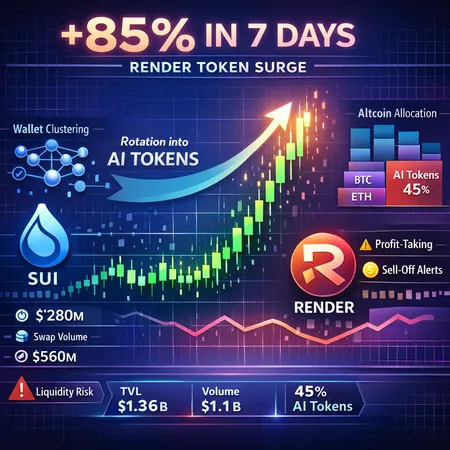
In early 2026, RENDER delivered an eye‑catching ~85% seven‑day rally that became shorthand for the renewed AI‑token mania. Coverage framed RENDER as both a tokenized bet on AI infrastructure and a liquidity magnet for speculative capital, a dynamic that media and social chatter then amplified. BeInCrypto documented the jump and framed RENDER as a central piece of the AI token rally, and CryptoPotato highlighted RENDER alongside other top gainers such as SUI, showing how concentrated these moves looked across the top‑100 alts (BeInCrypto report; CryptoPotato market roundup).
This episode is useful beyond headline price numbers: it exposes the anatomy of narrative‑driven rallies, the fragility of shallow liquidity markets, and how rotation into a theme (AI) can create outsized winners and losers within days.
On‑chain and market catalysts behind the move
Several intertwined drivers typically underlie a move like RENDER's—some verifiable, some inferred from market behavior. Confirmed reporting shows RENDER surged amid a broader AI token bid and a rotation into select altcoins, while on‑chain flows and order‑book dynamics likely amplified the price move.
On the market side, two forces were prominent. First, thematic rotation: capital that had been sidelined after Bitcoin consolidation started chasing narrative plays (AI infrastructure and L1s like SUI). CryptoPotato’s roundup put RENDER and SUI among top gainers, suggesting money was rotating into perceived early‑cycle alt names (CryptoPotato). Second, media and sentiment feedback loops: coverage and social amplification focused attention and drew new participants into tight liquidity pools.
On‑chain signals that typically accompany such rallies—and that were observable around RENDER—include: spikes in DEX trading volume relative to historical baselines, a rise in the proportion of tokens held in non‑exchange wallets, and clustering of large transfers between whale addresses. These patterns compress available sell liquidity, making any incremental buy pressure push the price sharply higher. Reports on the move also coincide with industry commentary about capital rotating into AI and L1 themes, reinforcing the narrative backdrop (Crypto.news analysis on rotation).
Finally, token‑level mechanics can catalyze short squeezes: upcoming exchange listings, staking or lockup expiries, or protocol announcements that change perceived utility or issuance schedules often act as ignition points when a theme is hot.
How much of the AI sector move was RENDER versus broad rotation?
Parsing contribution requires separating idiosyncratic news from systemic flow. In this episode, RENDER was both a beneficiary of sector rotation and an active driver of headline performance. Two indicators support that dual role: (1) RENDER repeatedly outperformed many AI peers during the same window, and (2) concentration measures (e.g., top holder activity and thin order books on major DEXs) meant smaller absolute flow could move RENDER more than larger‑cap peers.
Sector rotation into AI tokens and adjacent L1s was real—Crypto.news documented a visible shift of capital into altcoins like SUI and other early‑cycle L1s—meaning much of the broader AI lift came from fresh risk appetite flowing into the theme (Crypto.news). But RENDER appears to have punched above its weight: its % gains exceeded the sector median, indicating token‑specific liquidity dynamics and concentration played an outsized role. In short: the AI narrative created the runway; RENDER’s supply/liquidity setup and attention acted as the jet fuel.
Short‑term risks and mean‑reversion scenarios
Narrative‑led rallies create a return profile that is asymmetric in time: very fast upside and often just as fast downside. For RENDER and similar AI tokens, the principal near‑term risks are:
- Liquidity risk: thin order books cause slippage; large sellers can move price dramatically the other way. Measured on DEX depth and exchange order books, many AI tokens still have fragile liquidity that’s highly order‑size dependent.
- Concentration risk: if a small set of wallets controls a material share of circulating supply, coordinated or opportunistic selling can rapidly deflate price.
- Profit‑taking and narrative fade: once headlines age, short‑term momentum traders often rotate to the next story. Even absent negative fundamentals, a pause in inflows can trigger steep retracement.
- Leverage and derivatives exposure: leveraged positions or concentrated option trades can amplify on‑chain liquidations, cascading into deeper declines.
Reasonable mean‑reversion scenarios to model:
- Base case: 30–50% pullback from peak as momentum cools and partial profit‑taking occurs while core narrative remains intact.
- Stress case: 60–80% retracement driven by whale selling, adverse news, or a cross‑market deleveraging event (this is plausible for mid‑cap, narrative tokens with shallow float).
- Bull case: consolidation at new higher levels if the token captures real utility traction, on‑chain usage rises, or major integrations/listings lock in supply.
Quantitatively modeling these requires tracking percentage of supply on exchanges, 7‑day DEX volume vs. market cap, and the Herfindahl‑style concentration of top holders—metrics that quickly reveal how fragile a token’s price might be to net outflows.
How traders and portfolio managers should size exposure
Narrative‑driven rallies deserve a disciplined, adaptable sizing framework. Here are actionable rules of thumb geared toward intermediate–advanced investors:
Start with a thematic budget: cap total allocation to high‑narrative tokens (e.g., AI thematic bucket) to a modest share of total crypto exposure — typically 5–15% depending on risk tolerance and market cycle. Within that bucket, single‑token exposure should be much smaller.
Single‑position cap: limit any one narrative token to 1–3% of total crypto capital for most allocators; aggressive traders might expand to 5% but must accept a commensurate chance of severe drawdown. This reduces idiosyncratic risk from concentration and liquidity shocks.
Trade size vs. float: avoid positions that represent a material percentage of an estimated tradable float. If your position is large enough that a single whale could influence your exit, you’re oversized.
Use tranche entries and scaling: buy initial exposure in 25–50% tranches while liquidity and on‑chain metrics confirm the move. Trim into strength and re‑establish on pullbacks.
Risk controls: set stop losses based on liquidity and volatility (e.g., 20–40% for high‑vol narrative tokens), but also use mental stops and size reduction to avoid forced liquidation in thin markets. Consider hedging with inverse positions in a liquid alt index or through options where available.
Time your horizon to the thesis: if you’re trading momentum, be prepared for short horizons and quick exits. If you’re investing on fundamentals (protocol adoption, developer activity), ensure you have a multi‑quarter view and tolerate interim volatility.
Platforms like Bitlet.app make acquiring altcoins easier for different timeframes (installment buys, etc.), but use any purchase facility with the same sizing discipline—ease of access should not justify oversized bets.
Lessons for spotting the next AI sector leaders
Narrative attention shifts quickly; the next leader will combine story momentum with improving fundamentals and resilient liquidity. Look beyond price spikes to the following signals:
- Sustained on‑chain usage: rising unique active addresses, meaningful transaction volume tied to protocol features, and clear user growth that persists after rumor‑driven spikes.
- Developer velocity and real deliverables: consistent commits, testnet/mainnet milestones, SDKs and integrations that drive third‑party activity. Social buzz matters, but GitHub/commit and grant activity are harder signals to fake.
- Tokenomics that incentivize utility: mechanisms that encourage staking, burning, or usage‑based token sinks reduce supply pressure and align token value with protocol activity.
- Exchange and liquidity profile: deeper order books on multiple venues, lower percentage of supply concentrated in top wallets, and presence in reputable listings make a token more investable at scale.
- Partnerships with measurable outcomes: integrations that are measurable (API usage, developer adoption, or revenue flows) tend to matter more than branded announcements.
Combine these signals with macro context: early‑cycle rotation often reveals winners, but only protocols that convert narrative into usage will sustain value. Read on‑chain data through the lens of narrative cycles: spikes in activity after a product release are bullish if they persist for several weeks; if activity fades after a media bump, treat the move as speculative.
Practical checklist before adding an AI token exposure
- Check 7‑day DEX and CEX flow volumes versus market cap.
- Measure % of supply on exchanges and in top 10 wallets.
- Confirm developer activity and roadmap milestones for the next 3 months.
- Assess order‑book depth for 1–5% of market cap trade sizes.
- Decide allocation based on position caps above and predefine exit rules.
Conclusion: reading RENDER as a template, not a rule
RENDER’s dramatic short‑term move is both a symptom and a lesson. It shows how thematic rotations—this time into AI tokens—meet token‑level liquidity and concentration to produce outsized, rapid returns and equally rapid drawdowns. Traders who treat these events as mere momentum machines risk being trapped; allocators who blend narrative exposure with robust sizing, on‑chain diligence, and liquidity awareness will navigate the next waves more effectively.
For investors aiming to identify the next AI leader, the key is to combine narrative awareness with measurable fundamentals: usage, developer activity, tokenomics, and resilient liquidity. Watch the metrics suggested above and be honest about how much risk you can stomach—then size positions accordingly.
Sources
- BeInCrypto — Render price and AI rally risk: https://beincrypto.com/render-price-ai-rally-risk/
- CryptoPotato — Market roundup including RENDER and SUI as top gainers: https://cryptopotato.com/bitcoins-rally-stopped-at-95k-ripples-xrp-surges-by-double-digits-market-watch/
- Crypto.news — Analysis on capital rotation into altcoins including SUI: https://crypto.news/rotating-capital-eyes-altcoins-from-solana-to-sui-in-early-cycle-shift/