DAO Governance Tensions: Lessons from Aave (AAVE) and Jupiter (JUP) on Decentralization and Tokenomics
Summary
Why these disputes matter
DAO governance is no longer an academic curiosity. When governance frictions play out publicly they impact user trust, front-end continuity, and tokenomics — and they create real systemic risk for protocols and their treasuries. The recent Aave AAVE governance spats over brand and front-end control, and the JUP buyback debate, are instructive because they expose two sides of the same coin: control vs. decentralization, and discretionary treasury actions vs. predictable token-economics.
For operators and governance designers, the core question isn’t whether to decentralize — it’s how to structure rights, incentives, and fallback rules so decentralization doesn’t become chaos. Across DeFi the practical implications matter: front-ends can be forks or malfunctions; buybacks can drain treasuries or stabilize prices. Even long-term holders of established assets like Bitcoin watch these dynamics; governance design increasingly determines protocol resilience.
The Aave episode: brand, front-ends and governance friction
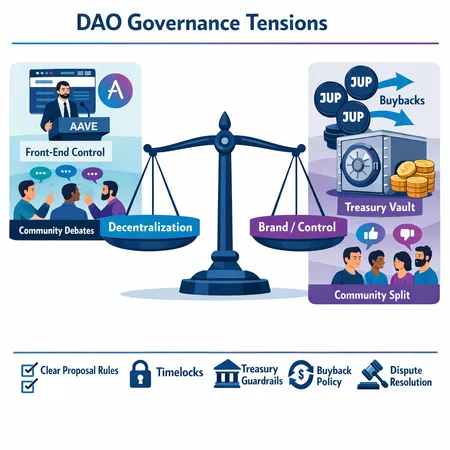
In the Aave case, a conflict emerged around who controls brand assets and front-end interfaces that users rely on. The Aave founder publicly responded to governance pressures with a strategic plan to reconcile community demands and protect the protocol’s usability. That response, and the reporting around it, crystallize a recurring governance tension: community ownership of identities and front-ends versus the need for operational control and brand protection. Read the founder’s response and the governance context here: Aave founder’s response and strategic plan.
Pros of community control of front-end assets
- Alignment with decentralization ethos: community ownership avoids concentrated control and captures the symbolic value of a public good.
- Reduced single-point-of-failure risk: if multiple teams can run front-ends, censorship or central outages are less catastrophic.
Cons and practical hazards
- Brand fragmentation and user confusion: multiple slightly different front-ends dilute UX and can erode trust.
- Security and scam risks: community-controlled brand assets can be co-opted or misused by bad actors if onboarding standards are absent.
- Operational paralysis: when critical decisions (e.g., removing an exploit-prone front-end) require broad votes, response speed suffers.
Aave’s episode shows that leaving brand and front-end control in a purely permissionless pond invites disputes that affect users instantly. The founder’s strategic plan argues for pragmatic mechanisms to preserve decentralization while preventing abuse — a temperate stance many DAOs will need to adopt.
The JUP buyback debate: treasury mechanics meet political economy
Jupiter’s CTO laid out why buyback programs may end, framing the debate as a trade-off between short-term token price support and long-term treasury health. The coverage highlights how buybacks interact with community sentiment, fiscal transparency, and opportunity costs: Jupiter CTO explains why JUP buybacks may end.
Buyback pros
- Price floor and signaling: visible buybacks can support token prices and demonstrate protocol commitment.
- Demand creation: swapping treasury assets for native tokens can reduce circulating supply temporarily.
Buyback cons
- Resource consumption: buybacks consume liquid treasury assets that could fund growth, grants, or protocol insurance.
- Governance externalities: buybacks run on the coattails of token price moves and can entrench insiders if not structured fairly.
- Moral hazard: expectations of buybacks can encourage short-termism among market participants.
Jupiter’s debate is a cautionary tale: buybacks are a tool, not an identity. Without pre-agreed policy and transparent metrics, buybacks become political flashpoints that strain DAO cohesion.
Common themes: decentralization isn’t binary
Both episodes reveal the same underlying truth: decentralization is a spectrum of design choices. A totally permissionless approach after launch can leave a protocol exposed to coordination failures, while excessive centralization undermines legitimacy. The middle ground is explicit, well-governed trade-offs.
Key tensions to recognize
- Control vs. usability: tokens and governance are great for high-level direction; day-to-day operational decisions often need speed and clarity.
- Public goods vs. private incentives: brand and front-ends are public goods that require curation; without delegated stewardship they can degrade.
- Treasury as shock absorber vs. strategic investor: treasuries should preserve optionality, not be a piggy bank for recurring market interventions.
Governance design fixes that actually work
Below are design patterns that can reduce the chance of crises like those Aave and Jupiter experienced.
1) Clear on-chain treasury policy and guardrails
Define on-chain rules for the treasury: maximum allocation for buybacks per quarter, permissible asset classes for reserves, and mandatory multi-sig approvals for large disbursements. Codifying these limits reduces ad-hoc political fights and provides predictable tokenomics.
2) Timelocks plus emergency admin with sunset clauses
Use timelocks to allow market participants to react to changes and to give governance time to deliberate. Where immediate action is required, keep an emergency admin (or admin multisig) with clearly defined and expiring powers.
3) Role-based delegation for operational assets
Separate ownership of brand/front-end assets from governance voting rights. Create delegated roles (e.g., a Brand Council or Front-End Stewardship committee) chosen by governance but empowered to act quickly on maintenance, takedown, or rebranding decisions. Require periodic rechecks via governance votes.
4) Pre-committed buyback frameworks
If buybacks are a tool you want available, pre-commit to the mechanics: trigger conditions (e.g., treasury surplus above X% of market cap), funding source, execution cadence, and oversight rules. This transforms buybacks from arbitrary to rule-based actions.
5) Economic voting safeguards
Implement quorum thresholds and proposal deposit requirements to deter low-quality or rent-seeking proposals. Consider quadratic voting or conviction voting to give long-term stakeholders and minority voices better representation.
6) Reputation and slashing for stewards
For delegates or councils, attach reputational accounting and optional slashing (social or on-chain) for negligence. Public, auditable performance metrics reduce capture risk.
7) Meta-governance and layered dispute resolution
Set up an on-chain appeals process or meta-governance layer that can mediate disputes over branding, IP, or widely impactful treasury moves. Off-chain arbitration with on-chain enforcement can be a pragmatic compromise.
Practical checklist for DAOs (operationally focused)
Use this checklist to audit your DAO and avoid the failures seen in Aave and Jupiter:
Treasury
- Is there an on-chain treasury policy codified and visible?
- Are buybacks explicitly described with triggers, caps, and reporting requirements?
Brand & Front-Ends
- Who legally/operationally controls brand assets and front-end domains? Is that control documented?
- Is there a steward role with delegated authority and regular review cycles?
Governance Mechanics
- Are quorum and proposal thresholds calibrated to discourage spam while enabling action?
- Do you have timelocks with emergency powers that expire or require renewal?
Voting & Representation
- Have you considered alternative voting systems (quadratic, conviction, delegated) to mitigate plutocracy?
- Is delegation transparent and revocable?
Transparency & Reporting
- Are treasury moves, buybacks, and brand decisions accompanied by public post-mortems?
- Do you publish performance and risk metrics for stewards?
Legal & Risk
- Are there clear off-chain agreements (e.g., trademarks, domain registrations) that protect community assets?
- Do you maintain an operational continuity plan if key stewards step away?
If the answer to any checklist item is “no” or “unclear,” prioritize fixes in that order: treasury guardrails, steward delegation, transparency mechanisms.
What to expect when you implement fixes
No governance design is perfect; implementing these fixes trades some pure permissionless flexibility for robustness and clarity. Expect an initial period of friction as roles and rules are tested. But over time, formal guardrails reduce theatrical governance wars, increase predictability for market participants, and preserve treasury optionality for strategic uses like partnerships, grants, or crisis insurance.
Bitlet.app and other platforms tracking DAO performance increasingly rate protocols by governance clarity — not just total value locked — because governance quality shapes long-term viability.
Final thoughts: design with humility and iteration
Aave’s brand-control dispute and Jupiter’s buyback debate are not moral failures so much as design failures: they revealed where assumptions were unstated and where incentives misaligned. The solution is pragmatic: codify key decisions, allow delegated operational roles with oversight, and make treasury operations rule-based and transparent.
DAO governance will continue to evolve. The most resilient DAOs will mix on-chain rules with off-chain norms, keep critical assets stewarded (not abandoned), and treat the treasury as a strategic endowment rather than an ATM for episodic political wins.
Sources
- Aave founder’s response and strategic plan amid governance tensions: https://bitcoinist.com/aave-founder-governance-tension-strategic-plan/
- Jupiter CTO on buybacks and treasury trade-offs: https://ambcrypto.com/waste-of-resources-jupiter-cto-explains-why-jup-buybacks-may-end/