Tether’s Year‑End BTC Push: Implications for Liquidity, Treasuries & Regulation
Summary
Executive summary
Tether’s year‑end accumulation — disclosed as an 8,888 BTC increment in Q4, putting total holdings above ~96,000 BTC — is more than a headline move. For institutional treasurers and compliance teams, it reframes the role of stablecoin issuers as active market participants, not passive custodians of cash equivalents. This piece examines the cadence and scale of the buys, why a stablecoin issuer would allocate into BTC, the likely effects on spot liquidity and ETF flows, the regulatory and audit friction points that follow, and scenarios for how Tether’s BTC stack might amplify or dampen future rallies.
What Tether bought, and how big it really is
Tether’s Q4 disclosure reported a large incremental buy — widely covered as 8,888 BTC (some outlets noted 8,889 BTC in alternative tallies) — adding materially to an already sizeable treasury position. Crypto.News and Cointelegraph ran the initial market stories on the purchase and its immediate price reaction, while TokenPost published a Tether CEO commentary and a detailed tally of the Q4 accumulation. Independent analyses tied the purchases to an explicit treasury strategy rather than opportunistic trading (Crypto.News, Cointelegraph, TokenPost, CoinGape, CoinSpeaker).
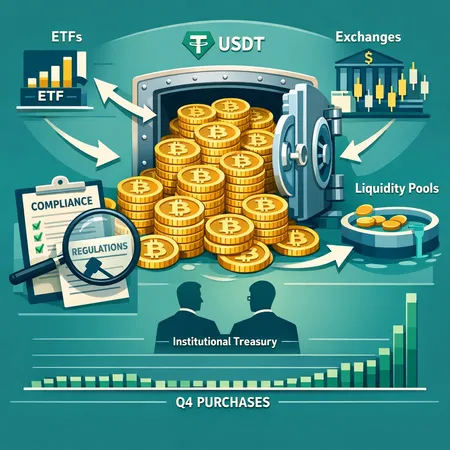
Put in context: 8,888 BTC is a sizable one‑quarter increment for a non‑exchange participant, and the cumulative stack above ~96k BTC makes Tether one of the largest single institutional holders on chain. That scale matters because the order book depth for large OTC/spot fills, the path of ETF creation/redemption flows, and the perception of supply tightness all shift when a market participant of this caliber is actively accumulating.
Why a stablecoin issuer would reserve in BTC
Stablecoin issuers historically kept reserves in cash, short‑dated commercial paper, and other low‑volatility instruments to match USDT liabilities. Tether’s pivot toward treasury BTC suggests a few linked motives:
Diversification and asymmetric upside. Holding BTC offers an inflation hedge and upside beyond the low yields of cash equivalents. For an issuer sitting on balance‑sheet profits, converting a portion into BTC can magnify returns relative to parking cash. TokenPost’s coverage includes Tether’s public remarks on profit allocation that support this reasoning.
Strategic reserve strategy. Treating BTC as a part of the treasury — rather than as a backstop for immediate USDT redemptions — reframes the reserves as layered: liquid cash and equivalents for immediate liability coverage, plus a strategic treasury BTC allocation for longer‑term value preservation.
Market signaling and balance‑sheet management. Large purchases can be a signaling tool to counterparties and regulators that the issuer is confident in crypto assets’ role in long‑term reserve composition.
From an institutional treasurer’s perspective, this is not just an investment decision; it’s a change in the issuer’s liability‑matching profile. When USDT reserves include volatile assets, the calibration between short‑term liquidity and long‑term reserve returns becomes a compliance conversation.
Profit allocation, accounting and USDT reserves
If BTC holdings derive from realized profits — a common corporate practice — the accounting treatment differs from funds set aside explicitly to back circulating USDT. Tether’s disclosed moves, and the CEO statements reported by TokenPost, emphasize that some BTC purchases stem from retained earnings or profit allocation rather than the pool of assets earmarked for USDT redemptions.
Still, three audit and compliance questions follow:
- How are BTC reserves marked to market on the balance sheet, and how often? Volatility creates balance‑sheet swings that auditors will want to stress‑test.
- Are BTC holdings segregated from assets that back circulating USDT, and is that segregation contractually enforceable and transparent? Reserve strategy must be defensible under regulatory scrutiny.
- How are off‑exchange OTC buys reported and timed relative to public disclosure, to avoid concerns over selective disclosure or market impact?
For compliance teams, the key is traceability: the stronger the documentation showing BTC came from corporate profits or a non‑reserve treasury bucket, the lower the immediate risk that auditors—and regulators—will classify the holdings as undermining USDT backing.
Impact on market liquidity and ETF flows
When a large, non‑exchange actor accumulates tens of thousands of BTC, the immediate market effect is to reduce the available tradable supply or at least the on‑exchange float. That has multiple knock‑on effects relevant to institutional investors and treasurers:
Tighter spot liquidity. Active accumulation, especially executed via OTC desks or dark pools, can reduce the supply that market‑makers rely on, widening bid‑ask spreads during periods of stress and increasing slippage for large orders.
ETF dynamics. Spot BTC ETF creation/redemption mechanics depend on arbitrage between ETF shares and underlying BTC. A large buyer removing spot BTC can increase the basis, making ETF share creation more costly and potentially amplifying inflows-driven price moves.
Interplay with institutional treasuries. Corporates or funds that hold BTC may find execution more costly during Tether accumulation windows. Conversely, if Tether later provides liquidity (selling into rallies or supplying OTC liquidity), it could act as a countervailing force.
Linking the market reaction to on‑chain and exchange metrics — exchange reserves, large transfer volumes, and OTC desk inventories — will be crucial for institutional traders to time execution and for treasurers to assess market impact.
For many traders, Bitcoin remains the primary market bellwether; when a major treasury changes behavior, the derivative and ETF markets reprice risk quickly.
Regulatory and audit risk: what compliance teams should watch
Tether’s accumulation invites greater scrutiny for several reasons:
Transparency and attestations. Regulators and counterparties will press for clearer attestations showing which assets back USDT liabilities and which are treasury allocations. Historical disputes around reserve disclosures mean any ambiguity invites formal inquiries.
Market conduct questions. Large, coordinated buys can trigger market‑stability reviews if they materially influence prices. Compliance teams should expect questions about execution methods (OTC vs exchange), use of affiliated counterparties, and disclosure timing.
Custody and segregation. Auditors will ask whether BTC is custodied with third‑party custodians, whether keys are multisig, and how quickly BTC can be liquidated to meet liabilities. The distinction between liquid reserves (for USDT redemptions) and strategic treasury BTC must be auditable.
Cross‑border regulatory complexity. Tether’s global footprint means multiple regulators may engage at once—each with different expectations on disclosures and reserve treatment.
Cointelegraph and TokenPost coverage highlighted the public and regulatory attention the purchases generated; for institutional treasuries, the lesson is to bake stronger documentation into any counterparty relationship with large stablecoin issuers.
Scenarios: how Tether’s BTC stack could amplify or dampen future rallies
Large treasury holdings are not destiny‑setting on their own; the effects depend on intentions and execution. Below are four concise scenarios that institutional investors should model.
- Accumulator (continuation of buys)
- Tether keeps buying from retained profits, shrinking spot float. Result: amplified rallies during inflow cycles as supply tightens; higher volatility on large orders; ETF basis may widen.
- Strategic rebalancer (sell into strength, buy into weakness)
- Tether uses BTC as a non‑liability buffer: sells during spikes, buys during dips. Result: dampened volatility; acts as a liquidity sink at peaks and buyer at troughs, potentially stabilizing markets if trades are sized and timed prudently.
- Liquidity provider under stress (sells to meet unexpected outflows)
- If USDT redemptions surge and liquid reserves fall short, selling BTC to cover obligations could accelerate downside and create a feedback loop with market stress.
- Opportunistic trader (short‑term profit taking, dynamic allocation)
- If Tether treats BTC as an investment portfolio, frequent rotations could increase market churn and unpredictability for large institutional execution.
Each scenario has different triggers and lead indicators. Accumulator behavior is detectable via persistent transfers to cold storage and falling exchange reserves; rebalancer behavior shows up as scheduled OTC sell blocks during runups.
Signals to monitor (practical checklist)
- Exchange BTC reserves and net flows (decreasing reserves + large off‑exchange inflows suggests accumulation).
- On‑chain transfer sizes to known Tether addresses and cold wallets.
- Public disclosures and CEO statements (TokenPost and other outlets are useful for confirmation).
- ETF arbitrage spreads and creation/redemption volumes.
- OTC desk inventories and bid/ask changes for large block trades.
Institutional treasurers and compliance teams should combine these signals with counterparty documentation — e.g., proof of segregation between USDT reserves and corporate treasury BTC — before sizing large market entries.
Practical takeaways for institutional investors and treasurers
- View Tether as an active liquidity participant, not merely a reserve keeper. That changes execution and counterparty risk modeling.
- Demand documentation and frequent attestations clarifying which assets back USDT liabilities and which belong to treasury BTC allocations. The regulatory debate will likely press for clearer labeling and disclosure.
- Factor potential market impact into execution plans: widen slippage assumptions, prefer staggered OTC fills, and monitor ETF basis as a leading indicator.
- Prepare contingency plans for sudden liquidity provision or withdrawal by large issuers: simulate how a forced sale of tens of thousands of BTC would affect your positions on both spot and derivatives books.
Bitlet.app clients and institutional treasurers alike should consider these changes when planning treasury allocations and counterparty risk profiles.
Final thoughts
Tether’s year‑end BTC accumulation is a structural data point: it signals that stablecoin issuers may increasingly use BTC as part of diversified treasury strategies. That evolution shifts market liquidity dynamics and raises audit and regulatory questions that institutional treasuries cannot ignore. Whether Tether’s stack ultimately amplifies rallies or acts as a stabilizer depends on execution discipline and transparency. For market participants, the immediate imperative is to adapt monitoring, execution, and compliance playbooks to a world where corporate and stablecoin treasuries materially participate in spot markets.
Sources
- https://crypto.news/tether-extends-bitcoin-bet-with-8888-btc-q4-purchase-above-96k/
- https://cointelegraph.com/news/tether-buys-another-8-888-btc?utm_source=rss_feed&utm_medium=rss&utm_campaign=rss_partner_inbound
- https://tokenpost.com/news/investing/18170
- https://coingape.com/bitcoin-treasury-news-tether-boosts-holdings-by-8888-btc-despite-market-volatility/
- https://www.coinspeaker.com/tether-buys-8889-btc-bitcoin-88k-3-scenarios/