Why Ethereum's Roadmap and On‑Chain Momentum Put ETH in a Stronger Position Heading into 2026
Summary
Executive overview
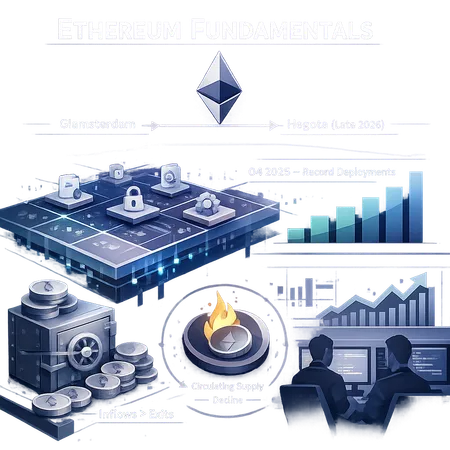
Ethereum’s 2026 narrative is increasingly grounded in protocol progress and on‑chain activity rather than pure price speculation. The roadmap milestones branded as Glamsterdam and the late‑2026 Hegota upgrade are more than marketing labels — they map to concrete changes that improve scaling, developer UX, and long‑term protocol optionality. At the same time, Q4 2025 posted record smart contract deployments and staking inflows have recently outpaced exits, a trio of signals that strengthen network fundamentals.
For intermediate and advanced crypto investors evaluating an ETH allocation, the question is not whether Ethereum will stay relevant — it already is — but whether the combination of upgrades, developer momentum, and supply dynamics materially improves the risk/reward compared with alternatives. Below I walk through what the upgrades mean, why developer activity matters for value, how staking flows reshape circulating supply, and a compact investment thesis plus practical risks to monitor. Bitlet.app’s product mix illustrates how retail demand can be structured around these fundamentals, but the real story here is protocol‑level optionality and composability.
What Glamsterdam and Hegota actually change
The Glamsterdam milestone and the later Hegota upgrade are successive roadmap stops that aim to make Ethereum more scalable and friendlier to users and developers. According to public announcements, Hegota — currently pitched toward late‑2026 — is a follow‑on that takes aim at execution and data‑availability efficiencies while smoothing UX frictions for accounts and wallets (Coinpedia announcement).
Concretely, these milestones are not a single big‑bang scaling magic trick. Expect incremental wins across three fronts: (1) better data availability and proto‑DA layers that lower L2 costs, (2) user experience improvements such as more robust account abstraction flows and wallet ergonomics, and (3) optimizations in the execution pipeline that reduce gas inefficiencies. Collectively, these changes lower the marginal cost of launching and using applications on Ethereum, which is the lever developers and users respond to. That matters because scaling on Ethereum today is primarily a layered story — base‑layer improvements that make rollups cheaper or simpler have outsized downstream effects.
Why record smart contract deployments in Q4 2025 matter
Token Terminal and industry tracking show that Q4 2025 hit an all‑time high in smart contract deployments on Ethereum (Cryptopolitan summary of Token Terminal data). High deployment velocity is not just noise: it signals developer confidence, experimentation, and the creation of composable primitives.
Why does that translate to long‑term value? First, more contracts mean more composability: a new DeFi primitive can be leveraged by other projects, creating a network effect that’s difficult to replicate on siloed chains. Second, sustained developer activity tends to increase on‑chain economic throughput (fees, stablecoin flows, collateralization), which supports revenue capture for validators and sequencers. Third, a deep developer ecosystem reduces migration risk — teams are less likely to abandon tooling and liquidity that already work. For investors this means fees and activity capture are likely to be stickier if deployments continue, and that improves the odds that ETH’s economic utility will expand rather than contract.
For context, many builders who still hedge between execution chains look at Ethereumbased infrastructure as the default place to build before branching; even traders watch Bitcoin for macro signals, but the developer moat is what ultimately locks in application‑level value on Ethereum.
Staking inflows now outpacing exits — implications for supply and price pressure
A recent shift in staking flows is an important microeconomic development: for the first time since June 2025, staking inflows have outpaced exits, signaling growing confidence in long‑term lockups and validator participation (Crypto.News coverage).
What this does for network fundamentals is straightforward but powerful. With more ETH entering stake than leaving: (1) the effective liquid supply available to sell is reduced, (2) expected future issuance pressure is mitigated because more ETH is locked, and (3) market psychology shifts as institutions and sophisticated holders demonstrate conviction. When combined with EIP‑1559 style burn dynamics — which continue to destroy base fees when network activity is high — the net issuance profile can move from inflationary toward disinflationary or even deflationary during high activity periods. That combination reduces structural sell pressure, which is a meaningful tailwind for ETH over multi‑quarter horizons.
A few caveats: staking is not perfectly illiquid — unlock windows, slashing risks, and liquid staking derivatives mean some ETH remains economically accessible. Yet larger, sustained staking inflows still alter the marginal supply curve in ways that matter to allocators sizing positions for 6–24 month horizons.
Putting the pieces together: network fundamentals and investment thesis
Pulling these threads together produces a clear, fundamentals‑driven investment thesis for ETH heading into 2026:
- Roadmap optionality: Glamsterdam/Hegota are designed to reduce L2 costs and improve UX, which amplifies rollup adoption and makes the base layer more future‑proof. Incremental protocol wins compound over time.
- Developer moat: Record smart contract deployments point to sustained developer engagement and composability, increasing the likelihood local economic activity (and fee capture) grows rather than fades.
- Supply dynamics improving: Net positive staking inflows tighten effective circulating supply and reduce near‑term sell pressure; combined with fee burns, this alters net issuance mechanics in ETH’s favor.
Collectively, these factors mean ETH’s risk/reward over 6–18 months is increasingly driven by protocol fundamentals (upgrades, developer activity, staking) rather than pure momentum chasing. For allocators, that suggests an approach that weights fundamental read‑throughs (roadmap timing, developer retention metrics, staking flow trends) more heavily than short‑term price momentum.
Practical sizing and time horizon
For investors with medium‑term horizons (6–24 months): consider an allocation sized to conviction in the upgrade timeline and developer signals. If Glamsterdam/Hegota progress visibly in protocol testnets and mainnet feature flagging, increasing exposure gradually as each milestone is validated reduces implementation risk. Diversifying execution across cash ETH and liquid staking derivatives can balance participation in staking benefits against the need for liquidity.
Key risks and what to watch
No thesis is complete without the downsides. The main risk vectors for an ETH fundamentals trade are:
- Technical delays or unmet expectations: Roadmap slips are common. If Glamsterdam or Hegota deliver fewer UX or scaling gains than priced in, the narrative can reverse quickly.
- Layer‑2 disintermediation: If L2s evolve into semi‑autonomous stacks that capture fees and liquidity off‑chain, some revenue capture might migrate away from the base layer.
- Regulatory and macro shocks: Stricter regulations on staking, exchanges or token services could disrupt staking inflows or institutional demand. Macro risk (rapid rate hikes, liquidity crunch) can also compress risk assets en masse.
- Ecosystem fragmentation: High deployment velocity is good only if liquidity follows. If smart contract deployments outpace the distribution of users and capital, many projects could remain unproductive.
Watch indicators: roadmap milestone dates and testnet progress, monthly smart contract deployment and active wallet metrics, net staking inflow figures, and fee/burn rates. These are the leading signals that will either validate or invalidate the thesis.
Bottom line
Ethereum’s 2026 positioning rests on a virtuous cycle: protocol upgrades that make L2s cheaper and UX better attract developers; developers produce composable apps that increase economic throughput; higher throughput supports fee burns and validator economics; and rising staking participation tightens liquid supply. The recent Q4 2025 surge in deployments and the turn in staking flows are tangible evidence that this cycle is alive.
That said, timelines matter. Execution risk on Glamsterdam/Hegota and macro/regulatory shocks are real and can change the trade quickly. For investors focused on fundamentals, the right approach is active monitoring of the roadmap, developer activity, and staking statistics, and to size positions with both conviction and humility.
Sources
- Ethereum accelerates its roadmap with Glamsterdam and Hegota upgrades — Coinpedia
- Ethereum smart contract deployments hit all‑time high in Q4 2025 — Cryptopolitan (Token Terminal data)
- Ethereum staking inflows outpace exits for first time since June 2025 — Crypto.News
- Ether reclaims $3,000 as bulls take control and ETH upgrade plans gather pace — Invezz