What 50 Billion SHIB Withdrawals Mean for Liquidity, Supply and a 2026 Comeback
Summary
The headline: 50 billion SHIB moved off exchanges — why it matters
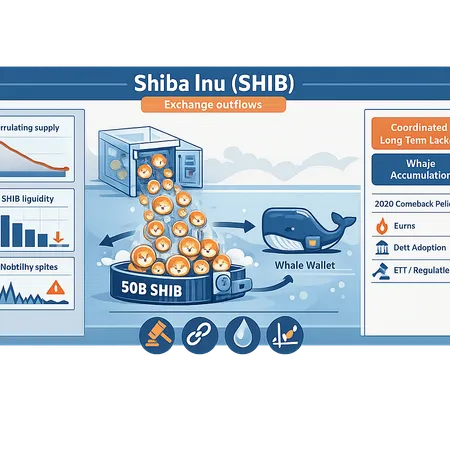
Coinpaper reported that roughly 50 billion SHIB were withdrawn from exchanges in a discrete set of transactions. On its face, the move is newsworthy because exchange outflows remove sell-side inventory and can tighten short-term liquidity, particularly for low-cost, high-supply tokens like Shiba Inu. The critical question for tokenomics-focused investors is how material that quantity is relative to circulating supply, traded volume and order-book depth — not just the raw token count.
Quantifying the change: circulating supply and the order-of-magnitude effect
Shiba Inu began with an extremely large supply base (hundreds of trillions of tokens after the Vitalik transfers and burns), so while 50 billion looks large in isolation, it is tiny as a share of total supply. Put another way: because SHIB's supply is measured in the hundreds of trillions, 50 billion is almost certainly well below 0.01% of the circulating supply — an order-of-magnitude statement that should guide expectations.
That small fractional change implies the move by itself is unlikely to materially change long-term inflation or the token's macro tokenomics. What matters more is where the tokens went and how they affect on-exchange sell-side inventory and immediate liquidity.
How exchange outflows affect SHIB liquidity and volatility
Exchange outflows affect markets through two linked channels:
- Immediate liquidity reduction on exchanges. Tokens removed from exchange wallets are unavailable for instant market sales, which can thin the sell-side book and widen bid-ask spreads. A thinner book amplifies price sensitivity to market orders.
- Signalling and behavioral effects. Large withdrawals can shift trader expectations: market participants may infer hodling, staking or burn plans and act preemptively, amplifying volatility.
Two practical metrics to watch:
- Exchange balance change as a percentage of the exchange float (not the total supply).
- The ratio of the withdrawal amount to 24h traded volume. If withdrawals are a meaningful slice of daily volume, they can reduce immediate sell pressure; if not, their impact is mostly psychological.
Illustrative price-impact example (simple math)
Because SHIB trades at very small per-token prices, convert tokens to USD to understand market reaction. Using conservative illustrative figures: if SHIB were $0.00001, then 50,000,000,000 SHIB ≈ $500,000. If the price were $0.00003, the same tokens ≈ $1.5M. Those are small sums for a liquid $100M+ market-cap altcoin, but they can be meaningful if they reduce tight on-exchange liquidity.
Market-impact intuition: a $500k withdrawal matters little for a market with $10M daily volume and a deep orderbook, but the same withdrawal could move price noticeably if the top levels of the book only show $200–$500k of sell liquidity.
A simple supply-shock model: conservative, moderate, aggressive
Below are three stylized scenarios showing how removing 50B SHIB from exchanges might influence price, assuming other factors constant. These are illustrative, not predictive.
Conservative (no meaningful shock): Withdrawn tokens are a tiny fraction of exchange float and 24h volume. Sell-side liquidity rebalances via other exchanges or OTC desks. Price effect: ±0–3% (noise range).
Moderate (noticeable squeeze): Withdrawal reduces visible sell orders in the top-of-book enough that routine sell orders consume remaining depth. If the withdrawal equals, say, 10–20% of visible top-level liquidity, short-term price could rise 5–15% before market makers refill depth.
Aggressive (dislocation / rally): Withdrawal is accompanied by coordinated buys or a burn announcement; visible float collapses and buy pressure is sustained. The same removed tokens could catalyze 20–50% moves for short periods, especially in a low-liquidity environment.
Key caveat: these ranges depend heavily on execution, market maker response, and whether other exchanges or OTC sellers step in. A token like SHIB with high nominal supply but concentrated sell-side listings can show outsized volatility even when absolute USD amounts are modest.
Are these withdrawals coordinated long-term locking or whale accumulation?
There are three plausible interpretations:
Long-term locking / staking or cold-storage HODLing. Buyers withdraw to wallets or staking contracts intending to hold, which reduces circulating exchange supply for long stretches. Coinpaper suggests the move could signal accumulation away from exchanges, which historically precedes quieter long-term demand narratives.
Whale accumulation with strategic timing. Large addresses may be moving tokens between custodial services and personal wallets for risk management (not necessarily buying), or consolidating positions ahead of an expected catalyst.
Intra-exchange or operational transfers. Some withdrawals are simply custody reorganizations, not genuine liquidity changes.
Distinguishing between these requires tracking on-chain behavior over time: are the tokens moved to many wallets and never reused? Are they sent to burn addresses or staking contracts? Or do they reappear on exchanges after days or weeks? The debate about SHIB’s outlook into 2026 is mixed (see discussion in Coinpaper's analysis and the neutral view at CryptoTicker).
Coinpaper's report on the 50B move argues the action could matter if it reflects sustained off-exchange accumulation rather than short-term re-custody. As a portfolio manager, assume neither intent nor permanency until you see persistent declines in exchange balances.
What would make SHIB a plausible comeback candidate in 2026?
SHIB’s path back to a strong performance is not a single trigger but a confluence of catalysts. Important conditions include:
- Sustained burns or supply-reducing mechanisms. Meaningful burns that reduce base supply materially over months could change tokenomics from nominal to scarce.
- Utility expansion and DeFi integration. If SHIB finds real use cases on DeFi rails (lending, staking, revenues) or is adopted in on-chain payment flows, the narrative can shift from memecoin to utility-led token.
- Macro and sector tailwinds. A renewed appetite for risk assets led by Bitcoin upside or a liquidity-driven altcoin season would help memecoins rebound.
- Concentrated accumulation unlocking a supply shock. If large holders lock tokens for long periods (staking/vesting) and do not sell, on-exchange float could shrink enough to amplify price moves during demand spikes.
- Clear roadmap and developer activity. Sustained development and partnerships increase the likelihood that market interest is durable.
Absent several of these factors, a headline withdrawal alone is unlikely to flip SHIB’s long-term risk/reward.
Risks to the thesis: regulation, supply concentration and tokenomics limits
- Regulatory risk. Increased scrutiny of memecoins or specific enforcement actions against marketing practices could reduce retail demand.
- Concentration and whale behavior. If large addresses control a material share of liquid tokens, sudden dumps remain a persistent tail risk.
- Tokenomics friction. SHIB’s enormous nominal supply creates rounding, UX and psychological hurdles; unless supply burns are meaningful and ongoing, simple scarcity narratives are hard to sustain.
- Market-making and exchange behavior. Exchanges can refill liquidity or route sellers elsewhere; coordinated withdrawals that look structural can be transient if other venues absorb supply.
Practical checklist for tokenomics-focused investors and PMs
- Track exchange balances daily. A persistent decline in exchange-held tokens over weeks (not just a single-day transfer) is more meaningful. Coinpaper’s story is a trigger to start that watch.
- Monitor the withdrawal destination: cold wallet, burn address, staking contract, or custodial wallet? Each implies different intent.
- Compare withdrawn amounts to 24h volume and the visible top-of-book liquidity. Use USD equivalents to get intuitive sense of market impact (e.g., at $0.00001 per SHIB, 50B ≈ $500k).
- Watch for announcements or coordinated token locks that confirm long-term intent.
- Stress-test your position sizing for memecoin-style liquidity shocks. Even modest USD moves can turn into large percentage price moves in shallow books.
For managers who want to implement trade signals, a reasonable trigger could be: a >0.1% persistent decline in exchange float over 7–14 days, coupled with rising on-chain accumulation metrics and improving developer activity.
Final assessment
The 50 billion SHIB withdrawal is a useful datapoint but not, by itself, a supply-driven bull signal. Given SHIB’s massive base supply, the removal is small in percentage terms and will only matter if it reflects sustained off-exchange accumulation, ongoing burns, or coincides with genuine demand growth. If the market sees this as the start of a longer-term lockup strategy, it could amplify upside in a future altcoin cycle — but absent confirming on-chain behavior and utility expansion, the move is more of a watch signal than a trade-by-itself.
For portfolio managers, the right response is to convert the headline into a monitoring rule: track exchange balances, flow destinations, orderbook depth and cross-reference with macro cycle indicators. In other words, treat the withdrawal as a potential catalyst that requires corroborating evidence before adjusting risk budgets.
Bitlet.app users and institutional traders should combine on-chain flow analysis with orderbook checks and be wary of narrative-driven FOMO.