Year‑End Squeeze: How the $28B Bitcoin Options Expiry Mutes Volatility—and What Traders Should Do
Summary
The squeeze defined: suppressed volatility vs. bullish macro positioning
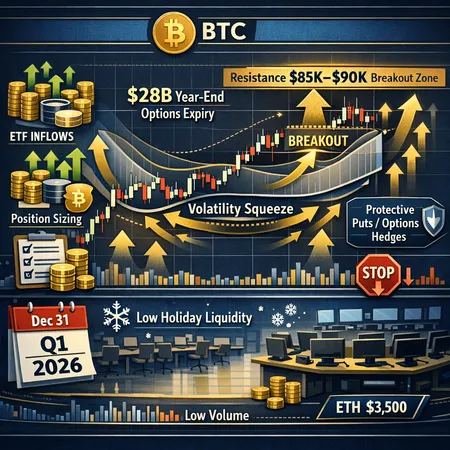
At year‑end the market often looks paradoxical: macro narratives are constructive while realized volatility sits low. That paradox is the current dynamic for BTC. The immediate catalyst is a roughly $28 billion options expiry concentrated at year‑end that, by structure, can temporarily mute price action as dealers manage and then release hedges. For many traders the obvious benchmark is the $85k–$90k range—where both delta exposure and retail/institutional attention cluster—and where short‑term pinning becomes more likely as expiry approaches. For context on this specific expiry and the calendar signals, see reporting on the record options expiry and muted pre‑news price action linked below.
The mechanics are straightforward if you follow dealer gamma and delta hedging: options sellers (market makers) offset directional exposure by buying or selling spot as volatility and deltas move. As the expiry nears, gamma exposure compresses and dealers reduce dynamic hedging, lowering incremental buying/selling pressure. That reduces realized volatility even when implied volatility stays elevated. CoinDesk recently explained how year‑end expiries can alter the available volatility, particularly when a large notional is concentrated in a narrow strike band: year‑end options expiry and volatility effects.
Why a big expiry can look like a ‘quiet’ market
Large expiries produce two complementary effects that compress action into muted ranges:
- Hedge flattening. Market makers reduce dynamic delta hedging heading into expiry, trimming the spot flows that amplify moves. With less friction from dealers, the spot market can sit still—even if order flow is biased.
- Pinning pressure. When OI concentrates at certain strikes dealers prefer to pin price near those strikes to minimize residual exposures. The result can be a persistent test of the $85k–$90k band rather than a clean breakout.
Crypto.news summarized how the market had been muted ahead of U.S. macro prints and a record options expiry, framing the liquidity backdrop that often causes the quiet: muted price action ahead of options expiry and US data.
ETF flows, liquidity thinness, and why outflows matter now
Options gamma is only part of the picture. ETF flows and trading liquidity are the other engine. Recent reporting shows US spot BTC/ETH ETFs experiencing net outflows around the holiday window. Those outflows subtract structural bid in a market already starved of depth, and they make breakouts more fragile. The Block documented these ETF outflows around Christmas and the immediate post‑expiry window—an important reminder that ETF tickets can be a persistent drain or a sudden source depending on investor behavior: spot BTC/ETH ETF outflows over Christmas.
Combine thin holiday books with concentrated options strikes and you get a higher probability of an outsized move when liquidity returns. Cointelegraph’s analysis highlights that on‑chain and liquidity signals show BTC struggling below $90k until liquidity thins or on‑chain selling eases, underscoring why the $85k–$90k band is a contested level rather than a given breakout: on‑chain and liquidity signals for BTC.
How expiry can temporarily mute volatility but seed later volatility
There’s a timing pattern traders should internalize: the expiry itself often reduces realized volatility, but it does so by concentrating risk in residual stockpiles of orders that will reorganize afterward. Two practical effects:
- During the expiry window: low realized volatility, tight ranges, and pinning near large strikes as hedges are neutralized.
- Post‑expiry, especially as markets reopen after holidays: re‑acceleration in volatility if ETF flows reverse, funding/friction re‑enter, or macro prints surprise.
The near‑term quiet is therefore not safe—it’s latent risk. That’s especially true for large players who balance sheet hedge via options and ETFs. For a snapshot of the muted pre‑expiry market mood and liquidity context, see the linkage above on the record expiry and pre‑data calm from crypto.news.
Likely price paths into Q1 2026 (three scenarios)
Below are plausible, actionable scenario paths with triggers and probabilities (not investment advice). I note macro positioning is still bullish, but liquidity metrics and ETF flows create a nontrivial chance of corrective moves.
- Consolidation then breakout (base case — ~45% probability)
- Price pins in the $85k–$90k band through expiry; dealers reduce gamma. ETF outflows stabilize or turn neutral in early Jan, and macro prints (jobs, CPI) are benign. Liquidity returns, and a breakout above $90k follows a volume pickup and higher open interest.
- Trade implication: small directional exposure added post‑expiry with confirmed volume and rising realized volatility.
- Holiday lull then abrupt repricing (higher‑volatility unwind — ~30% probability)
- The expiry mutes action, ETF outflows persist or accelerate, and a thin market allows a slippage move lower (a quick 10–20% move) as forced sellers hit the thin book. Re‑pricing occurs when liquidity returns and stop clusters cascade.
- Trade implication: maintain strict size caps, prefer optionality (put spreads, collars) to protect downside.
- Rapid run‑up after expiry (gamma squeeze + flows flip — ~25% probability)
- Post‑expiry dealers need to re‑establish hedges into fresh demand; ETF inflows resume with macro tailwinds and funding gets tighter. The absence of dealer hedging during expiry results in pent‑up demand that triggers a swift move above $90k.
- Trade implication: momentum trades work but require tight risk controls—trade size limits and trailing stops.
Practical trade and portfolio adjustments (actionable guidance)
Below are concrete adjustments intermediate traders and portfolio managers can implement to navigate the expiry/holiday squeeze.
Position sizing and execution
- Cap headline exposure: Limit any single directional BTC trade to a fixed % of portfolio (commonly 1–3% for active trades, 5–10% for core positions). During thin holidays, skew toward the low end.
- Time‑slice large orders: Break large buys/sells into TWAP or POV slices, and avoid placing market orders across thin OTC windows where spreads widen.
- Use limit liquidity ladders: Deploy staggered limit orders around key levels (e.g., 84k, 86k, 88k, 91k) to avoid chasing a flash move.
Options and hedging
- Collars for conservative protection: If you hold long BTC spot, buy a protective put and sell a covered call (collar). This reduces cost vs. outright puts and limits upside forgone. Structure strikes away from the $85k–$90k band to avoid being exercised into expiry friction.
- Calendar spreads to harvest time‑decay: Sell near‑term volatility (strikes near current spot) and buy longer‑dated protection. This profits from expiry‑related IV contraction but preserves longer downside hedges.
- Avoid illiquid expiries: Post‑expiry liquidity is often better priced; don't add large complex option greeks into expiry dates with thin markets.
Stop placement and risk controls
- Wider but smarter stops: Place stops outside obvious clusters of options strikes and expected pin bands. For example, if the $85k–$90k band is filled with OI, place protective stops beyond 10–12% from your entry to avoid chop. Use time‑based liquidation rules (if a stop is triggered in a thin market, reassess before re‑entering).
- Use modal exits: Stagger exits (25/50/25) rather than an all‑in stop to avoid one‑way liquidation into a liquidity vacuum.
Hedging Rationale and Execution Examples
- If you hold 1 BTC spot at $88k and want downside protection through Q1: buy a 3‑month 0.75 BTC put at strike $72k and sell a 1‑month 0.25 BTC call at $98k to offset part of the cost. That collar reduces P&L volatility while keeping upside optionality.
- For short‑term directional plays (2–4 weeks): consider buying a small call spread (bull call spread) rather than an outright long call—this limits premium cost and avoids large gamma exposure into expiry.
Monitoring checklist (live trade adjustments)
- Watch option gamma maps and large open interest clusters around strikes in the $85k–$90k band.
- Track ETF net flows daily—The Block’s reporting on holiday outflows is a good reminder of how ETF tickets can change structural liquidity quickly.
- Monitor funding rates, on‑chain exchange inflows, and US macro prints (jobs data) that can catalyze post‑expiry moves.
Tactical calendar and timing considerations
- Avoid adding fresh, large net directional overnight exposure during the US holiday window and into the first trading day post‑expiry. Historically, most re‑pricings and volatility returns occur when desks reopen and dealers re‑establish risk hedges.
- If you plan to add asymmetric optionality (long puts or calls), stagger expiries across months to avoid concentrated gamma in a single expiry.
Final checklist for risk‑aware positioning
- Treat the $28B expiry as a liquidity event more than a directional signal.
- Prioritize option structures or size limits over outright leveraged directional bets into expiry.
- Use post‑expiry volume confirmation before adding momentum trades toward or above $90k.
- Keep an eye on ETF flows—persistent outflows materially lower the chance of a clean breakout.
Contextual note: platforms like Bitlet.app that offer installment and P2P services can be helpful for managing exposure across time slices rather than carrying concentrated spot risk into holiday windows.
Sources
- CoinDesk — Bitcoin nears breakout from the USD85,000–USD90,000 range as options expiry looms: https://www.coindesk.com/markets/2025/12/24/bitcoin-nears-breakout-from-the-usd85-000-usd90-000-range-as-options-expiry-looms
- Crypto.news — Crypto prices muted ahead of US jobless data and $28B options expiry: https://crypto.news/crypto-prices-today-dec-24-btc-eth-bnb-trx-remain-muted-ahead-of-us-jobless-data-and-28b-options-expiry/
- The Block — Spot Bitcoin/Ether ETFs outflows over Christmas: https://www.theblock.co/post/383717/spot-bitcoin-ether-etfs-outflows-christmas
- Cointelegraph — Bitcoin stuck below $90k until these market conditions improve: https://cointelegraph.com/news/bitcoin-stuck-below-90k-until-these-market-conditions-improve?utm_source=rss_feed&utm_medium=rss&utm_campaign=rss_partner_inbound
For traders focused on BTC/ETH positioning, monitor the expiry structure and post‑holiday liquidity carefully—the quiet today can become volatility tomorrow. For further reading on derivatives flows and execution tactics, check deeper options analytics and gamma maps, and consult your execution desk or services like Bitlet.app for staggered exposure management.