Uniswap's UNIfication Vote Explained: The $100M UNI Burn and Tokenomics Shift
Summary
Why UNIfication matters right now
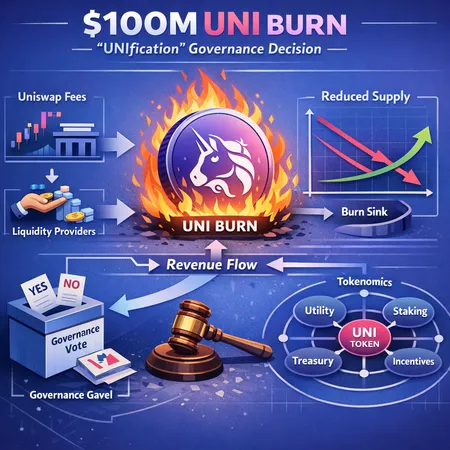
Uniswap’s UNIfication governance package is one of the clearest examples in DeFi of a protocol converting operational revenue into token deflation. At its core the proposal approves a one-time 100 million UNI burn and introduces a mechanism to tie future protocol revenue to ongoing UNI burns — a hybrid of buyback-and-burn logic and on-chain fee monetization. News outlets tracking the vote explained the proposal’s path through governance and community backing; the mechanics and the market response matter for anyone holding UNI or watching DEX competition.
For context, this isn’t a tiny tweak. Burning 100 million UNI equals roughly 10% of the protocol’s 1 billion maximum supply, a headline-sized reduction that changes the arithmetic for token holders and governance participants.
What UNIfication changes in Uniswap tokenomics
UNIfication has two linked effects on tokenomics:
- A one-off deflationary event: the 100M UNI removed from the supply. That cut is immediate and measurable.
- A recurring revenue-linked burn: a share of protocol revenue (fees) will be routed to burn UNI over time, so future fee growth translates into sustained supply pressure rather than just treasury accrual.
The recurring mechanism is the structural change. Instead of protocol revenue accumulating as a passive treasury balance or being redirected into grants, the proposal effectively monetizes fee flow into supply reduction. Multiple reports describe the community-backed decision and the new revenue-burning arrangement — see coverage from invezz and crypto.news.
Governance mechanics and why the vote passed quorum
Uniswap governance requires a quorum and then a majority to pass major changes. UNIfication cleared those thresholds, a result of several practical dynamics:
- Broad community alignment: Many UNI holders prefer deflationary mechanics after years of inflationary emissions and perceived dilution. The optics of a large, explicit burn were persuasive.
- Active campaigning and signaling: Core contributors and large delegates coordinated outreach to reach quorum and shape voter turnout. Media frames and on-chain posts pushed the narrative that burning reduces dilution risk.
- Practical compromise: The package bundled immediate and long-term reforms, attracting both voters who wanted a symbolic burn and those focused on structural revenue capture.
Market roundups that week placed the Uniswap vote in a broader macro context, alongside economic updates and other crypto events, which helped concentrate attention and participation Coindesk coverage summarized the week.
How the revenue-based burning mechanism will work (practical steps)
The proposal ties a stream of protocol receipts to UNI burning. Operationally this can happen in a few ways — and governance typically specifies the exact flow — but the practical models are:
- On-chain conversion model: Fees collected in various tokens are periodically swapped for UNI on open markets (or routed through an automated swap path) and the acquired UNI is burned.
- Direct treasury burn model: If the treasury already holds UNI or assets convertible to UNI, governance can authorize scheduled burns from that balance.
- Hybrid cadence: A fixed percentage of fee revenue is reserved for buybacks and burns at pre-agreed intervals (weekly/monthly), ensuring predictable deflation while keeping enough revenue for maintenance and grants.
The distinguishing feature is that protocol activity — more swaps, higher fees — mechanically increases the rate of burns. That aligns incentives: growth in fees benefits long-term UNI holders through supply reduction, not just treasury accumulation. Crypto reporting on UNIfication highlights this new revenue-link as the key innovation see crypto.news coverage.
Supply shock scenarios: immediate and ongoing
There are two timelines to consider.
Short-term (one-time): The 100M burn immediately lowers total supply. Expect a quick repricing as markets re-input the new supply figure; in practice that often translates to a price uplift driven by reduced sell-side depth and speculative buying.
Medium-term (revenue burns): If Uniswap fee revenue grows (higher volume, new products, or fee-tier changes), the recurring burns compound the deflationary effect. Conversely, if fees stagnate, the long-term burn rate will be modest.
Three scenario buckets help make this concrete:
- High-fee growth — strong compounding deflation, steady UNI appreciation if demand holds or grows.
- Moderate-fee growth — periodic bumps to price and slowly declining supply; market rebalances around a new baseline.
- Low-fee growth — the one-time 100M burn is the main driver; long-term inflationary pressures from other sources (if any) could reassert themselves.
How dramatic the supply shock is depends on where the 100M came from (treasury vs circulating wallets), and how aggressive the future burn schedule is. The market’s reaction will internalize both the headline burn and the expected revenue trajectory.
On-chain fee flow monetization: mechanics, risks, and benefits
Turning fee flow into buybacks/burns is an attractive model because it directly links protocol utility to token scarcity. Benefits include:
- Alignment: More usage -> more burns -> potentially higher token value; this creates a circular incentive for token holders to support product adoption.
- Predictability: A codified burn schedule can reduce uncertainty about future dilution.
But there are trade-offs and technical risks:
- Swap slippage and MEV: Converting diverse fee tokens into UNI on-chain can produce slippage or MEV extraction if not carefully batched and protected.
- Treasury trade-offs: Routing too much revenue into burns reduces available funds for development or safety nets.
- Governance fragility: Future governance could reallocate burn flow; the mechanism only persists if the community maintains support.
Overall, monetizing on-chain fee flow can be a powerful lever — provided the burn process is implemented with smart routing, auction-resistant swaps, and clear governance thresholds.
Comparisons to other notable token burns
It helps to benchmark UNIfication against familiar systems:
- EIP-1559 (Ethereum): Base-fee burns are native and automatic; they can be large when network demand spikes. Uniswap’s burn is analogous in intent (using protocol activity to destroy supply) but must contend with multi-token fee receipts and swap execution.
- Exchange buyback burns (e.g., Binance): These are often off-chain or off-protocol, funded by business profits and scheduled quarterly. Uniswap’s design is more on-chain and directly proportional to protocol usage.
- Other DeFi projects: Some DEXes have experimented with partial fee-sharing to token holders or automatic burns tied to protocol revenue. UNIfication is notable because it combines a large one-off symbolic burn with a recurring, governance-backed revenue-burn design.
Each model differs in transparency, durability, and alignment. The main advantage for Uniswap is on-chain enforceability of the link between fees and burns if implemented cleanly.
Market implications: UNI holders, DEX competitors, and LPs
Short-term market impacts
- Price action: Announcements and the executed one-time burn typically cause a short-term price spike as traders front-run reduced supply and recalibrate positions.
- Volatility: Expect increased volatility around governance milestones and the initial burn execution.
Medium-term dynamics
- Sustained scarcity: If fee growth is sustained, recurring burns compound scarcity and may produce persistent positive price pressure for UNI.
- Competitive responses: Rival DEXes may counter with fee incentives, liquidity mining, or their own tokenomic tweaks to retain or regain market share. Uniswap’s brand and market share give it a head start, but nothing is guaranteed.
Effects on liquidity providers (LPs)
- Direct vs indirect benefits: LPs don’t automatically receive UNI burns unless they hold UNI. If the protocol diverts revenue from LP rewards to burns, that could reduce yields for LPs — a potential tension.
- Liquidity churn risk: If LP returns decline relative to alternatives, some liquidity might re-allocate to yield-hunting venues, increasing slippage for traders.
- Offset dynamics: However, higher UNI valuations could incentivize LPs who are also UNI holders; shifts in TVL will depend on the net of these forces.
UNI as a governance asset
- Voting power changes: Reducing supply can concentrate voting power — particularly if the burned tokens came from a passive treasury rather than an evenly-distributed circulating base. That could increase the influence of large holders unless parallel measures (like vote-locking incentives) are considered.
- Stakes and coordination: A deflationary UNI can make governance more valuable, incentivizing active delegation, campaigning, and potential vote-buying dynamics. Governance design needs to anticipate these behaviors.
Practical takeaways for investors and governance watchers
- The 100M UNI burn is a meaningful, immediate change; treat it as a structural shift rather than a symbolic PR move.
- The long-term price impact depends on fee growth. An operationally robust revenue-burn pipeline is the more important lever than the one-time burn alone.
- Watch for implementation details: swap routing, cadence of burns, and whether liquidity provider economics are altered to subsidize the new mechanism.
- Governance follow-ups matter. The initial vote passed quorum, but future votes could expand, limit, or re-route the burning flow. Active participation or delegation strategy will determine outcomes.
For DeFi observers, UNIfication is an important case study in turning protocol utility into token economics. Platforms that track DEX flows — including analytics providers and front-end traders on services like Bitlet.app — will be watching fee-to-burn conversion metrics closely.
Conclusion
UNIfication pairs a headline one-off 100M UNI burn with a structural experiment: converting protocol revenue into recurring token burns. That combination makes UNI both a symbolic and economic bet on Uniswap’s ability to sustain fee growth. Short-term market reactions are likely to favor UNI holders; medium-term outcomes depend on fee trajectories, execution risk, and competitive responses. For governance watchers and token investors, the vote illustrates how DeFi protocols can monetize usage directly into token scarcity — a pattern that other projects will either copy or counter.
Sources
- Invezz — UNIfication proposal and governance path
- Crypto.news — Community backs 100M UNI burn and revenue-linked mechanism
- CoinDesk — Uniswap vote in markets week roundup
For readers who want to follow on-chain flow metrics and protocol fee conversions over the coming weeks, keep an eye on official governance threads and analytics dashboards. And for market participants, remember: implementation matters as much as intent.
Also see platform context on Uniswap and broader protocol trends in DeFi.