Stablecoin Safety Playbook: Prevent Address Poisoning After a $50M USDT Loss
Summary
Why this matters now: the near-$50M USDT incident
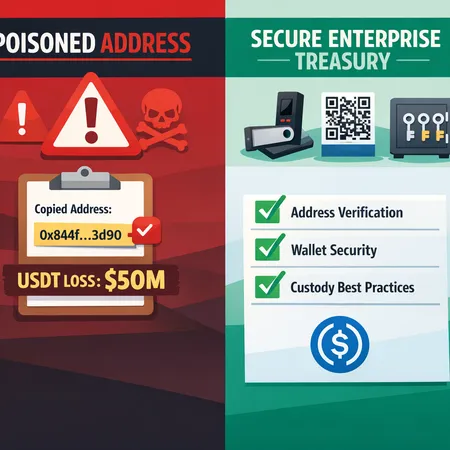
A recent report detailed a nearly $50 million USDT loss traced to a poisoned copy-paste address — a blunt reminder that even basic UX flows can become attack vectors when clipboard tampering and poor verification meet user haste. Read the coverage of the attack here: Cointelegraph report.
For retail users and treasury teams, the takeaway is simple: fund movement is still the weakest link. Whether you're transferring USDT to a DEX counterparty or moving USDC between custody providers, a single pasted address can wipe out balances if you don't have verification controls in place.
How address poisoning works — the mechanics in plain language
Address poisoning (often seen alongside copy-paste scams) is an attack that substitutes a victim's intended crypto address with an attacker-controlled address at the moment of paste. Common methods:
- Clipboard malware: software that monitors the clipboard and replaces specific-looking addresses when copied. It triggers on patterns (hex strings, familiar prefixes) and swaps them with attacker addresses.
- Browser extensions and overlays: malicious or compromised extensions can intercept clipboard or DOM events and change displayed addresses before you click.
- Phishing pages with dynamic elements: pages that generate a fresh deposit address but load a malicious replacement right before the paste.
Why it succeeds: human factors. People copy long addresses, paste quickly, and rely on visually scanning the prefix/suffix — or worse, only check a few characters.
Common UX/UI and wallet pitfalls that enable address poisoning
1) Overreliance on copy-paste
Many wallets and web pages promote copy-paste because it's easy. But copy-paste hides the risk that something changed the clipboard between copy and paste.
2) Insufficient on-device verification
Desktop wallets and browser-based flows often show addresses on the computer screen only. If malware modifies the address before the transaction is broadcast, you're blind.
3) Truncated address displays and weak checksums
UI that shows only the first/last few characters (e.g., 0x12…F3) encourages shallow visual checks. Some chains have weak human-readable checksums, and users assume the wallet will flag problems.
4) Mixed-chain and token confusion
Sending USDT across different networks (Ethereum, Tron, BSC) to an incompatible address can cause losses. UX that doesn't force the chain selection or explicit token confirmation increases risk.
5) QR and deep-link shortcuts without verification
QR codes and deep links are convenient but can embed malicious payloads, wrong-chain addresses, or amounts. Mobile wallets that auto-confirm deep links without showing the on-device address invite mistakes.
Concrete protections — step-by-step checks for retail users
Below are practical, repeatable steps you should adopt today. These are deliberately low-friction for regular users but raise the bar against common attacks.
Always verify on-device for hardware wallets. When sending funds from a desktop wallet that uses a hardware signer (Ledger, Trezor, etc.), check that the address and amount are shown on the hardware device screen. The device is the final arbiter.
Use address whitelists and saved contacts. If you send often to a set of addresses (exchanges, counterparties), put them in your wallet’s secure address book and avoid copying/pasting for routine transfers.
Check the full address checksum before sending. Don’t rely on a visual prefix/suffix check; paste the address into a trusted checksum tool or verify the entire string against the expected address.
Prefer QR scanning when you can verify the on-device string. Scanning a QR is less error-prone than copying a long hex string — but only if your wallet shows the resolved address and you confirm it on screen before signing.
Avoid copy-paste from untrusted pages or social media. Attackers commonly post fake “deposit” addresses in tweets, Discord, or Telegram. Get addresses directly from the recipient via established channels.
Use separate, hardened machines for treasury operations. For treasury teams: use dedicated endpoints (air-gapped cold signing, hardened VMs) to keep clipboards and browser extensions off the critical path.
Scan your clipboard for suspicious changes. Several open-source clipboard monitoring tools can detect when a copy action is followed by a substitution; use them on machines used for transfers.
Double-check chain and token. Confirm the network (Ethereum, Tron, BSC, etc.) and that the address format matches the token standard (ERC‑20 vs TRC‑20). Mistyped chain choices are an easy path to loss.
Hardware wallets, multisig and MPC — institutional-grade controls for treasury teams
Retail protections help, but treasury teams need layered controls:
- Multisig on-chain: Require multiple approvals for outgoing transfers. Tools like Gnosis Safe reduce single-key risk and provide an audit trail.
- MPC (multi-party computation): Offers threshold signing with performance similar to single-key signing but without a single secret. Good for programmatic operations.
- Cold-signing workflows: Keep private keys offline and only sign pre-validated transactions. Even better: pair cold-signing with human review and reconciliation.
- Smart contract limits and timelocks: Enforce daily/weekly limits and delay high-value transfers with timelocks that enable intervention.
These custody best practices are no longer optional for institutional treasuries. If you’re running a sizable stablecoin treasury, put multisig/MPC and cold signing at the center of your playbook.
QR vs copy-paste: pros, cons, and recommended flows
QR pros: fast, avoids clipboard, less chance of subtle character substitution.
QR cons: QR images can be replaced on a webpage or on-screen; a malicious app can serve a fake QR; scanning an image off a compromised device replicates the same risk as copy-paste.
Copy-paste pros: flexible for desktop-to-desktop transfers, convenient with long addresses.
Copy-paste cons: clipboard tampering, people tend to check only ends of the string.
Recommended flow:
- If using mobile-to-mobile, scan QR and confirm the address on your mobile wallet screen before approving. Don’t auto-approve deep links.
- If using desktop, copy the address but verify the entire string with a checksum or on a separate trusted device, or better: use hardware wallet verification.
- For repeated counterparties, use whitelists or ENS-style human-readable names (but be aware of typosquatting — see below).
Address naming, ENS and domain-based addresses — helpful but not foolproof
Human-readable names (ENS, Unstoppable Domains) reduce paste errors but introduce typosquatting risk. An attacker can register a visually similar name (think mytreasury.eth vs mytreasury.eth) or use homoglyphs.
Best practice: map any human-readable name to a verified on-chain address in your wallet and treat changes to the underlying address as a high-risk event that requires out-of-band confirmation.
Custody trade-offs: USDT vs USDC and why enterprise stablecoins matter
Stablecoins like USDT and USDC are both staples of treasury operations, but their ecosystems and institutional positioning differ. Circle is actively pushing USDC deeper into enterprise rails — embedding it into payments and settlement workflows rather than just trading liquidity. Read more about Circle’s strategy here: Circle drives USDC expansion.
Implications:
- Retail users still largely interact with stablecoins through exchanges, wallets, and P2P platforms. For them, on-device verification and hardware-wallet hygiene are the most effective controls.
- Institutional users and treasuries care about integration with bank rails, settlement guarantees, and custodial assurances. Enterprise-grade USDC integrations can reduce settlement friction, but they also push institutions toward custodial arrangements and tighter KYC/AML processes.
Trade-offs to consider:
- Custodial models (third-party custody) can reduce operational risk but introduce third-party counterparty risk and regulatory dependencies.
- Self-custody with multisig/MPC gives control but requires operational maturity; the right toolchain and checks must be in place to avoid simple mistakes like address poisoning.
Practical checklist: what to implement this week (Retail + Treasury)
Retail users:
- Use a hardware wallet for non-trivial amounts and confirm the address on-device.
- Keep an address book for frequent recipients; never copy deposit addresses from social channels.
- Enable wallet features that detect suspect clipboard changes or require extra confirmations.
- Prefer QR when both parties can verify the displayed address.
Treasury teams:
- Adopt multisig or MPC for outgoing transfers; avoid single-key custody.
- Enforce address whitelists, two-person signoffs, and out-of-band verification for new payees.
- Use dedicated machines (hardened VMs or air-gapped signing) and restrict clipboard/extension usage on critical endpoints.
- Implement daily limits, timelocks on large transfers, and real-time reconciliation after every settlement.
- Log and monitor every on-chain transfer; run alerts that compare counterparties against expected address lists.
Recoverability and insurance — manage expectations
If funds are sent to an attacker address, recovery is usually impossible on public blockchains without cooperation from the attacker or the receiving exchange. That’s why prevention is the primary tool. For institutional users, consider:
- Custody providers that offer insurance and defined recovery processes.
- Contracts with counterparties (e.g., exchanges) that include timely freeze/recovery clauses when funds reach centralized points.
Bringing it together: cultural and technical hygiene
Security isn't a single control — it's a culture. Train teams to treat any change in a payment address as a security incident: verify, confirm, escalate. Combine that mindset with technical protections (hardware wallets, multisig, whitelists) and you dramatically reduce the risk of address poisoning and copy-paste scams.
If you use services like Bitlet.app or other P2P platforms to move stablecoins, incorporate these checks into your routine and request providers support on-device verification and whitelisting.
Sources
- Cointelegraph — report on the nearly $50M USDT loss from an address poisoning/copy-paste mistake: https://cointelegraph.com/news/address-poisoning-copy-paste-mistake-50m-usdt-loss?utm_source=rss_feed&utm_medium=rss&utm_campaign=rss_partner_inbound
- Bitcoin.com — coverage of Circle’s push to embed USDC into enterprise rails: https://news.bitcoin.com/circle-drives-usdc-expansion-as-enterprise-platforms-shift-from-trading-to-real-world-usage/
For deeper reading, consider wallet security docs from hardware wallet vendors and custody best-practice guides from multisig providers. For context on chain-specific address rules and checksums, consult the token standards for USDT (ERC‑20/TRC‑20/etc.) and USDC (ERC‑20) and keep your wallet software up to date.
Stay cautious, verify on the device, and codify these steps into your treasury SOPs — prevention is the only reliable recovery.