Why Bitcoin’s Christmas Week Could Be a Volatility Inflection: Gamma, Expiries, ETFs, and the BOJ Shock
Summary
Executive snapshot — why Christmas week matters for BTC
The next 7–14 days look structurally different than an average week. A concentrated calendar of options expiries and gamma roll-offs — much of it centered on Deribit — sits on top of a stop-start ETF flow backdrop and a fresh macro shock from the Bank of Japan. In combination these elements can create a volatility inflection: a period where small triggers produce outsized directional moves and liquidation cascades.
For many traders the operative question is simple: how likely is a gamma-induced squeeze or a liquidity vacuum, and what hedges make economic sense? Below I unpack the mechanics, point to the concentration risks, and translate them into tactical ideas for spot, futures, and options participants.
Options gamma 101 (and why roll-offs matter)
At a high level, gamma measures how quickly an option’s delta changes as the underlying moves. Market-makers who sell options are short gamma: they hedge dynamically by buying spot or futures when price rises and selling when it falls. That hedging flow is stabilizing when sustained, but around expiries and big roll-offs the hedging slopes change materially.
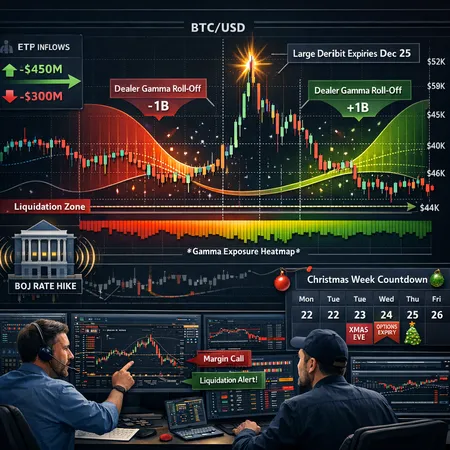
When a large chunk of short-dated options expires, dealers either unwind hedges or re-establish them at new strikes and maturities. That transition period is where the market can become endogenously unstable: dealer hedges flip direction, liquidity thins, and price moves get amplified. NewsBTC recently highlighted the possibility of a concentrated ~$415 million gamma-related flush over an eight-day window — an illustration of how quickly these dynamics can become self-reinforcing (see the analysis here).
Deribit expiries and concentrated notional: the amplifier
Deribit remains the dominant venue for BTC and ETH options. The size and timing of its expiries matter because the platform concentrates notional at specific timestamps. Recent reporting suggests a particularly large Deribit expiry cluster that market participants should not ignore — some coverage pegged the notional impact at roughly $3.18 billion of expiries that could add to BTC/ETH turbulence around the expiry date.
Large single-day or single-week expiries compress order flow into narrow windows. That means:
- Dealer gamma exposure is concentrated, so their delta rebalancing becomes a large, predictable flow.
- Stop levels and liquidation bands around key strikes become focal points, increasing liquidation risk in perpetual futures.
- If macro liquidity is light (holiday season effects), even modest rebalancing can cause outsized slippage.
These are not hypothetical: the market has historically seen outsized moves around concentrated expiries, and the combination of gamma roll-off plus sizeable Deribit expiries raises the probability of directional amplification in a short window.
ETF flows: a transient stabilizer, sometimes a fragility
ETF flows interact with derivatives gamma in non-linear ways. On one hand, steady ETF inflows can add a sticky bid to spot, reducing the effectiveness of dealer hedging to push price sharply lower. On the other hand, abrupt switches from inflows to outflows or concentrated buying/selling can remove that stabilizing liquidity.
Recent coverage shows ETF flows snapping back into inflows for Bitcoin (a notable $457 million inflow snapshot), even while Ether experienced outflows — a reminder that flows can be asset-specific and time-limited. This reintroduction of buy-side liquidity may blunt downside moves, but it can also fuel rallies that squeeze short liquidity if dealer hedges need to quickly buy futures and spot to remain delta-neutral (source: Bitcoin.com coverage).
The key takeaway: ETF flows are an important liquidity overlay but they are not a constant. Active traders should treat them as a conditional factor — helpful in one scenario, absent in another.
Macro shock: BOJ rate hike as a catalyst, not the cause
The Bank of Japan’s move to raise rates — the first substantive policy shift in decades — weakened the yen and triggered ripples across global liquidity markets. Crypto is not immune. Macro shocks change risk premia, leverage tolerance, and funding costs; in short, they tweak the background conditions in which the gamma/expiry dynamic operates.
Crypto-specific consequences of such macro shocks include faster deleveraging in cross-margin accounts, quickly shifting FX hedges for offshore desks, and altered correlations that can produce sudden directional flows. Coverage of the BOJ rate move highlighted how the policy surprise acted as a catalyst for volatility and liquidations across crypto markets (see the Bank of Japan analysis).
Put together: concentrated options expiries + ETF flow variability + a fresh macro shock equals materially increased odds that the next 7–14 days experience outsized moves and liquidation episodes.
How dealer gamma can amplify directional moves — a simple scenario
Imagine the spot price drifts down toward a cluster of heavily sold puts before expiry. Dealers short those puts are short gamma and short delta — they must buy futures/spot to hedge incremental declines. That demand from dealers counterintuitively becomes buying pressure, which can arrest a decline and create a short squeeze if the market snaps higher.
Reverse the scenario: if spot pops up near large sold call strikes, dealers buy more delta to hedge, adding fuel to the rally. When expiries and roll-offs change the net gamma sign, the hedging inertia reverses and can create abrupt flips in directional flow. Layer in a volatile macro event or thin holiday liquidity and the resulting move can cascade into forced liquidations across leveraged positions.
Practical tactical strategies and risk rules
Below are actionable ideas for derivatives portfolio managers and active traders. These are not trading advice but tactical framing that firms commonly use to navigate concentrated expiry windows.
For options market-makers and volatility sellers
- Reduce concentrated short-dated short-gamma exposure into expiry. If you must hold, size positions so a 3–5% intraday move leaves P&L within risk limits.
- Consider converting short-dated shorts into calendar positions (sell near-dated, buy further-dated) to reduce net gamma while retaining vega exposure.
- Use straddle roll techniques: roll short straddles to a later date before the heavy expiry to avoid forced dynamic hedging in a low-liquidity period.
For directional futures traders
- Manage position size relative to open interest and known expiration windows. A common rule: trim size by 20–40% when expiries concentrate and funding/liquidity is uncertain.
- Use stepped stop orders or time-weighted exits rather than market stops in thin order-book conditions to avoid slippage.
- Consider buying staggered protective calls (synthetic collars) rather than single large stops to control liquidation risk.
For spot allocators and ETF flow-sensitive desks
- If you rely on ETF liquidity as a backstop, model scenarios where flows reverse for 24–72 hours — don’t assume continuous inflows.
- Use limit-based rebalancing and staged dollar-cost averaging around expiries rather than single large spot trades.
For volatility traders and hedgers
- Buy convexity: long-dated straddles or calendars can profit if realized vol spikes after expiries; cheaper long-dated realized vols act as insurance.
- Gamma scalps: if you have capacity to trade spot and delta-hedge, short-dated long-gamma positions (costly but responsive) can capture rapid reversion moves around dealer flips.
Risk management checklist (concise)
- Scenario-size: estimate notional expiries and translate into expected dealer delta flows vs. average daily traded volume.
- Funding/futures liquidity: monitor basis and funding spikes; widen margin buffers ahead of expiry windows.
- Correlation shock: hedge cross-exposure to ETH and large altcoins if your book is multi-asset; contagion happens fast.
- Holiday liquidity: layer in worse-case thin-book assumptions for Christmas week.
Tactical example: a collar-for-the-holidays
A practical, lower-cost hedge for a spot holder ahead of concentrated expiries: buy a put at a conservative strike ~5–10% OTM and fund it by selling an out-of-the-money call (further OTM than the put). This collar limits downside and allows participation on moderate rallies while avoiding large upfront premium expenditure. If you worry about dealer call squeezes, widen the short call strike and accept a higher hedge cost.
Final framing — probabilities not certainties
Concentrated gamma and Deribit expiries increase the probability of an inflection, but they do not guarantee direction. ETF flows and macro catalysts like the BOJ rate shock change the conditional probabilities: they make big moves more likely and make market liquidity less predictable. Active traders and portfolio managers should treat the next 7–14 days as a high-attention window: reduce asymmetric tail risk, size for slippage, and prefer hedges that buy convexity or reduce short-gamma exposure.
For desks interested in execution and risk tooling, platforms such as Bitlet.app and others provide derivatives access and settlement layers that are useful during concentrated calendar events, but the core discipline remains scenario sizing and disciplined hedging.
Sources
- Analysis warning of a possible $415 million gamma-related flush over the coming eight days
- Report on a large $3.18B Deribit options expiry adding to BTC/ETH turbulence
- Coverage of ETF flows snapping back into inflows for Bitcoin and how that interacts with market liquidity
- Macro trigger: Bank of Japan’s rate hike that spurred volatility and liquidations across crypto