How OCC Approvals Are Rewriting Stablecoin and Tokenized‑Asset Custody Risk
Summary
Executive overview — why OCC approvals matter now
The U.S. Office of the Comptroller of the Currency (OCC) approving critical steps for Circle, Paxos and Ripple is not just headline noise: it shifts supervisory responsibility closer to the federal axis and creates new legal design anchors for stablecoins and tokenized real‑world assets (RWAs). For compliance officers and institutional crypto teams this means rethinking counterparty risk, custody schematics and legal recourse chains for on‑chain dollar products like USDC and tokenized gold offerings such as PAXG, XAUT — and emergent products sometimes labeled as RLUSD. These approvals do not magically remove market, operational or custody risks, but they do change the regulatory calculus and contractual baseline institutions should expect from large issuers.
What the three OCC actions were — a quick comparison
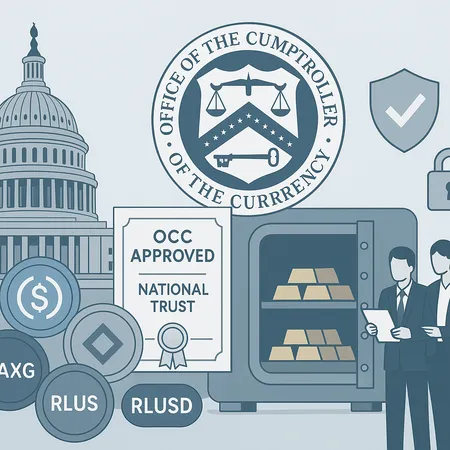
The three approvals differ in form and implication: Circle received conditional OCC approval to create a national digital currency bank for USDC; Paxos converted to a national trust under OCC supervision and aligned its stablecoin and tokenized gold products with federal rules; and Ripple secured an OCC nod focused on stablecoin compliance. Each action represents a different legal vehicle and supervisory perimeter.
Circle: a conditional OCC approval to charter a national digital currency bank for USDC signals a path toward a federally chartered institution designed specifically around dollar‑pegged digital liabilities. (See Circle’s approval coverage for operational context.)(Circle gains conditional OCC approval to create a national trust bank for USDC)
Paxos: the firm’s move to convert to a national trust and align tokenized gold and stablecoin products with federal rules shows how tokenized commodities like PAXG can be folded into a federally supervised custody and issuance model. (Two reporting threads: Paxos’ conversion and product alignment.)(Paxos converts to a national trust under OCC supervision, Paxos aligns stablecoins and tokenized gold with federal rules)
Ripple: an OCC approval tied to stablecoin compliance highlights that non‑bank token issuers can negotiate supervisory frameworks that focus on custody, reserve management and on‑chain controls for tokens like RLUSD.(Ripple wins OCC approval for stablecoin compliance)
Each pathway — national digital bank, national trust, or OCC‑monitored compliance arrangement — creates different implications for counterparty risk, contractual enforceability and the expectations supervisors have for custody, reserve audits and consumer protections.
How issuer risk profiles change under federal oversight
Federalization narrows some legal uncertainty but introduces new operational expectations.
Counterparty credit and prudential risk: A national trust or OCC‑chartered bank model places an issuer into a supervised prudential regime. That typically increases capital, liquidity and audit standards relative to a purely state‑chartered or unregulated issuer. For counterparties, the credit risk of an OCC‑supervised issuer becomes more comparable to traditional custodians, but not identical — exposures remain tied to on‑chain settlement, smart‑contract risk and operational continuity.
Legal recourse and insolvency clarity: Federal charters and trusts create clearer statutory playbooks for receivership, asset segregation and creditor priorities. This is meaningful for institutional counterparties holding large USDC balances or tokenized gold—knowing which assets are held in bankruptcy‑protected structures changes recovery assumptions.
Operational and cyber expectations: OCC supervision brings higher expectations for disaster recovery, AML/KYC and operational resilience. Institutions should expect more granular reporting, incident notification obligations and third‑party vendor scrutiny.
Residual risks that remain: Smart contract bugs, oracle failures, cross‑chain bridge security, and concentrated key‑custody risks are not solved by an OCC letter. Those risks must be assessed separately in contractual terms and technical due diligence.
Tokenized gold and RWAs: why PAXG, XAUT and similar products matter differently
Tokenized gold (PAXG, XAUT) straddles two risk dimensions: commodity custody and on‑chain token mechanics. Paxos’ move to a national trust is a useful poster child for how tokenized commodities can be folded into federal oversight.
Custody provenance: Tokenized gold’s primary risk is the physical custody and audit trail of the underlying bullion. A national trust structure typically implies stricter segregation, independent vault audits and clearer title rules — elements institutions prize for asset‑backed tokens.
Pricing and redemption mechanics: Even with better custody, tokenized gold depends on dependable redemption processes and transparent pricing. Supervisory scrutiny will likely require clearer redemption windows, proof‑of‑reserves methodologies and dispute‑resolution paths.
Cross‑product interactions: Institutions that custody both stablecoins (USDC, RLUSD) and tokenized gold should model cross‑asset settlement risk: how quickly can an institution convert tokenized gold into fiat, and under what legal protections? Paxos’ alignment with federal rules points toward standardized disclosure and operational guardrails.
Market liquidity and counterparty concentration: Even if issuer risk declines, liquidity risk for large position exits can be acute. Institutions should treat tokenized gold liquidity as separate from bullion market liquidity and require pre‑defined settlement assurances.
Practical custody and counterparty changes institutional teams should adopt
The combination of federal chartering and OCC oversight means institutions must update policies and operational playbooks. Below are practical, prioritized steps for compliance officers and institutional crypto teams.
1) Re‑baseline legal and contractual standards
Update master custody agreements and ISDA/CSA equivalents to reference counterparty regulatory status explicitly (national trust, OCC‑chartered bank, or OCC‑monitored issuer). Define insolvency waterfall expectations and require representations about asset segregation and proof‑of‑reserves frequency.
2) Increase operational and technical due diligence
Demand third‑party audit reports, SOC-type examinations and technical security assessments for the issuer’s custody stack, smart contracts and bridging components. For public blockchains, require attestation of private key control, multi‑sig thresholds, and incident response playbooks.
3) Revisit settlement and reconciliation workflows
Design workflows that reflect different settlement finality: fiat rails vs on‑chain token movement. For large transfers, consider staged settlement windows or liquidity buffers. Integrating ledger reconciliation with treasury systems is now table stakes.
4) Adjust collateral and capital treatment
Risk‑based capital models must be updated to reflect the issuer’s supervisory status. A federally supervised issuer may justify lower capital add‑ons compared with unsupervised counterparts, but only after validating operational controls and legal protections.
5) Enforce continuous monitoring and conditional triggers
Set up continuous monitoring for regulatory changes, OCC guidance and issuer disclosures. Triggers should include material changes in charter status, adverse supervisory actions, or changes in custody providers for the issuer.
A short checklist for custody counterparties
- Verify the issuer’s charter: national trust vs OCC charter vs supervised compliance arrangement.
- Obtain and review recent OCC correspondence or public supervisory letters where available.
- Confirm physical custody audit reports for tokenized commodities and custodial key controls for stablecoins.
- Require contractual insolvency and segregation clauses tailored to federal trust/bank regimes.
- Stress‑test liquidity and redemption scenarios under market stress.
What this does — and doesn’t — mean for market structure
These OCC approvals create a stronger, clearer regulatory baseline for large stablecoin issuers and tokenized asset custodians. That should increase institutional appetite for on‑chain dollar products and tokenized RWAs, but not without work: counterparties still face smart‑contract, market and custody‑concentration risks. Practically, expect a bifurcation: highly supervised issuers will attract larger institutional flows and face higher compliance costs; smaller, less supervised issuers will persist but be used more cautiously.
For many traders and treasury teams, Stablecoins will become a more integrated component of short‑term liquidity management as issuer clarity improves. Simultaneously, protocols and platforms in the DeFi ecosystem will have to adjust collateral assumptions and counterparty exposures.
Final recommendations for compliance officers and institutional teams
- Treat OCC approvals as a material change: reclassify counterparty risk bands and update exposure limits.
- Demand contractual certainty on custody, segregation and insolvency treatment.
- Maintain strong technical due diligence; regulatory supervision does not remove on‑chain vulnerabilities.
- Coordinate treasury and legal teams: settlement mechanics need joint operational and legal sign‑off.
- Monitor issuer disclosures and OCC statements — these will be the primary signals that operational promises are backed by supervisory reality.
A final note: clarity is improving, but governance and technology still matter. A federally supervised issuer that poorly manages private keys or redemption mechanics can be just as disruptive as an unsupervised counterparty. For institutions building production flows around USDC, RLUSD or tokenized gold (PAXG, XAUT), the new supervisory architecture is an opportunity — to tighten controls, renegotiate protections and migrate liquidity toward counterparties that meet both regulatory and technical standards. Platforms like Bitlet.app and other custody partners will need to reflect these expectations in their product and counterparty reviews.
Sources
- https://www.altcoinbuzz.io/cryptocurrency-news/circle-gains-occ-approval-for-usdc-stablecoin-bank/
- https://en.cryptonomist.ch/2025/12/15/paxos-trust-occ-oversight/
- https://www.altcoinbuzz.io/cryptocurrency-news/paxos-aligns-stablecoins-and-tokenized-gold-with-federal-rules/
- https://www.altcoinbuzz.io/cryptocurrency-news/ripple-wins-occ-approval-for-stablecoin-compliance/