DeFi Security Post-Mortem: Lessons from the Aevo (Ribbon) $2.7M Drain and Zerobase Front-End Takeover
Summary
Executive overview
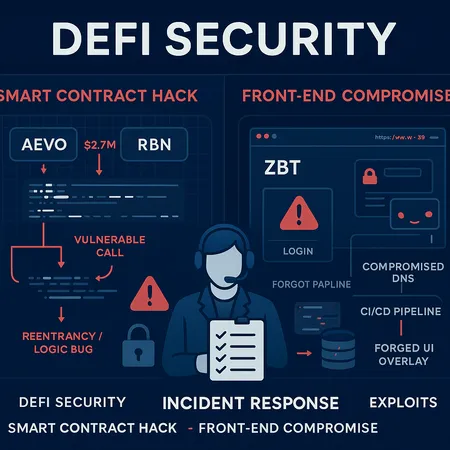
DeFi security has evolved from a narrow focus on smart-contract correctness to a broader battlefield that includes front-end and UX-layer compromises. Two recent incidents crystallize this shift: the reported $2.7M drain tied to Ribbon Finance / Aevo and a front-end takeover that cost Zerobase users roughly $240k in USDT. The Ribbon case reads like a classic on-chain exploit with funds moved across wallets, while Zerobase is a reminder that the user interface you trust can be weaponized. Both deserve careful post-mortems because defenses and responses are different.
For teams building in DeFi and security professionals, the takeaway is simple: secure the code, the keys, and the delivery pipeline. This article provides technical breakdowns, prioritized hardening steps for protocol operators, incident response procedures, and actionable user-side mitigations.
Case studies: what happened and what we know
Ribbon Finance / Aevo — $2.7M drain (RBN / AEVO)
Public reporting indicates Ribbon Finance (operating under the Aevo umbrella in recent communications) suffered an exploit that resulted in approximately $2.7M being drained and subsequently moved across a chain of attacker-controlled wallets. Early coverage and on-chain traces have been collected by researchers and journalists; see the initial report for timeline and wallet movement details.
What we can assert with confidence:
- Funds were moved on-chain and routed through multiple wallets after extraction, typical of attempts to obfuscate provenance.
- The incident has been characterized as a smart contract exploit/drain rather than a simple phishing campaign in press reporting and chain analysis.
What remains under investigation (and what operators should check immediately):
- Whether the root cause was a contract logic vulnerability (reentrancy, access control, incorrect invariant), an admin key compromise, or an exploited upgradeability path.
- Whether privileged signing keys or timelocks were bypassed.
For the initial reporting see Cryptopolitan's coverage of the event: Ribbon Finance hacked for $2.7 million.
Zerobase — front-end takeover and UX-level losses (ZBT)
Zerobase users reported losses after the protocol's front-end was taken over and replaced with malicious code that prompted users to sign transactions transferring value to attacker addresses. This incident is a clear example of a front-end compromise where the smart contracts may be secure but the signing UX was subverted.
Key features of the Zerobase incident:
- Users interacted with an authentic-seeming UI but were given malicious transaction payloads (for example, crafted allowance/transfer calls).
- The attacker obtained value directly via user signatures rather than breaking the smart contract itself.
Reporting and timeline are available in the coverage here: Zerobase front-end hacked.
Technical anatomy: contrasting attack vectors
Smart-contract exploit (on-chain drains)
Common patterns seen in contract-level exploits include:
- Logic bugs (reentrancy, integer underflow/overflow in rare EVM versions, oracle manipulation, incorrect accounting assumptions).
- Broken access control (missing onlyOwner checks, improperly scoped modifiers, or misconfigured multisigs).
- Upgradeability pitfalls (malicious or accidental upgrade that adds a backdoor, initializer functions left callable).
For a protocol that experiences an on-chain drain like the Ribbon/Aevo report, investigators should look at recent deployments, upgrade transactions, owner/address changes, and any anomalous contract calls originating from migration or admin flows.
Front-end / UX compromises
Front-end compromises are qualitatively different and increasingly common. Attackers do not need to subvert a contract if they can trick users into signing arbitrary transactions. Typical vectors:
- DNS hijack or domain takeover that points the canonical domain to attacker-hosted resources.
- Compromised CI/CD pipelines or exposed hosting credentials that allow direct replacement of the served UI.
- Malicious third-party JS libraries or compromised package dependencies inserted into the bundle.
- Tampered analytics/CDN or injected inline scripts that alter displayed addresses, prompts, or transaction payloads.
Attackers use these vectors to craft signing payloads that look innocuous in a UX but do dangerous things on-chain (e.g., transferFrom calls with large allowances, permit-style approvals, or batched calls that drain balances).
Why front-end attacks are rising (and why they are hard to mitigate)
- Attackers target the human element: it’s easier to trick a user into approving a transaction than to find and exploit a complex contract bug.
- Modern front-ends pull rapid, composable dependencies from many sources (analytics, widgets, wallets). Each dependency expands the attack surface.
- Infrastructure mistakes — expired registrar contacts, misconfigured DNSSEC, or leaked API keys in CI logs — are common and often overlooked.
This doesn't mean smart-contract security is unimportant: it remains critical. But teams must treat delivery, build, and signing flows as first-class attack surfaces.
Hardening recommendations for protocol operators
These recommendations prioritize low-effort, high-impact controls and then move to deeper architectural investments.
1) Front-end delivery and CI/CD hygiene
- Enforce least-privilege on deployment credentials (separate deploy keys for build systems). Rotate keys on personnel changes.
- Use CI secrets managers and avoid embedding secrets or API keys in logs or environment files. Make secrets ephemeral where possible.
- Enable DNSSEC and monitor registrar contact info for unauthorized changes. Use registrar lock features and 2FA on domain registrars.
- Serve static assets from a hardened CDN; use subresource integrity (SRI) for third-party scripts where possible and set strict Content Security Policy (CSP) headers.
- Lock down package dependencies: pin versions, run SBOM scans, and use tools that monitor for malicious or typosquatted packages.
2) Signing patterns and UX design
- Avoid ever asking users to sign raw message payloads that can effect arbitrary ERC-20 approvals or transfers. Use descriptive transaction information surfaced from on-chain decoding libs.
- For approval flows prefer permit patterns that include clearer intent OR design wallets/UIs to show decoded calldata fields (to the extent wallet vendors allow).
- Encourage users to use hardware wallets and make hardware-compatible flows first-class.
- Educate users with in-UI warnings around high-value approvals and “infinite” allowances.
3) Admin key architecture
- Avoid single-point-of-failure admin keys. Use multi-sig with a high threshold (Gnosis Safe or similar) and require time-locks for sensitive operations.
- Consider governance delay windows and on-chain timelocks for upgrades or critical parameter changes.
- Treat upgrade paths as privileged attack vectors: make implementation upgrades auditable and require multi-party signoffs.
4) Monitoring and detection
- Instrument both on-chain and off-chain telemetry: watch for unusual contract calls, sudden allowance increases, and large transfers.
- Use automated alerting for admin-critical activity (owner changes, new code deployments, proxy upgrades).
- Maintain a runbook for quick “pause” or circuit-breaker actions (pausable modules, emergency freeze multisig) and test them regularly.
Incident response: a practical playbook
- Triage quickly and publicly: post an initial incident notice that you’re investigating; transparency reduces phishing/false info and helps coordinate defenders.
- Snapshot state: gather contract state, key holder lists, multisig logs, recent commits, build artifacts, DNS registrar activity, and CI logs. Preserve logs (timestamped and hashed) for forensic integrity.
- If on-chain abuse is occurring, push available mitigations: pause contracts, revoke approvals where possible, or disable vulnerable routes with an emergency multisig step.
- Engage a security firm for forensic analysis while making a coordinated disclosure plan. Funders and treasury addresses should coordinate with exchanges and mixers analytics teams if funds are being laundered.
- Communicate to users clearly: what happened, what you’re doing, and what users should do now (e.g., revoke allowances, stop interacting with the site). Keep updates regular.
- Collect artifacts for potential legal action and insurance claims (transaction IDs, signed messages, compromised artifacts). Notify relevant law enforcement where appropriate.
Insurance, recovery, and prevention of future loss
- On-chain restitution is hard once funds are moved. Teams should cultivate relationships with white-hat groups and on-chain analytics firms to track and possibly recover funds quickly.
- Protocols should evaluate insurance providers (e.g., Nexus Mutual and others) and consider layered risk: treasury insurance, bug-bounty programs, and post-incident recovery budgets.
- Maintain a contingency treasury for user reimbursements where feasible, with clear governance steps for any payouts.
Practical tips for experienced users to minimize exposure
- Verify domains and bookmarks: always navigate to a service via a known bookmark or typed URL. Check registrar WHOIS if a site looks different.
- Use hardware wallets for high-value interactions and require device confirmation for critical fields.
- Avoid signing permit messages or arbitrary data blobs; when in doubt, decode calldata in a sandbox (etherscan / tenderly / custom tooling) before approving.
- Periodically revoke or limit token allowances using tools such as Revoke.cash or token-allowance features in wallets. Never grant unlimited approvals to automated contracts you don’t control.
- Watch for sudden UI changes, especially if a site asks for approvals you never used before. If a product’s front-end shows a different look or strange popups, stop and verify the source.
- Where possible, use a multisig or vault for treasury and personal high-value holdings.
Quick checklist for teams (one-page reference)
- DNS: Registrar 2FA, DNSSEC enabled, registrar lock
- CI/CD: rotate keys, limit scope, no secrets in logs
- Front-end: SRI, CSP, pin dependencies, hardened CDN
- Admins: multisig + timelock, clear upgrade governance
- UX: decode call data, warn on large approvals, hardware wallet support
- Monitoring: on-chain watchers, alerting, incident runbook
Final thoughts
The Ribbon/Aevo drain and the Zerobase front-end takeover show two sides of the same problem: DeFi security is an end-to-end discipline. You can have formally verified contracts but still lose value because the delivery or signing surface was weak. Conversely, a hardened UX will fail to protect users if there are exploitable contract invariants.
Protocols and experienced users must assume that attackers will target the weakest link — and that link may well be your DNS, CI pipeline, or a third-party JS library. Design for defense-in-depth: secure the contracts, secure the keys, and secure the delivery.
Bitlet.app and other platforms in the ecosystem benefit when protocols and users adopt these patterns — safer rails reduce systemic risk for everyone.