Lessons from the Terraform Collapse: Accountability, Stablecoin Risk, and New Legal Precedents
Summary
The verdict and why it matters
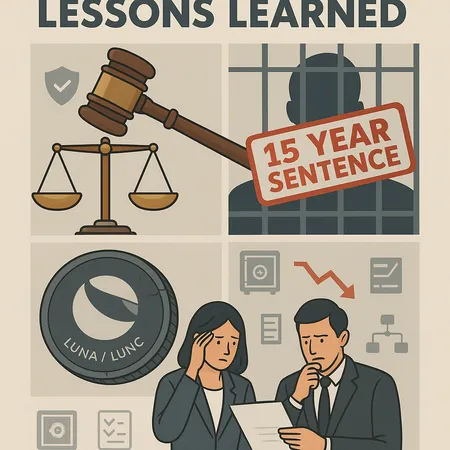
In a landmark judgment, a U.S. federal court sentenced Terraform co‑founder Do Kwon to 15 years in prison after finding he committed wire fraud in the collapse tied to Terraform Labs and its token ecosystem. Coverage of the sentence frames the episode as not just a failed protocol experiment but a criminally actionable scheme linked to the roughly $40 billion market shock that followed the LUNA/UST unwind. See reporting from The News Crypto for primary sentencing coverage and a concise timeline of the prosecution.Terraform co‑founder receives 15 years prison sentence
The Manhattan federal judge — whose remarks were emphasized in contemporaneous reports — characterized the conduct as an 'epic fraud', highlighting deliberate misrepresentations and coordination that harmed retail and institutional holders alike. Crypto outlets summarized the judge’s tone and the market fallout in ways that underscore how the case will be read by prosecutors and compliance teams going forward.Terra’s fall comes full circle — Do Kwon hit with 15‑year prison term
Victim impact: the human and market toll
Victim impact testimony and market coverage stress two intertwined harms: direct investor losses and the broader confidence shock to algorithmic stablecoins and related token ecosystems. Reporting highlighted how rapid de‑pegs cascaded into panicked liquidations and long tails of loss for retail holders who lacked meaningful protections or visibility into on‑chain and off‑chain entanglements.NewsBTC’s coverage documents subsequent market reactions, which in some pockets amplified contagion pressures in correlated projects.
Taken together, the human stories and price charts deliver a blunt lesson: opaque token mechanics and central figures with outsized control create single points of failure that can destroy savings and shake market trust.
Legal precedents and the enforcement playbook
This prosecution establishes a number of practical legal takeaways:
- Criminal liability for crypto founders: The sentence signals prosecutors are prepared to treat deliberate misrepresentation, coordination to manipulate markets, and failures to disclose material risks as wire fraud and related offenses. That raises the bar for executive behavior in decentralized projects.
- Cross‑border enforcement feasibility: High‑profile extraditions and prosecutions demonstrate U.S. willingness to pursue actors outside its borders when U.S. investors and markets are affected, setting a deterrent tone.
- Evidentiary expectations: Successful prosecutions will likely rely on a mix of on‑chain tracing, communications evidence, and expert economic analysis to show intent and causation — meaning that sloppy operational security or contradictory public claims can be probative in court.
For regulators and compliance teams, the implication is simple: governance and public communications matter legally, not just reputationally. The Terraform case will be cited in future litigation and enforcement memos as a precedent for holding protocol leaders personally accountable when conduct crosses into fraud.
What this reshapes for investor due diligence (stablecoins, L1s and L2s)
Investors — retail and institutional — must recalibrate what ‘due diligence’ means in a post‑Terraform world. Quick checklist items that should become standard practice:
- Token model audit beyond the code: Understand economic assumptions (e.g., peg maintenance mechanics for algorithmic stablecoins), stress test scenarios, and failure modes. Don’t treat a formal audit alone as sufficient.
- Leadership and governance mapping: Identify who can influence protocol economics — multisigs, off‑chain committees, and founders — and evaluate checks and balances. A founder with repeated unilateral powers is a legal and operational concentration risk.
- Reserve evidence and transparency: For any stablecoin exposure, ask for verifiable proof of reserves, proof of custodial arrangements, and timely third‑party attestations. Algorithmic models, by design, often lack hard reserves — that’s a material risk.
- Legal opinion and jurisdictional risk: Know where the entity is incorporated, how tokens are marketed, and the legal regimes that may apply. Cross‑border enforcement is possible, but it adds delay and uncertainty.
Deeper due diligence is particularly urgent for algorithmic stablecoins (the seed keyword here). Unlike overcollateralized fiat or crypto‑backed stablecoins, algorithmic designs depend on market dynamics and incentives; their resilience assumptions should be stress‑tested by compliance and treasury teams.
Practical risk‑management steps for retail holders
Retail holders are often the most exposed and least prepared. Practical steps they can take now:
- Diversify stablecoin exposure: Hold a mix of reputable, reserve‑backed stablecoins and keep a portion in fiat bank accounts or insured custodial accounts.
- Keep withdrawal options available: Don’t lock all savings into a single protocol or yield platform; ensure you retain on‑chain liquidity to exit.
- Check transparency signals: Prefer stablecoins with publicly auditable reserves, regular attestations, and clear custodial arrangements. If a stablecoin’s peg relies on an opaque algorithm, reduce position size.
- Use reputable custody and insurance when available: For sizable holdings, prioritize regulated custodians that offer insured custody or segregated accounts.
- Maintain an exit plan: Set thresholds and automated alerts for material price divergence or abnormal on‑chain flows.
Practical risk‑management steps for institutional holders and compliance teams
Institutions have added responsibilities and tools: legal contracts, governance engagement, and operational controls. Key actions:
- Contractual protections: Negotiate representations, warranties, and indemnities in counterparty agreements; require proof of reserve attestations as a contracting condition.
- On‑chain monitoring and stress tests: Build tooling that alerts to peg slippage, large mint/burn events, and concentration of holdings in governance multisigs.
- Custody and segregation: Use regulated custodians and prefer segregated accounts or cold‑storage solutions for stable assets.
- Protocol engagement and governance: Where possible, participate in governance or work with service providers to limit unilateral actions by founders or small committees.
- Insurance and capital buffers: Maintain insurance and liquidity buffers calibrated to worst‑case unwind scenarios rather than historical volatility.
These institutional actions reduce legal, operational, and reputational exposure, but they also require budgets and technical maturity to implement.
Governance, custody and disclosure: what regulators should prioritize
Regulatory policymakers will draw three obvious lessons from the Terraform collapse:
- Disclosure and reserve standards: Mandate clear, frequent attestations of reserves for stablecoins and require proof of custodian relationships.
- Minimum governance and custodial safeguards: Policies that reduce single‑person control (e.g., multisig minimums, time‑locked governance actions) and require fail‑safes such as circuit breakers.
- Accountability frameworks: Clear rules that allow civil and criminal liability where deliberate deception or negligent misrepresentation is proven, coupled with pathways for faster restitution mechanisms for retail victims.
For algorithmic stablecoins specifically, regulators might prohibit certain uninsured algorithmic designs from being marketed as ‘stable’ unless they meet reserve or insurance standards. The Terraform case will likely accelerate proposals that tie the label “stablecoin” to a set of enforceable transparency and reserve requirements.
Litigation and future enforcement trends
Expect more litigation aimed at founders, operators, and early token sellers where marketing claims are inconsistent with internal practices. Prosecutors now have a high‑profile example to point to when arguing for criminal charges in cases of deliberate misrepresentation. Civil litigants — including class actions — will also lean on the factual record produced in prosecutions to seek restitution.
At the same time, caution is warranted: not every protocol failure will be criminal. Distinguishing negligence, poor design, or honest mistakes from intentional fraud requires careful legal and factual analysis. Still, the new precedent narrows the margin for error for founders and boards.
Governance and custody lessons for founders and builders
Founders and protocol operators should take away clear operational imperatives:
- Adopt transparency by default: Publish clear, machine‑readable statements of tokenomics, reserve holdings, and emergency plans.
- Reduce centralization: Limit unilateral controls and document decision‑making processes; prefer multi‑stakeholder governance where feasible.
- Keep legally informed communications: Coordinate marketing and public statements with legal counsel; avoid promises that imply guaranteed returns or stability absent hard backing.
- Prepare off‑ramps: Design and document circuit breakers and redemption windows for stress periods.
Notably, these are good governance practices whether or not a jurisdiction ultimately brings enforcement actions.
Concluding thoughts: balancing innovation and protection
The 15‑year sentence for Do Kwon is a heavy marker in crypto’s maturity arc. It says two things at once: innovation will be tolerated, but obfuscation and fraud will be punished. For long‑term investors, compliance teams, and regulators, the Terraform collapse and its legal aftermath make clear that the era of trusting unchecked token models without documentary proof is over.
Practically, that means more rigorous due diligence, stronger custody and disclosure rules, and an acceptance that algorithmic stablecoins carry unique, often systemic, risks. The industry should absorb these lessons in product design, legal structuring and risk management. For pragmatic coverage and tools to implement some of these operational controls, organizations may look to ecosystem platforms — including Bitlet.app — that bridge custody, compliance and liquidity practices for institutional and retail users.
Sources
- Terraform co‑founder receives 15 years prison sentence — The News Crypto
- Terra’s fall comes full circle — Do Kwon hit with 15‑year prison term in US court — CryptoPotato
- NewsBTC coverage of the sentencing and market reaction
For broader reading on stablecoin mechanics and regulatory proposals, compliance teams should consult primary regulatory guidance in their jurisdictions and independent technical audits.
For many traders, Bitcoin remains the primary market bellwether, but the Terraform story teaches that asset class‑specific governance and disclosure matter as much as market signals.