Buybacks and Meme-Economics on Solana: A Deep Dive into Pump.fun’s PUMP
Summary
Why buybacks matter in crypto — and why Solana is fertile ground
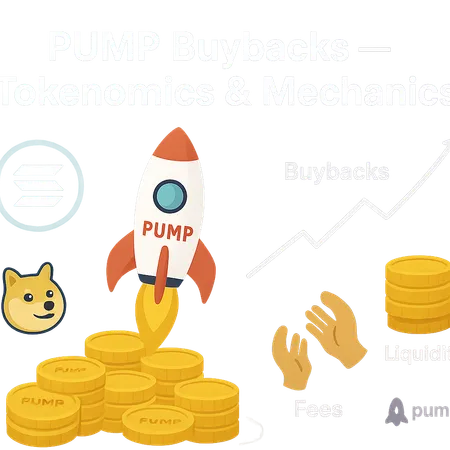
Buybacks are familiar from traditional markets: a company repurchases shares to signal confidence, reduce float, or return capital. In crypto, the mechanic is similar in intent but different in execution. On-chain buybacks are typically funded by protocol revenue (fees, treasuries, or token sinks) and executed transparently on public markets — but they interact with liquidity pools, AMMs, and memetic narratives in ways that amplify price action.
Solana’s fast, low-cost execution has made it a playground for high-frequency tokenomic experiments. Meme tokens like PUMP have leaned into structured buybacks as a core narrative: fees earned by the platform are mechanically used to buy PUMP on-chain, which can shorten supply on exchanges and concentrate buying pressure into predictable windows.
For many retail traders the dynamic is simple: recurring buy pressure + tight liquidity = outsized rallies. But that surface-level logic masks several technical and economic caveats we unpack below. For context on how this model has played out in practice, see reporting on Pump.fun’s repurchases and fee activity: Coinspeaker documented that Pump.fun’s cumulative buybacks exceeded $205 million, and crypto press coverage has tracked its revenue and repurchase cadence on Solana. (Coinspeaker; Cryptopolitan).
How Pump.fun’s buyback mechanics work (a practical breakdown)
Revenue → Buyback pipeline
Pump.fun appears to operate a loop where collectible fees, marketplace fees, or platform revenue are routed to a treasury that executes repurchases of PUMP on Solana DEXes. That sequence has four typical steps:
- Protocol collects revenue (marketplace/tx fees, subscription, or other on-chain income).
- A smart-contract-defined or off-chain scheduler transfers revenue to a buyback wallet.
- The wallet executes market buys of the native token (PUMP) across DEX pools to avoid slippage concentration.
- Purchased tokens may be burned, locked, or redistributed — each choice changes long-term scarcity differently.
This visible pipeline is appealing because it’s easy to explain to communities: “Fees buy PUMP, that reduces supply, price goes up.” That messaging, amplified in social channels, can be powerful.
Where liquidity lives and why it matters
Buybacks interact with AMM liquidity depth. On Solana, concentrated liquidity and thinner order books for meme tokens mean a $100k daily buy will move price more on an undercapitalized pool than on a deep pool. Pump.fun’s activity has materially impacted PUMP markets precisely because repurchases occurred in environments where liquidity was relatively shallow compared to the buy flow — that magnified rallies and signaling effects.
Coinbase’s recent improvements to Solana on-chain trading UX and native DEX access also matter here. By broadening where and how SOL and SPL tokens trade on-chain, exchanges and wallet-level DEX upgrades can improve price discovery and liquidity routing for tokens like PUMP, reducing slippage for large repurchases. See reporting on Coinbase’s Solana DEX upgrade for context on on-chain liquidity improvements. (Coinpedia).
Quantifying the scale: fees, repurchases, and rally size
Public coverage indicates Pump.fun’s buyback program has been large in aggregate. Coinspeaker reported cumulative buybacks above $205 million, a headline figure that signals real capital flow into token repurchases. Crypto press has also documented daily fee generation and repurchase cadence on Solana that funded these purchases, though day-to-day figures can vary with user activity and market cycles (Cryptopolitan).
What that $205M means in practice:
- It’s a cumulative gross buy figure — the total dollars spent buying PUMP over time. That magnitude can materially reduce circulating float if accompanied by burns or locks.
- Even large cumulative buybacks can produce diminishing returns if liquidity depth grows or if buybacks are spread thinly.
- Short-term rallies are easier when buy pressure is concentrated relative to the available liquidity; over time markets tend to price in predictable buying flows unless there is a genuine growth in organic demand.
Numbers like these attract speculators, but they also invite scrutiny: where did the revenue originate, and is it sustainable?
Sustainability: Why buybacks can run out of fuel
Buybacks only scale as long as the revenue source that funds them persists. Common funding models carry distinct sustainability profiles:
- Fee-funded buybacks: Sustainable only if user activity (trading, minting, transactions) sustains fees. Activity can be seasonal or promotional-driven.
- Treasury-funded buybacks: Finite — large initial treasuries can finance long campaigns but will deplete unless replenished.
- Inflationary fueling or token-swap tricks: These can temporarily prop up buybacks but often introduce long-term dilution or tokenomics fragility.
For meme projects, attention-driven usage is fickle. A sequence of high-profile rallies can dry up once community interest moves on, leaving buyback-driven price support without its revenue base. That’s why it’s important to distinguish between buybacks that are an operational outcome of sustainable product usage and buybacks that function mostly as engineered demand incentives.
Governance and concentration risks
Buybacks may sound mechanical, but control matters. Key governance risks include:
- Centralized treasury control: If a single multisig or team wallet decides buyback timing, the community is exposed to unilateral action or rug possibilities.
- Vesting and token distribution: Large pre-allocations to insiders can be sold into buyback-driven rallies.
- Lack of on-chain proof: Off-chain buyback schedules reported by teams but not enforced by code can be changed.
- Admin keys and upgradeability: Contracts that allow owners to pause or redirect buybacks create single points of failure.
For PUMP and similar tokens, community managers and token holders should verify whether the buyback mechanism is on-chain (immutable) or off-chain/operation-led. Immutable, on-chain buybacks with audited logic are stronger assurances than simple press releases.
Regulatory and investor-protection implications
Structured buybacks complicate how regulators view a token. A few angles regulators and compliance teams may consider:
- Market manipulation: Buying a token to push price, especially when coordinated with promotional messaging, can attract scrutiny under market-abuse frameworks if actors are artificially influencing prices.
- Securities analysis: If buybacks are presented as a form of income distribution, or if token value is largely dependent on managerial actions, some jurisdictions might view the token under securities law tests.
- Consumer protection: Retail investors attracted to headline buyback totals may not understand the underlying revenue sustainability, leaving them vulnerable to sharp drawdowns.
These risks do not mean buybacks are inherently illegal, but they increase the need for transparent, on-chain mechanisms and careful disclosure. Exchanges and custodial platforms improving Solana UX, like the Coinbase DEX upgrade, raise the bar for market access — which also increases the attention regulators pay to tokens that show large on-chain buy flows. (Coinpedia).
Practical due-diligence checklist for buyback-driven tokens
Below is a pragmatic checklist retail investors and community managers can use before allocating capital to a buyback-driven meme token such as PUMP.
Smart contract transparency
- Is the buyback logic encoded on-chain or only conducted by off-chain team wallets? On-chain rules are preferable.
- Are the contracts audited? Who performed the audit and are findings public?
Revenue provenance
- Where do the funds for buybacks come from (fees from product, treasury, inflationary minting)?
- Can you see fee flow on-chain that matches reported buybacks?
Treasury and multisig controls
- How many signers control the treasury? Are signers known and reputable?
- Are multisig transactions time-locked or publicly observable with a delay that prevents instant rug actions?
Token distribution and vesting
- What portion of supply is held by insiders, and what are the vesting cliffs? Large short-term unlocks are red flags.
Liquidity depth and exchange routing
- Check AMM pool depths where buybacks occur (slippage for representative ticket sizes).
- Are buybacks concentrated on thin pools where price can be easily moved?
Buyback cadence and transparency
- Is there a published schedule or a verifiable on-chain function that executes buys? Are receipts of buys verifiable and public?
Burn, lock, or redistribution policy
- After buybacks, are tokens burned (reducing supply) or held in a lockup? Burning creates lasting scarcity; holding in a wallet may mean future dumps.
Community health and dependency
- Is organic activity (users, volume, product usage) growing independent of buyback promotions? A healthy project has multiple demand vectors.
Legal and compliance posture
- Has the team commented publicly on legal classification or sought counsel? Be cautious if a token is marketed as an investment with guaranteed returns.
Exit scenarios and stress tests
- Model what happens when buybacks stop: price, liquidity, and token velocity. If the token collapses without buybacks, treat prior gains as speculative income rather than sustainable value capture.
Red flags and green flags — practical signals
- Red flags: buybacks funded exclusively by treasury dumps, lack of multisig transparency, opaque or unverifiable fee flows, large insider allocations unlocking soon, and marketing language promising guaranteed price increases.
- Green flags: on-chain, auditable buyback logic; buybacks funded by organic fees from an active product; progressive burns or lockups; transparent multisig with time-locks; and reputable third-party audits.
What this model implies for community managers and retail investors
Community leaders should be candid: buybacks can be a powerful tool to bootstrap demand and provide narrative momentum, but they are not a substitute for sustainable product-market fit. For retail investors, the lesson is straightforward: treat buyback-driven rallies as trading opportunities with defined risk, not long-term guarantees, unless the project shows independent growth in user activity and fee-based revenue.
Tools and platforms that improve on-chain trading — including upgrades that make SOL and SPL tokens more accessible — change the plumbing of liquidity. That can reduce frictions for legitimate projects but also make it easier for speculative strategies to scale quickly. When you evaluate a buyback token, use on-chain explorers, multisig trackers, and liquidity analytics to verify claims rather than rely on press or hype. Bitlet.app users often rely on careful tokenomic checks when deciding on installment or trading strategies; the same rigor applies here.
Final thoughts: buybacks are a tool, not a promise
Pump.fun’s PUMP buybacks — with reported cumulative repurchases in the hundreds of millions — demonstrate how structured repurchase programs can create outsized market effects on Solana. But scale does not equal sustainability: the underlying revenue model, governance design, and liquidity context determine whether buybacks deliver lasting value or temporary price theater.
If you participate in buyback-driven tokens, do the homework outlined above. Look for auditable mechanics, transparent treasuries, and a broader demand story beyond engineered repurchases. When in doubt, treat headline buyback totals as one data point among many.