From Trade to Savings: How Bitcoin Is Becoming Part of Household Portfolios — A Guide for Advisers

Summary
Why Abigail Johnson’s Statement Is a Turning Point
When Fidelity CEO Abigail Johnson said Bitcoin is migrating out of a pure speculative trade and into household savings portfolios, she distilled a narrative many in the industry have been watching for: institutional plumbing and product maturity are lowering the frictions that once confined BTC to traders and speculators. That observation matters because advisers and retail savers don’t adopt assets on thesis alone — they adopt when custody, regulation, and portfolio-grade products align with fiduciary practice. For the original quote and context, see the reporting on Fidelity’s position here.
This piece breaks down what changed, why now, and how advisers should think about allocation, custody, and regulation as BTC — ticker: BTC — becomes a candidate for long-term household savings.
1) Evidence: Household Adoption vs Institutional Demand
The narrative of household adoption can be read two ways. On one hand, retail interest has resurged: retail exchanges, consumer apps, and P2P marketplaces make buying smaller amounts easier than ever. On the other hand, true household-savings adoption — i.e., inclusion on balance sheet-like schedules, IRAs, or pension programs — requires institutional rails.
Institutional demand is the engine that often translates speculative interest into durable household allocations. The last few years delivered that engine in several forms: spot ETF approvals in major jurisdictions, custodial service expansion, and analyst/institutional buy-side coverage that frames Bitcoin as an investable, portfolio-level asset. For example, several institutional voices continue to argue Bitcoin’s long-term case remains strong even amid equity weakness, signaling conviction that can underpin broader household adoption (see an analyst perspective here).
But institutional demand is not the same as immediate retail adoption. Institutions make products and infrastructure available; retail savers adapt when advisers, platforms, and pension sponsors educate, approve, and operationalize those options.
2) Product and Policy Developments That Enable Pensions and Savings Use
Two classes of developments have been decisive: product innovation (notably ETFs and custody services) and policy/regulatory adjustments (state laws and pension guidance).
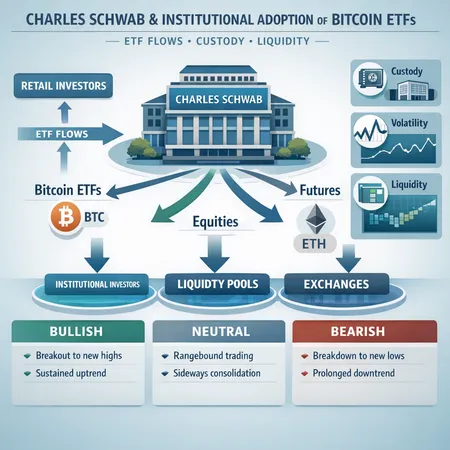
Spot and regulated ETFs: Spot BTC ETFs standardize exposure for retirement accounts, brokerage platforms, and advisers who prefer a regulated, exchange-traded vehicle to direct coin custody. ETFs simplify trading, accounting, and custody compared with self-custody for many households.
Institutional custody and insurance: Major custodians and specialized custody firms have scaled insured custody, auditor-grade controls, and independent key-management processes that satisfy many institutional risk teams and ERISA advisors.
Policy experiments at the state level: States are starting to create pathways for public funds and pensions to consider crypto ETF exposure. A concrete example is Indiana’s HB1042, which allows public pension exposure to crypto ETFs and signals how sub-federal policy can enable pension allocations to Bitcoin — a useful regulatory pathway for other states to watch (read the item on Indiana’s bill here).
Together these developments reduce three classic barriers to household adoption: custody risk, regulatory uncertainty, and product accessibility.
3) Choosing the Right Vehicle: ETF vs Direct BTC (Custody Considerations)
Advisers must evaluate vehicles through the lens of client goals, operational capability, and fiduciary duty. The main options are:
Spot ETFs: Easiest to integrate into brokerage accounts, IRAs, and pension plans. ETFs avoid many custody headaches because the issuer handles underlying custody and reporting. They trade on exchanges and fit familiar reporting workflows.
Direct Bitcoin (self-custody or custodial): Offers direct ownership but raises custody, insurance, and operational complexity. Self-custody can be appropriate for sophisticated clients who accept the responsibility for key management. Institutional custodians (bank trust companies, regulated custodians) provide a middle ground for households wanting direct BTC exposure without the operational burden.
Wrapped/tokenized or DeFi solutions: For some high-net-worth clients already engaged in on-chain ecosystems, tokenized Bitcoin on smart contract platforms offers yield and composability — but introduces smart contract and counterparty risk. For most household savings plans, those tradeoffs will be unattractive. (Compare this to traditional markets where the ETF is the standard savings-friendly wrapper.)
Key custody checklist for advisers:
- Verify custodian regulation and insurance coverage.
- Demand SOC-type audit reports and proof of segregated client accounts.
- Review redemption mechanics and liquidity windows for the chosen vehicle.
- Confirm tax reporting and compatibility with the client’s account types (IRA, 401(k), trust).
4) Practical Allocation Frameworks and Risk Management for Long-Term Savers
Advisers should integrate BTC into a client’s strategic asset allocation rather than treating it as a speculative trade. Here are practical frameworks:
Conservative: 0.5–2% of net investable assets. Target clients with low risk tolerance, short horizons, or regulatory constraints (e.g., fiduciaries with conservative policies). Use ETFs or custodial solutions.
Moderate: 2–5% of net investable assets. For long-horizon savers seeking diversification, a modest allocation can capture asymmetric upside while keeping overall portfolio volatility manageable.
Growth/Aggressive: 5–10% (or more for crypto-native investors). Suitable for clients with a high tolerance for drawdowns, long time horizons, and explicit belief in BTC’s long-term store-of-value or portfolio-role thesis.
Sizing should be driven by a client’s risk budget, not by a fixed “Bitcoin percentage” rule. Important risk-management rules:
- Position sizing tied to drawdown tolerance: Model multi-year drawdowns (BTC has seen 70–80% drawdowns historically) and ensure the client can tolerate that without panic selling.
- Use dollar-cost averaging (DCA) for initial entries to reduce timing risk.
- Rebalance with a rules-based cadence: Quarterly or semi-annual rebalancing keeps allocation disciplined and captures disciplined sell discipline during rallies.
- Stress-test portfolios for correlation regimes: BTC’s correlation with equities has varied, so plan for both commodity-like and equity-like regimes.
Tax treatment and account placement matter. For many clients, holding BTC exposure inside tax-advantaged accounts (IRAs, 401(k)s, or pension vehicles) can be preferable; ETFs simplify this. For direct holdings outside tax-advantaged accounts, be explicit about capital gains crystallization events and recordkeeping.
5) Fiduciary, Compliance, and Documentation: What Advisers Must Do Now
If Bitcoin is moving into household savings, advisers must treat the inclusion process like any new asset class: documented due diligence, client suitability, and ongoing monitoring.
Minimum steps for fiduciaries:
- Update the firm’s Investment Policy Statement (IPS) to reflect allowable crypto allocations and rationales.
- Maintain written due diligence on selected ETFs/custodians, including operational controls and insurance limits.
- Use suitability frameworks that consider time horizon, liquidity needs, net worth, and client understanding of crypto-specific risks.
- Provide plain-language client education materials outlining volatility, legal/regulatory uncertainty, and operational responsibilities (especially for self-custody).
6) Regulatory Outlook and What to Expect in the Next 12–36 Months
Expect incremental progress rather than a single watershed event. Key vectors to watch:
- More state-level pension pathways: Indiana’s HB1042 is an early example that other states could mirror, enabling pension managers to use ETFs for exposure. As more states experiment, pension allocation debates will shift from can we to how much and under what governance.
- ETF proliferation and product refinement: We’ll likely see more institutional wrappers targeted to different client types (insurance-friendly structures, ETF share classes for retirement platforms).
- Custody standardization: Continued pressure on custodians to publish independent audits and expand insurance and operational transparency will reduce a major barrier.
- Regulatory clarity and taxes: U.S. federal regulation remains an important wildcard, but product approvals and precedent-building litigation will incrementally clarify compliance expectations.
For advisers, the implication is simple: get governance in place now. Waiting for perfect clarity cedes the implementation advantage to competitors and may leave clients underexposed or turning to non-advised channels.
7) Portfolio Construction Implications for Advisers and Personal Finance Writers
Practically, integrating BTC into portfolios will look like any other tactical/strategic allocation change but with heightened emphasis on operational due diligence.
- Model portfolios: Build versions of conservative, moderate, and aggressive models that include BTC as a labeled line item with explicit rebalancing thresholds.
- Client segmentation: Not all clients should be offered BTC exposure. Prioritize long-horizon savers, clients with discretionary capital, and those who understand and accept volatility.
- Education and narrative: Writers and advisers should move beyond price-focused narratives. Explain why BTC belongs in a portfolio for certain clients — e.g., potential inflation hedge, non-sovereign digital asset, or low-correlation diversifier — and equally explain the counterarguments.
Actionable Checklist for Advisers and Savers
- Document a clear investment thesis and risk budget for BTC exposure in each client’s IPS.
- Prefer ETFs or regulated custodians for household savings unless the client explicitly requests and understands self-custody risks.
- Use conservative initial sizing (0.5–5%) tied to the client’s risk tolerance and rebalance rules.
- Perform annual stress tests and update suitability assessments after major market moves or regulatory changes.
- Stay informed on state pension policies and ETF developments, which will shape institutional availability and household adoption.
Final Thoughts
Abigail Johnson’s framing is useful because it highlights the structural prerequisites for household adoption: product availability, custody confidence, and policy permissibility. Those prerequisites are coalescing now. That doesn’t make Bitcoin a fit for every household, nor does it reduce its risk profile. What it does mean is that advisers and personal finance writers need operational playbooks: how to size positions, what vehicles to use, how to document decisions, and how to educate clients.
Bitlet.app and similar platforms are part of the broader ecosystem building retail-friendly access and educational tools — but the real shift will be visible when pensions, IRAs, and adviser models consistently incorporate BTC with proper governance.
Sources
- Fidelity CEO coverage and thesis: Fidelity CEO — Bitcoin Is Entering Household Savings Portfolios
- Institutional analyst perspective on Bitcoin’s long-term case: Cantor analyst / institutional view
- Example state bill enabling pension exposure: Indiana HB1042 and pension crypto rights
For many advisors and writers, Bitcoin will increasingly be discussed in the same breath as allocation decisions for equities or commodities — and for a subset of clients, it will be a legitimate strategic allocation. For those exploring broader digital-asset services, keeping an eye on DeFi innovation is useful, but for household savings the immediate focus should remain on ETFs, custodians, and governance.