Tether Expansion Beyond Stablecoins: Trade Finance, Robotics, and What It Means for USDT Liquidity
Summary
Executive snapshot
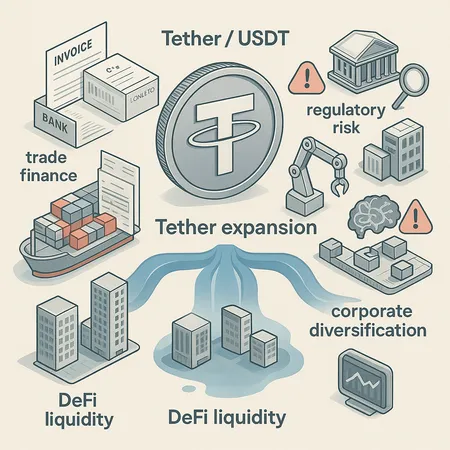
Tether — long known as the issuer of one of the largest stablecoins, USDT — is reportedly broadening its corporate footprint. Recent coverage details moves into trade finance and large private funding rounds in robotics and AI, including reported talks around a European robotics play and even a possible lead role in a billion‑plus dollar funding round. These developments are corporate diversification in action — but they also raise immediate questions for liquidity managers, DeFi risk officers, and corporate strategists who rely on USDT as an on‑ and off‑ramp.
This explainer unpacks the mechanics of those reported moves, why they matter to stablecoin issuance and counterparty concentration, how DeFi and institutional liquidity corridors could react, and what regulators might do next.
What reportedly changed: trade finance and robotics bets
Multiple outlets have reported on Tether’s new activities. One piece outlines a planned expansion into trade finance to fund global commodity trades, positioning Tether as a counterparty in physical trade flows. Read the report on Tether’s trade finance ambitions here: Tether’s trade finance expansion. Separately, coverage describes talks to invest in a European robotics firm, Neura, and even the possibility that Tether could lead a sizable funding round in a German robotics startup — a move corroborated in reporting here and here: Tether in talks to invest in Neura and Tether may lead a $1.2B round in a German robotics startup.
Taken together, these items portray a company shifting some balance‑sheet capacity from short‑term cash‑like instruments toward longer‑dated, less liquid real‑world exposures. From a corporate diversification perspective this reduces reliance on interest rates and cash yields, but it changes liquidity and counterparty risk profiles materially.
How corporate diversification affects stablecoin issuance and reserve mechanics
Stablecoins like USDT rely on credible backing and the ability to redeem at par. That credibility rests on two technical pillars: the composition of reserves and the liquidity of those reserves when redemptions spike.
Reserve composition: If Tether increases allocations to trade finance receivables, inventories, or private equity stakes in robotics firms, a greater share of its backing becomes illiquid, subject to counterparty credit risk and longer settlement cycles. That contrasts with highly liquid short‑term assets (cash, Treasury bills) that support instant redemptions.
Liquidity and maturity mismatch: Trade finance instruments and large private equity stakes are typically illiquid and may require days, weeks, or months to monetize without significant haircuts. In stress scenarios, forced sales can realize steep discounts, undermining the ability to redeem USDT at par quickly.
Valuation and transparency: Illiquid assets are harder for outsiders to value. Absent frequent and independent attestations, market participants will have to rely on issuer disclosures and reputational signals — a source of uncertainty that can affect market pricing of USDT.
In short: corporate diversification can increase expected returns for the issuer but introduces redemption risk and valuation opacity for token holders.
Counterparty risk: new vectors and concentration concerns
Trade finance and robotics investments introduce counterparty exposures that differ from cash and short‑term credit instruments.
Trade finance counterparty risk: Financing commodity trades ties reserve performance to commodity price swings, shipping and logistics counterparties, and jurisdictional enforcement of payment claims. Political risk in commodity corridors can create concentrated, correlated losses.
Technology/private equity risk: Large private funding rounds in robotics/AI carry traditional venture and growth equity risks — long holding periods, high failure rates, and binary outcomes. They also increase concentration risk if sizable portions of reserves are allocated to a handful of private bets.
Related‑party and governance questions: Any opaque intercompany lending, affiliated‑entity investments, or preferential terms could compound risk. Observers will scrutinize governance, conflict‑of‑interest policies, and whether arms‑length valuation protocols are applied.
For DeFi risk officers, the relevant takeaway is straightforward: USDT’s counterparty map may start to look like that of a trading house or family office, not a cash‑management vehicle. That shifts the kinds of stress tests you should run.
What this means for USDT liquidity across DeFi and institutional corridors
USDT liquidity is not a single monolith — it travels through centralized exchanges, custodial corridors, OTC desks, stablecoin pools, lending markets, and AMMs. The effect of Tether’s diversification will depend on market perception and speed of information flow.
Normal conditions: If markets view these moves as prudent diversification with robust disclosures, the impact on everyday liquidity may be muted. USDT will continue to function as a base trading and settlement unit for markets that prize scale and ubiquity.
Stress scenarios: If an adverse mark or news event calls into question the immediate convertibility of USDT, the following dynamics are likely:
- Premiums/discounts: USDT may trade at a discount on some venues as counterparties demand spreads to compensate for liquidity risk. Institutional corridors that rely on instant redemption could widen bid‑ask spreads.
- DeFi amplification: On‑chain lending protocols, collateralized debt positions, and AMMs are highly sensitive to short‑term price moves and liquidity. A run on redemptions could force deleveraging, slashing LP positions, and causing cascading liquidations. Tracking on‑chain USDT flows on major DeFi pools becomes more consequential.
- Credit‑tightening in CeFi: Centralized lenders accepting USDT as collateral could reprice risk or increase haircuts, restricting institutional corridors that use USDT for settlement and margin.
Secondary effects on stablecoin composability: Projects that accept USDT as backbone liquidity (or use it for peg management) might need fallback mechanisms, multi‑stablecoin baskets, or insurance layers to mitigate single‑issuer concentration.
How sovereigns and regulators might respond
Regulatory scrutiny of stablecoins was already intensifying globally. Tether’s move into trade finance and tech investing crystallizes several likely policy reactions.
Demand for higher transparency: Regulators will call for more granular, frequent attestations of reserve composition, including valuation methodologies for illiquid assets. Independent audits could become mandatory rather than voluntary.
Prudential or custody rules: Authorities may require ring‑fencing of assets backing redeemable liabilities, stronger custody regimes, or restrictions on investing reserves in private equity and trade receivables.
Licensing and activity limits: Jurisdictions might require separate licensing for trade finance operations, or limit how much of a stablecoin issuer’s balance sheet can be deployed into non‑cash assets. Cross‑border regulatory arbitrage will be a live issue.
Systemic buffers and recovery planning: For large stablecoin issuers, regulators could demand capital buffers, resolution plans, or even deposit‑like protections for certain classes of stablecoin holders.
These measures would reshape the economics of stablecoin issuance and create compliance costs, but they would also reduce tail‑risk for users and the broader financial system.
Practical recommendations for strategists and DeFi risk officers
If you steward liquidity, custody, or counterparty exposure, treat these developments as a call to revise assumptions, not a headline to ignore.
Update reserve‑stress scenarios. Model differing liquidation speeds and haircuts for trade finance assets and private‑equity stakes. Include cross‑market contagion effects (AMM slippage, lending protocol deleveraging).
Monitor disclosure and on‑chain flows. Track Tether’s public attestations, and watch stablecoin inflows/outflows across major pools and exchanges. On‑chain analytics are early warning systems for shifting liquidity patterns.
Revisit counterparty limits. For institutional treasury and prime brokerage desks, cap single‑issuer exposure and maintain diversified stablecoin holdings. Consider spreads and haircut frameworks that reflect issuer asset mix.
Stress proofs for peg robustness. Ensure liquidation thresholds, collateral haircuts, and circuit breakers in DeFi integrations assume the possibility of rapid USDT premium/discount episodes.
Legal and operational safeguards. Re‑examine contractual clauses, settlement finality assumptions, and recovery options in OTC and custody agreements — especially where redemptions or freeze powers exist.
Scenario exercises with partners. Run tabletop exercises with custodians, liquidity providers, and settlement partners to rehearse a USDT redemption shock and coordinated responses.
Platforms that track flow and liquidity, including enterprise tools and interfaces like Bitlet.app, can help signal stress early — but don’t substitute for contractual diversification and stress testing.
Bottom line: diversification delivers returns — but not without tradeoffs
Tether’s push into trade finance and robotics/AI funding is a plausible corporate diversification strategy: it seeks yield and growth beyond low‑return cash instruments. But for holders of USDT and the ecosystems that depend on it, the move changes the default risk calculus. Illiquid real‑world assets elevate redemption and valuation risk, expand counterparty concentration, and invite stronger regulatory oversight.
For corporate strategists and DeFi risk officers, the appropriate response is pragmatic: assume higher idiosyncratic risk from large stablecoin issuers, increase monitoring and contingency planning, and diversify operational and asset exposures. The stability of USDT as a plumbing asset depends not just on Tether’s aggregate net worth, but on the liquidity and legal seniority of the assets that sit behind every token.
Further reading and data points
- Original trade finance reporting: Tether’s trade finance expansion.
- Coverage of talks to back European robotics firm Neura: Tether in talks to invest in Neura.
- Reporting that Tether may lead a large robotics funding round: Tether may lead a $1.2B round in a German robotics startup.
For many traders, Bitcoin remains a bellwether — but for liquidity managers, the important signal is how large stablecoin issuers manage the tradeoff between yield and redeemability. This is a live story with potential market‑wide consequences; stay skeptical, monitor disclosures, and make contingency plans.