Winklevoss-Backed Zcash Treasury: Cypherpunk’s $50M Play and the Privacy-Coin Comeback
Summary
Executive snapshot
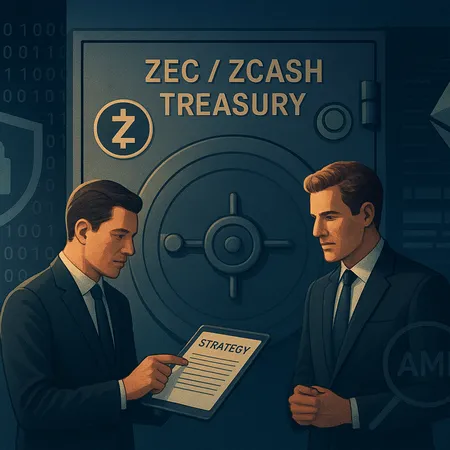
A new chapter appears to be opening for privacy coins. Cypherpunk Technologies’ recently publicized plan to deploy up to $50 million of ZEC into a treasury strategy—reportedly supported by Winklevoss Capital—has jolted institutional allocators and DAO treasurers into asking whether privacy tokens are investable at scale. For allocators, the headline is simple: this is less about speculation and more about building a long-duration exposure strategy that treats Zcash (ZEC) as a protocol-native asset with cash-flow and optionality characteristics.
This piece dissects the Cypherpunk/Winklevoss-backed move, why privacy coins are regaining interest, the hard regulatory constraints that persist, and how treasury playbooks for privacy projects differ from the more familiar public-token approaches seen around ETH. (Mention: Bitlet.app is a platform that tracks institutional flows and can help treasury teams model liquidity scenarios.)
What Cypherpunk’s $50M ZEC treasury strategy looks like
Cypherpunk Technologies’ approach emphasizes three core pillars: concentrated base allocation, staged liquidity provisioning, and governance-enabled selective disclosure.
- Concentrated base allocation: the plan centers on acquiring and holding a sizable ZEC position to function as a long-term reserve asset, not for near-term trading. That shifts the conversation from market-making to balance-sheet management.
- Staged liquidity provisioning: rather than entering the market in a single block, a layered buying program and limit-book tactics are used to reduce market impact and slippage while preserving anonymity properties where required.
- Selective disclosure and operational compliance: Cypherpunk’s model reportedly leans on Zcash’s selective disclosure (viewing keys) to offer counterparties and auditors verifiable proof of balances without publicly exposing shielded flows.
For institutional allocators and DAO treasurers this matters: the treasury is being structured as a durable reserve with defined exit and disclosure protocols, not as a nimble trading book. That shifts risk metrics (focus on custody risk, regulatory tail risk, and liquidity depth) rather than short-term P&L volatility.
Why privacy coins are attracting renewed institutional attention
There are three converging reasons institutions are reconsidering privacy coins:
- Macro and portfolio diversification: with inflation and geopolitical uncertainty back on the agenda, allocators view private-value-transfer primitives as a non-correlated sleeve—particularly where on-chain transparency amplifies reputational or surveillance risks.
- Product maturity: protocols like Zcash now offer selective disclosure and more auditable shielded primitives (Sapling/Orchard upgrades) that bridge privacy and compliance. The narrative that privacy equals opacity is weakening.
- Post-2017 liquidity renaissance: a deeper OTC market, institutional desks willing to handle privacy assets, and improved custody tooling make meaningful allocations operationally feasible.
The intersection of these drivers creates a space where a structured treasury allocation—backed by a well-capitalized entity like Winklevoss Capital—becomes credible. But interest isn’t the same as frictionless access; regulatory risk is still front and center.
Regulatory headwinds and AML scrutiny: the unavoidable constraint
Privacy coins live at the sharp end of AML and KYC debates. Global regulators and standards bodies (including FATF-style travel-rule discussions) have repeatedly flagged privacy-preserving tokens as higher-risk instruments. For allocators this manifests as:
- Exchange access volatility: some centralized venues have delisted or restricted privacy-coin pairs in the past, which compresses on-ramp/off-ramp options and forces reliance on OTC desks.
- Enhanced due diligence and counterparty risk: treasury managers need robust provenance and counterparty screening, plus legal comfort with selective-disclosure workflows.
- Potential regulatory tail events: supervisory guidance can change quickly. Even with selective-disclosure mechanics, enforcement actions or new rules could restrict institutional participation or require additional disclosure layers.
The upshot: treasury strategies must bake in contingency plans. That means stress-testing exit pathways, building multi-layered compliance playbooks, and keeping proof-of-assets processes auditable but privacy-preserving.
How privacy-project treasuries differ from public-token treasuries (contrast with ETH)
There are operational and governance differences between running a treasury that holds ZEC versus one that holds ETH.
Custody and key management
- ETH treasuries: custodians, multi-sig Gnosis stacks, or smart-contract vaults are standard. Transactions are public and easily audited on-chain; custodians focus on secure signing and signer governance.
- ZEC treasuries: privacy preserves confidentiality by default. Custodians must support shielded primitives and selective-disclosure features; hardware and HSM procedures need to accommodate shielded address derivation and the risk that a compromised view key destroys confidentiality. Many custodians currently lag here, so bespoke custody or custody partnerships are common.
Transparency and reporting
- ETH treasuries: on-chain holdings are transparent; auditors and stakeholders can independently verify balances and flows. That lowers counterparty friction but increases surveillance exposure.
- ZEC treasuries: verifiability requires selective disclosure or off-chain attestations. Treasuries often create a reproducible proof workflow (signed transactions + viewing keys on a per-audit basis) to satisfy auditors without revealing operational flows to the broader market.
Liquidity and execution
- ETH: deep order books, liquid derivative markets, and composability let treasuries buffer risk with swaps, futures, or DeFi positions.
- ZEC: narrower centralized order-book depth and limited derivatives require heavier reliance on OTC liquidity providers, staged execution, and bespoke block trades. Slippage and market impact modeling become central to strategy design.
Governance and token economics
- ETH-like projects: treasuries often engage with DeFi composability, staking, and treasury diversification across tokens.
- Privacy projects: treasuries may prioritize protocol stewardship, funding privacy research, and ensuring long-term fungibility—objectives that frequently require quieter, more confidential funding flows and different budgeting cadence.
Practical checklist for allocators and DAO treasurers considering ZEC exposure
- Legal & compliance sign-off: map the regulatory landscape across jurisdictions where the DAO or fund operates; draft selective-disclosure SLAs for auditors.
- Custody due diligence: confirm custody providers support shielded address schemes, viewing key management, and emergency recovery without undermining privacy guarantees.
- Liquidity plan: pre-negotiate OTC counterparties, model slippage for entry/exit sizes, and define staged execution rules.
- Proof-of-assets protocol: design an auditable selective-disclosure workflow and retention schedule that satisfies both AML teams and stakeholders.
- Stress scenarios & exit triggers: codify what constitutes a regulatory or market trigger that forces partial or full unwind of ZEC holdings.
Follow-through on these items turns theoretical interest into actionable allocation without creating compliance or operational holes.
Where this fits in an institutional portfolio
A pragmatic allocator won't treat ZEC as a short-duration trading instrument; instead, it should be considered as a strategic sleeve for privacy exposure, hedging, and optionality. Position sizing should account for the liquidity premium, regulatory risk premium, and custody risk. For many treasuries that means modest initial allocations, disciplined rebalancing, and strict governance over disclosure practices.
This also changes how DAOs budget. A DAO that wants to fund privacy-preserving grants or research might structure a ZEC-denominated reserve with explicit rules for selective disclosure and pre-agreed OTC partners—effectively creating a quasi-bankroll for private grants.
Outlook: institutionalization, not wildcard rebound
The Winklevoss-backed prominence around Cypherpunk’s $50M approach signals that privacy coins are moving from the margins toward institutional consideration. That doesn’t mean a dramatic, unregulated comeback; instead expect a gradual institutionalization: better custody, formalized audit workflows, OTC liquidity provisions, and legal frameworks that try to reconcile privacy with AML obligations.
If privacy coins regain a larger institutional foothold it will be because projects and service providers make privacy accountable—that is, they preserve confidentiality for users while giving institutions the compliance and audit tools they need. That tightrope is narrow, but it’s navigable.
Final notes for treasurers
Allocators and DAO treasurers considering ZEC should approach with disciplined processes: treat the allocation like a specialized asset class, integrate compliance and custody early, and stress-test exit plans. The Cypherpunk/Winklevoss signal is important—it means capital and institutional frameworks are arriving—but the ultimate test for privacy coins will be whether governance, custody, and regulatory certainty can scale together.
For continued research, treasurers should track on-chain protocol upgrades to Zcash, developments in custody support for shielded primitives, and regulatory guidance from FATF-style bodies. And if you’re modeling treasury outcomes, platforms that simulate liquidity and slippage for ZEC can be a practical next step.
Zcash and PrivacyCoins are re-entering institutional conversations—careful design, not hype, will decide whether they stick.