Ripple, DTCC and the Institutional Race to Tokenize: Evaluating XRP and XLM as Liquidity Rails
Summary
Executive summary
DTCC’s patent language that cites XRP and Stellar as possible digital liquidity tokens and Ripple’s work on a bridge to Wall Street are not isolated headlines: together they reveal how legacy market utilities and fintech builders are mapping crypto rails to familiar settlement workflows. For tokenization strategists and fintech partners, the key questions are practical: what role should XRP and XLM play as liquidity layers, how will a Ripple-built bridge integrate with custodians and banks, and which regulatory and operational frictions matter most when scaling tokenized asset settlement?
Why the DTCC patent matters — and what it doesn’t
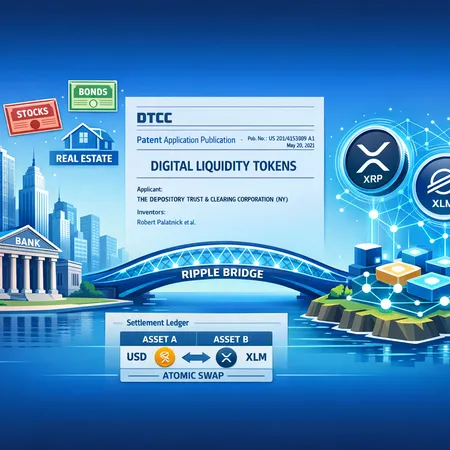
The DTCC’s patent discussion that explicitly names XRP and Stellar (XLM) as candidate digital liquidity tokens signals institutional design thinking: the industry expects on‑chain native tokens to serve as short‑term bridges between fiat legs in tokenized markets. Read in context, this is an architecture choice, not a technology endorsement. The DTCC is mapping functional requirements — low volatility settlement windows, high throughput, mature reconciliation — and identifying token types that could meet those needs.
Practically, the patent does three things for the market:
- It normalizes the concept that a centralized market utility will rely on native digital tokens for intraday liquidity rather than exclusively on fiat nostro/vostro nets.
- It creates a menu of technical requirements (throughput, finality, monitoring hooks) that network designers and custodians must satisfy to be considered by incumbents.
- It telegraphs incentives: vendors that can demonstrate regulated custody, predictable liquidity, and integration adapters will be prioritized in proofs of concept. See the DTCC patent coverage for specifics.
But be cautious: naming in a patent is not the same as operational adoption. Institutional players will still demand legal opinions, custodial guarantees and audited liquidity providers before routing meaningful volumes through any token.
Ripple’s bridge for Wall Street: architecture and integration implications
Reports suggest Ripple is building a major bridge designed to connect Wall Street firms and custodians to digital markets. That bridge is about more than messaging — it is about mapping legacy settlement constructs (trade confirmations, reconciliations, netting, custody rails) onto tokenized workflows while minimizing operational change for banks.
At a high level the bridge will need to provide several capabilities:
- Protocol translation and connectivity: Translate ISO 20022/payment instructions and SWIFT‑style data into on‑chain settlement calls, while offering APIs for custodians and trading venues.
- Liquidity orchestration: On‑demand sourcing and routing of XRP (or XLM) to complete cross‑border tokenized transfers with minimal pre‑funding.
- Regulatory and audit trails: Retain immutable transaction records while enabling off‑chain attestations and reconciliations required by custodians.
- Custody integration: Support enterprise custodians (cold/hot custody separation, multi‑sig or institutional MPC) and bridges to existing trust accounting systems.
From an integration perspective, banks will want adapters that plug into existing back‑office systems. The more the Ripple bridge can emulate current settlement latencies and reporting models, the lower the operational friction. That said, meaningful integration requires joint roadmaps between vendors, custodians and regulators: settlement finality assumptions on‑chain must be reconciled with legal finality frameworks off‑chain.
For a deeper read on Ripple’s bridge project and market positioning, see the reporting on the initiative.
Technical flow, latency and liquidity considerations
A plausible settlement flow using Ripple’s bridge looks like this: an institutional order is matched, trade details are transmitted to the bridge, the bridge sources XRP/XLM liquidity via on‑chain pools or market‑making partners, executes the cross‑token settlement (tokenized asset moves and liquidity token moves), and writes back reconciliation information to the custodian. Latency targets will vary by asset class: tokenized cash‑like instruments need near real‑time settlement windows, while more complex securities may allow longer settlement finality.
Two operational levers lower friction: pre‑positioned liquidity (nostro‑style balances in XRP/XLM) and reliable market‑making, with the latter requiring credit and counterparty risk frameworks.
XRP vs XLM as liquidity rails: tradeoffs for institutions
Both XRP and XLM appear in industry discussions; they are sometimes grouped because of their design goals, but they have different product fits:
XRP (Ripple network)
- Strengths: deeper FX liquidity pools, higher on‑chain throughput for many institutional use cases, and an ecosystem focused on liquidity products like On‑Demand Liquidity (ODL). ODL specifically targets the reduction of pre‑funding needs for cross‑border flows, which maps well to tokenized asset corridors that require quick fiat‑to‑token conversions.
- Considerations: market perception and regulatory narratives influence adoption. Recent flows into and out of related products (e.g., ETF-related dynamics) can show how sensitive institutional uptake is to regulatory signals.
XLM (Stellar)
- Strengths: Stellar’s anchor model is intentionally built for asset tokenization and issuance, offering robust tools for KYC’d anchors and token issuance workflows. XLM’s design favors anchors and compliance primitives that issuers and custodians can adopt for stablecoin‑like assets or tokenized securities.
- Considerations: liquidity depth for some FX pairs may be shallower than XRP, requiring supplemental market‑making or pools.
The DTCC patent naming both tokens underscores that institutions are keeping options open: in some corridors or asset classes, XRP’s liquidity depth and Ripple tooling may be preferable; in others, XLM’s issuer‑centric model and compliance tooling could win.
Regulatory and operational hurdles for large‑scale settlement
Scaling tokenized asset settlement onto crypto rails faces several non‑trivial barriers:
- Legal classification and finality: Do tokenized shares or bonds legally transfer when an on‑chain event occurs? Regulators and custodians will require legal certainty that blockchain settlement equals legal transfer of title.
- Custody and trust models: Institutional custody standards (segregation, insured cold storage, delegated signing) need to map to blockchain key management. Many institutions will favor regulated third‑party custody or qualified custodians with audited MPC setups.
- AML/KYC and sanctions screening: On‑chain transactions must be paired with identity attestations and sanctions screening; anchors or middleware must surface compliant counterparty data.
- Accounting and reconciliations: Tokenized asset accounting standards for mark‑to‑market, collateral calls and margining require integration between on‑chain events and general ledger systems.
- Market‑making and liquidity commitments: To avoid adverse price impact, markets need committed liquidity providers or synthetic rails (e.g., temporary on‑chain liquidity pools backed by fiat pools). The industry will need contractual assurances for intraday liquidity.
- Operational resilience and dispute resolution: Institutions demand clear processes for failed transactions, rollbacks, and dispute resolution — areas where deterministic on‑chain finality can clash with traditional post‑trade processes.
Evidence of adoption friction is present in recent outflows and product hesitancy; for example, ETF‑linked products around XRP have seen heavy weekly outflows in certain windows, underscoring how market and regulatory sentiment can quickly affect institutional flows.
How institutions can approach pilots and production rollout
For tokenization strategists and fintech partners, the pragmatic path is phased and hedged:
- Start with a dual‑rail strategy. Run tokenized asset pilots that can settle over both familiar fiat rails and a crypto bridge. This reduces operational risk while measuring benefits.
- Define legal finality tests early. Obtain legal opinions for each jurisdiction and asset class demonstrating that on‑chain settlement transfers legal title or is otherwise supported by enforceable custodial frameworks.
- Partner on liquidity commitments. Negotiate market‑making arrangements or liquidity backstops for pilot corridors to ensure price stability during settlement windows.
- Integrate institutional custody from day one. Use qualified custodians or enterprise MPC solutions and make custody proofs auditable to regulators and counterparties.
- Implement robust compliance middleware. Ensure AML/KYC data is attached to on‑chain flows via attestations or oracles, and keep reconciliation channels auditable and machine readable.
- Engage regulators iteratively. Invite supervisory input during pilots to bake in reporting and consumer protections and avoid retroactive changes.
Platforms like Bitlet.app and other market infrastructure providers will need to adapt product design and settlement assumptions as these pilots scale.
Strategic takeaways for decision makers
- The DTCC’s patent language is significant: incumbents are actively imagining tokenization architectures where native tokens play the liquidity role. Treat that as a design brief rather than a technology endorsement.
- Ripple’s bridge can materially lower integration friction if it supplies enterprise‑grade adapters, custody integrations and liquidity orchestration. However, technology alone won’t win — legal, accounting and compliance assurances will.
- XRP and XLM each have merits: use XRP where FX liquidity and fast on‑chain rails reduce pre‑funding needs; use XLM where issuer control, anchors and compliance primitives are primary. A corridor‑specific approach is likely more realistic than a one‑token‑fits‑all mandate.
- Operationalizing tokenized settlement at scale requires market‑making commitments, clear legal finality, enterprise custody models and regulator engagement. Expect a multi‑year phased rollout with dual‑rail fallbacks.
For institutional teams evaluating rails today, the pragmatic playbook is to run targeted pilots, negotiate liquidity protections, and insist on custody and legal clarity before material exposure. The conversation is moving fast: alongside traditional benchmarks such as Bitcoin, tokenization and liquidity innovations are reshaping treasury and market‑making assumptions in 2026 and beyond. Practitioners in DeFi and enterprise tokenization should monitor both DTCC framing and vendor bridges as they mature.
Sources
- DTCC patent coverage naming XRP and Stellar as digital liquidity tokens: DTCC patent names XRP and Stellar as key liquidity tokens for global tokenization
- Reporting on Ripple building a bridge aimed at Wall Street firms: Ripple builds major crypto bridge for Wall Street giants
- Counterpoint on adoption friction and ETF outflows: Ripple ETFs bleed out weekly as XRP was rejected at 1.45