How March 2026’s Packed US Macro Calendar Could Re-price Bitcoin: A Tactical Playbook
Summary
Why March 2026 matters for Bitcoin
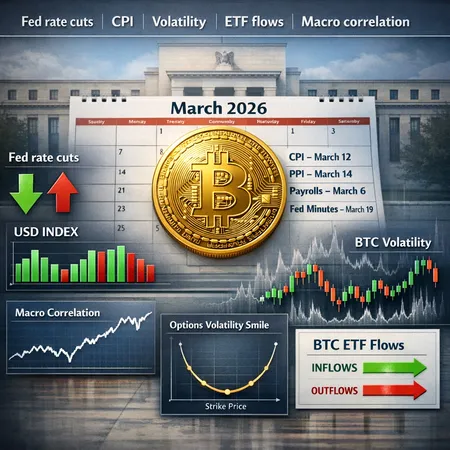
A dense sequence of US macro prints in March 2026 can do more than move rates for a day — it can re-price the probability of Fed rate cuts, which cascades through nominal yields, the dollar, equities and ETF flows that have become an important marginal buyer for BTC. Market commentary ahead of the week already flags inflation and payrolls as potential catalysts; for a compact preview see the market outlooks by CoinDesk and BeinCrypto. These releases change expectations about timing and magnitude of cuts, and that expectation shift is the key channel to Bitcoin.
The four macro releases to watch and why they matter
CPI (headline and core)
Headline and core CPI are the headline risk. Markets look at m/m prints for a read on momentum and the two‑month annualized trend for the Fed’s reaction function. A hotter-than-expected CPI raises the probability the Fed delays cutting, pushing real yields up and often strengthening the dollar—both negatives for risk assets, including BTC. For context on how traders are framing the data and potential market impacts this week, see the CoinDesk week preview and the BeinCrypto macro outlook.
PPI (Producer Price Index)
PPI is an input to CPI and an early indicator of pass‑through. A sharp surprise in PPI, especially on the core series, can change inflation trajectory expectations and widen the gap between market-implied and Fed-implied terminal rates. That shift often shows up in front-end Treasury yields and in the real yield component that historically correlates with BTC price action.
Payrolls (Nonfarm Payrolls / unemployment)
NFP remains the volatility event that tends to produce the largest intraday moves in rates and equities. Strong payrolls reduce the odds of near-term cuts and elevate real yields; weak payrolls do the opposite. Importantly, payrolls also affect risk appetite and equity correlation, which can amplify or dampen BTC moves depending on positioning in stock indices.
Fed minutes (FOMC minutes)
Minutes from the last FOMC meeting provide qualitative nuance—how concerned the Fed is about inflation stickiness, the balance of votes, and the likely timing of cuts. Minutes don’t move markets as violently as headline prints, but they can change the narrative and steepen or flatten the rate path, influencing medium-term flows into risk assets and spot BTC ETFs.
Transmission channels from macro to BTC
Rates and real yields
The clearest direct link is through rates. If market odds for Fed cuts rise, nominal and real yields typically fall; that lower yield environment supports higher valuations for long-duration, risk-on assets. Bitcoin, viewed increasingly as a risk asset and alternative store of value, has shown sensitivity to real yields—when real yields compress, BTC tends to perform better, all else equal.
USD (DXY) strength/weakness
A stronger dollar—often the immediate reaction to hotter inflation—raises the local currency price for dollar‑priced assets, which can be a drag on BTC demand from dollar‑priced buyers. Conversely, a weaker dollar on dovish surprises tends to buoy dollar‑denominated Bitcoin purchases and inflows into ETFs.
Equity correlation and risk‑on flows
BTC’s correlation with equities, especially large-cap tech, is high in risk-on/risk-off episodes. Hot macro prints that rip equities down can drag BTC with them; soft prints that lift risk appetite can result in a quicker rotation into BTC, memecoins and speculative corners of the market like some DeFi tokens or NFTs.
ETF flows (spot BTC ETFs as marginal buyer)
Spot BTC ETFs have established a structural bid for BTC. Expectations of easier monetary policy increase the attractiveness of risk assets and can mechanically lift ETF inflows as yield-seeking investors reallocate. Conversely, a hotter macro sequence that pushes back cuts can slow inflows or trigger redemptions. Monitoring daily ETF flows and AUM changes is therefore a practical way to infer macro-driven demand shifts.
Options, implied volatility and short‑term trading implications
Implied volatility (IV) dynamics
IV typically increases into macro prints—traders pay up for options to hedge tail risk. After the data, IV will re-price depending on how surprising the print is and how it shifts rate-cut odds. Expect the largest IV spikes around payrolls and CPI releases; PPI and Fed minutes can sustain or reduce IV depending on the narrative.
Skew and risk premia
When markets fear upside inflation risk (i.e., hotter data), call protection (calls) can cheapen relative to puts; put demand can push skew higher. If markets price in easier policy, call demand for upside in BTC may lift. Watch the 25‑delta risk reversal and the put/call ratio for real-time sentiment.
Gamma, dealers and intraday liquidity
Options dealers who are short gamma will hedge dynamically, buying/selling spot to remain delta‑neutral. In practice this can amplify moves: if a CPI surprise pushes BTC down, dealers buying puts will sell underlying, exacerbating the move; the reverse happens on dovish surprises that compress IV and force dealer put coverings.
Common tactical option plays
- Short-dated straddles or strangles: for traders who expect a big directional move but are uncertain of sign; expensive in high IV regimes.
- Directional call spreads: if you have a moderately bullish view on a dovish surprise but want limited cost.
- Risk reversals: buy calls/sell puts when skew favors calls (bullish bias), or the reverse for a protective put stance.
- Calendar spreads: use when you expect IV to hammer front-months but remain elevated longer out.
Each strategy should factor in execution cost, IV level, and dealer gamma; large surprises can wipe out premium-selling strategies quickly.
Two concrete scenarios and the likely market mechanics
Scenario A — Upside surprise (hotter inflation / stronger payrolls)
- Rates: Front-end and real yields move higher; Fed cut odds pushed out.
- USD: Strengthens.
- Equities: Risk-off rotation; indices fall as discount rates rise.
- ETFs & flows: Spot BTC ETF inflows slow; possible redemptions if equities sell off hard.
- BTC: Downside pressure as higher yields and a stronger dollar weigh on BTC, at least in the short term. Expect a spike in IV and a steepening of the skew toward puts.
Tactical implications: protect long spot exposure with puts or buy protective collars; if you expect an overshoot, consider buying front‑dated puts or widening risk reversals. Traders with short gamma exposure should be cautious—liquidity can evaporate.
Scenario B — Downside surprise (cooler inflation / weak payrolls)
- Rates: Yields fall; Fed cut timing is brought forward.
- USD: Weakens.
- Equities: Risk-on rally, especially for growth names.
- ETFs & flows: Spot BTC ETFs see renewed inflows as investors chase yield and risk assets.
- BTC: Bid emerges quickly; IV compresses after the move but may remain elevated if flows continue.
Tactical implications: long-dated call spreads or buying calls ahead of expected sustained flows can capture asymmetric upside. If IV is elevated, consider paired trades—buy calls and sell nearer-term calls (verticals) to finance the position while retaining upside convexity.
A practical week-by-week tactical playbook (timeframe: event → 1–4 weeks)
Pre-print positioning (24–72 hours): Reduce directional leverage; identify strike prices for options hedges; set clear stop-loss levels for spot positions. If you hold significant long exposure, buy protective puts or collars rather than adding naked leverage.
Event execution (day of print): Use limit orders and be mindful of slippage. For options traders, consider buying front‑month straddles if IV is reasonable and you expect a large move; if IV is already rich, a butterfly or defined-risk vertical may be safer.
Post-print (0–3 days): Monitor flows—watch spot ETF inflows/AUM and futures basis. If the print moves the Fed story dovish and ETF flows pick up, layering into longs on pullbacks is reasonable. If the print is hot and volatility remains elevated, wait for mean reversion before deploying capital.
Medium-term (1–4 weeks): If the Fed odds changed materially, rotate into directional trades sized to your view; for example, add call spreads on confirmed dovish repricing. Keep some capital for gamma scalps during reversion days.
Sizing & risk management: For intermediate traders, a common rule is to risk no more than 1–2% of capital on an event-driven trade, and to avoid multiple overlapping levered bets on the same macro sensitivity. Use position limits and pre-defined stop-losses; options can be sized to limit absolute dollar risk.
Execution and information edge — what to monitor in real time
- Treasury yields and real-yield moves (TIPS breakevens) — these reprice before BTC often does.
- DXY and cross-asset correlations — sudden decoupling can offer trade setups.
- Spot BTC ETF flows and daily AUM changes — feel for the marginal buyer.
- Options market: IV term structure, 25‑delta risk reversal and open interest concentration.
- Order book liquidity (on-chain and exchange) — events widen spreads; be aware of slippage.
For up-to-date previews and analysis of the week’s macro calendar, see reporting from CoinDesk and for how CPI might shift sentiment, see BeinCrypto’s primer. CryptoTicker also addresses CPI and related policy items worth watching this week.
Risk notes and caveats
Events produce binary outcomes and fast repricings. Selling premium into a high-IV environment without a clear view leaves you exposed to tail risk. Liquidity can evaporate in stressed moments—use defined-risk structures if you cannot absorb large intraday moves. Also, cross-asset dislocations (e.g., equities rallying while risk-free rates rise) can produce counterintuitive BTC responses.
Finally, remember that narratives can change quickly: what seems like a neat macro-to-BTC mapping can break when flows or technicals dominate. Tools like Bitlet.app can help manage installments, staking and P2P exposures if you’re also handling portfolio flows while trading macro events.
Quick checklist for traders (pre‑print)
- Confirm breakeven levels for CPI/PPI and market-implied Fed cut odds.
- Pre-book option strikes and max premium you’re willing to lose.
- Size positions to a fixed percent of capital; avoid adding leverage across correlated bets.
- Monitor ETF flows and futures basis throughout the session.
- Have contingency exits defined for both price and time (e.g., close within X hours if no directional move).
Conclusion
March 2026’s packed US macro schedule is a live test of how much monetary policy expectations still drive crypto prices. The mechanics are familiar—rates → USD → equities → ETF flows → BTC—but the magnitude and speed of moves depend on surprises and dealer positioning in options. For intermediate traders, the path to consistent edge is disciplined sizing, pre-defined hedges, and attentive monitoring of flows and options-skew. Keep strategies simple around big prints: protect, prefer defined risk, and let new information—rather than emotion—dictate follow‑up trades.
Sources
- BeinCrypto: Preview of the US macro week and how it could shift Bitcoin sentiment
- CryptoTicker: Market events to watch — CPI and CLARITY Act context that could move crypto prices
- CoinDesk: Crypto week ahead including US inflation and market-moving items
For many traders, Bitcoin will remain the primary bellwether this week, and cross-market moves in places like DeFi will help confirm whether flows are broadening beyond ETFs.