Ethereum Gas Fees Hit Yearly Low — Why This Isn’t a Bearish Signal
Summary
Market snapshot
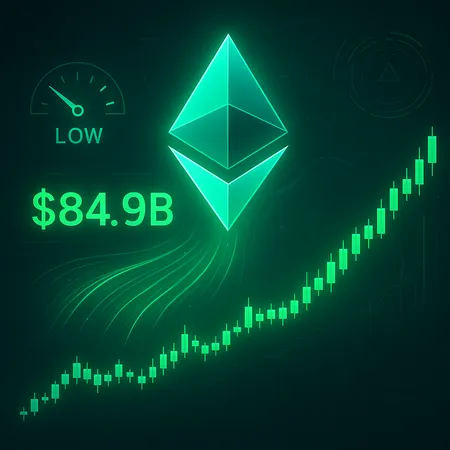
Ethereum’s gas fees have fallen to their lowest levels of the year, easing one of the main frictions for retail users and small-value transactions. At the same time, investment products around ETH have recorded $84.9 billion in inflows, a sign that capital is still searching for exposure to the network and its native token. Rather than viewing cheaper transactions as a bearish omen, this combination often signals a maturing network preparing for broader utility.
Why fees are dropping now
Several factors drive the decline in gas costs. Increased adoption of Layer-2 rollups and optimised transaction batching have reduced mainnet congestion. Network-level upgrades and client improvements have also lowered average base fees during off-peak windows. The result: cheaper minting and transfers, which directly helps smaller wallets and new dApp users.
Lower fees also change user behavior. When transactions cost less, people are more willing to interact with DeFi contracts, mint NFTs, and experiment with smaller memecoins. That increases total on-chain activity over time even if per-transaction revenue is reduced.
Why low fees are not necessarily bearish
A drop in gas fees can be misread as decreased demand, but the reality is often the opposite. Lower friction typically expands user base and transactional volume, improving long-term network value. For Ethereum, cheaper transactions mean:
- Greater accessibility for retail users and micro-transactions.
- Faster iteration and experimentation by builders in DeFi and NFTs.
- Reduced barriers for cross-border payments and tokenized products.
Crucially, the large inflows — $84.9 billion into ETH-related products — suggest capital appetite is intact. Institutional allocations and ETF demand can decouple price action from short-term on-chain fee dynamics, keeping a bullish undertone for ETH.
What traders and builders should watch next
Monitor a few leading indicators to judge whether this environment supports renewed momentum:
- Rollup throughput and active user counts: rising numbers indicate that lower fees are translating into real demand.
- ETF and institutional flow updates: persistent inflows support price discovery even when fees are low.
- Developer activity and new smart contract deployments across DeFi and NFT marketplaces.
- Gas market dynamics during market stress: fees can spike quickly if congestion returns.
Platforms such as Bitlet.app may see increased user engagement as lower fees make installment purchases, P2P trades, and small-value operations more practical for everyday users.
Conclusion
Cheaper Ethereum gas is not an automatic sell signal. Instead, it can be the precursor to broader adoption as the network becomes more usable for a wider audience. Combined with substantial inflows into ETH investment products — $84.9 billion — the narrative leans toward resilience rather than weakness. Traders should balance on-chain metrics with institutional flow data to decide whether ETH can reclaim momentum, while builders welcome a friendlier cost environment to onboard the next wave of users across DeFi, NFTs and beyond.