DeFi Safety Playbook: Defending Users and Protocols Against Fake Ads and Phishing
Summary
Overview: why fake ads and phishing are a top DeFi risk right now
Crypto users used to watch phishing emails and malicious Telegram links. Today the attack surface has expanded into search and ad networks. Threat actors are buying keywords, registering lookalike domains, and pushing sponsored adverts that appear above legitimate results — then funneling users to cloned interfaces that request wallet connections and signatures. The result can be immediate: token approvals, rug pulls, or drained wallets.
Real-world examples matter. Recent reporting shows coordinated fake ads targeting Uniswap that led to mid-six-figure losses for at least one investor and multiple wallet drains across users and chains. I’ll walk through the tactics used, practical defenses for individuals, and a remediation playbook for protocol teams and community managers. For context on ecosystem responses, platforms like Bitlet.app highlight the need for layered safeguards across UX, domain hygiene, and user education.
Anatomy of the Uniswap-targeted fake-ad campaigns
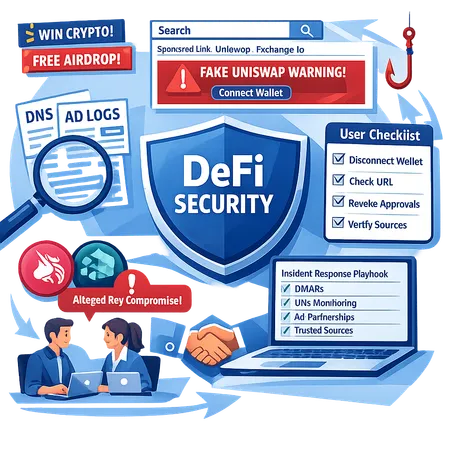
Attackers created sponsored listings that mimicked Uniswap’s branding and, crucially, showed up above official search results. Once a user clicked a malicious ad, they landed on a near-perfect clone of Uniswap’s swap UI. The page typically asks the user to connect a wallet and then prompt one or more transactions — often an “Approve” that grants a contract the ability to transfer tokens, or a crafted signature that performs an on-chain transfer.
Cointelegraph’s investigation outlines how those fake ads and spoofed pages systematically drained wallets by abusing signature approvals and misleading UX flows. The Uniswap founder publicly warned after an investor lost a mid-six-figure portfolio, which Coinpedia covered as a case study in how convincing these adverts can be when they leverage paid placement and user trust. Read the reporting on the deep-dive by Cointelegraph and the loss case summarized by Coinpedia to see the exact social-engineering steps attackers favored.
How search and sponsored results are exploited (technical and human vectors)
There are two linked axes to these attacks: (1) advertising channels and (2) UX/contract-level trickery.
Advertising: Threat actors buy exact-match and brand-keyword ads on major search engines or exploit weaker ad networks. These ads get visibility above organic results; many users click them by habit. Attackers also use typosquatting and lookalike domains (uniswap[–]app[.]xyz or similar) so the domain in the address bar looks plausible at a glance.
UX and blockchain vectors: The cloned UI requests a wallet connection; once connected, the malicious site requests one or more signatures. Common successful tricks include requesting token approvals (the ERC-20 approve flow) with unlimited allowance, or a crafted typed-data signature that the attacker converts into an on-chain transfer. Because signatures and approvals are authorized by the wallet, the actions are valid and irreversible on-chain. The Cointelegraph piece describes these specific moves and how easy it is for users to misinterpret what they’re approving.
Together, a paid ad + a believable UI + a single careless click can be enough to drain funds.
Quick defensive steps every DeFi user should adopt (immediate and ongoing)
These are practical, prioritized actions you can take today.
- Bookmark trusted dapps; avoid clicking sponsored search results. If you must search, verify the domain carefully before connecting.
- Use a hardware wallet for meaningful balances; never use a hot-wallet with large holdings for interactive dapp sessions.
- Inspect transactions: when MetaMask (or another wallet) asks for an approval, check whether it’s an ERC-20 approve, a permit, or a contract interaction that moves funds. If the approval is for an unlimited allowance, treat it as high risk.
- Revoke suspicious approvals immediately. Tools like Revoke.cash and Etherscan’s token approvals page allow you to see and cancel allowances. Make this a habit post-dapp use.
- Limit approvals with spending caps where supported; prefer one-time approvals when offered.
- Use middleware/approval guards: browser extensions and mobile wallets increasingly offer “approval guard” features that warn for dangerous patterns.
- Verify community announcements from multiple official channels (website, X/Twitter, Discord with verified server badge) before acting on claims or clicking links.
- If you suspect compromise, move unaffected funds to a fresh wallet (created offline/hardware), revoke approvals on the compromised wallet, and document the transaction hashes for any support or forensic work.
These steps directly address the attack vectors used in the Uniswap fake-ad cases and are practical for end users and community members.
Remediation and incident-response playbook for protocols and security teams
Projects must treat advertising-based phishing as an operational security problem, not just a marketing nuisance. Below is a pragmatic playbook you can adopt and adapt.
Prevention (ongoing hygiene)
- Brand and domain hygiene: proactively register common typo domains and redirect them to your canonical site. Enable DNSSEC where possible and maintain TLS certificates.
- DMARC, DKIM, SPF: enforce strict email authentication to reduce phishing via spoofed project emails. Publicly document your security contact and PGP key so security researchers and users can verify communications.
- Ads/keyword monitoring: use an ad-monitoring service or a security partner to detect when malicious ads appear for your brand keywords. Regularly search your brand and competitors from multiple vantage points (geolocated results differ).
- Partnerships with ad platforms and search engines: establish channels for expedited takedowns and register as a verified brand when platforms offer it.
- Brand monitoring & takedown SLA: subscribe to threat feeds that detect lookalike domains, social impersonations, and malvertising; set an internal SLA (e.g., 4 hours) for takedown requests.
Detection & rapid response
- Maintain a single, discoverable security contact and incident response (IR) email on your website and social profiles.
- When a phishing ad or domain is found, immediately file takedown requests with: ad platforms (Google Ads, Microsoft), domain registrars (abuse contacts), and hosting providers.
- Use on-chain analysis firms to track funds moved to exchanges; prepare legal/KYC escalation templates for exchanges to freeze funds when possible.
- Publish a clear, pinned announcement with official links and guidance for affected users; avoid ambiguous language that could feed panic.
Communication strategy
- Quick, factual alerts: explain what happened, who is affected, immediate user actions (e.g., revoke approvals, do not interact with suspicious pages), and your remediation steps.
- Provide verified links: a security page with PGP-signed updates reduces confusion.
- Coordinate with community moderators to remove malicious links in Telegram/Discord and to post official copy.
Post-incident controls
- Rotate credentials and any compromised private keys; move treasury funds into multi-sig vaults.
- Publish a postmortem with timelines and mitigations so users and partners can learn what changed.
These measures are directly usable by community managers and security teams responding to the sorts of fake-ad incidents that hit Uniswap (UNI) users.
Monitoring, partnerships and who to call for takedowns
Ad networks and search engines are where the campaign lifecycle starts. Protocols should: (1) create verified brand accounts on major ad platforms, (2) build relationships with trust and safety teams, and (3) subscribe to ad-monitoring feeds. File formal abuse reports with ad platforms and domain registrars and keep a checklist for each takedown path.
Contract tracing companies and exchanges are also important partners: if stolen funds reach centralized platforms, a properly formatted KYC/takedown request can get funds frozen while investigations proceed. On-chain analytics tools will also speed attribution and recovery attempts.
How confusing breach claims spread — the IoTeX example and verification steps
Not all alarming headlines are accurate. The IoTeX (IOTX) incident demonstrates how confusion and unverified claims can amplify. Reports about an alleged private key breach circulated rapidly, creating uncertainty among holders and projects. The core lesson: claims that sound technical are often repeated without primary evidence.
How to verify a breach claim before amplifying it:
- Check official channels: confirm the claim on the project’s verified website, official X/Twitter account, or PGP-signed statement on the security page.
- Look for forensic evidence: has the team published tx hashes, on-chain indicators, or a coordinated security advisory? Independent forensic analysis from reputable firms is a plus.
- Cross-check with reputable media and blockchain-monitoring feeds: reputable outlets will seek confirmation; look for corroborating reports.
- Contact the team’s security contact before reposting or panicking — they may already be investigating and can issue accurate guidance.
- Avoid forwarding clickbait. Misinformation fuels social-engineering campaigns and can cause unnecessary wallet interactions from users checking “status” pages.
The Coincu piece on the IoTeX confusion is a useful example of how quickly unverified assertions can travel; use it as a cautionary tale to double-check wording before sharing.
Practical checklist: put this into practice this week
- Bookmark official dapp pages and share them in your community’s pinned channels.
- Enable DMARC and publish a security contact and PGP key on your site.
- Run a domain/typo audit — register critical typos and set redirects.
- Search your own brand keywords in private browsing and via an ad-monitoring partner; report any malicious ads immediately.
- Train community moderators to remove suspicious links and to direct users to verified resources.
- Add a section to your incident response playbook for ad-driven phishing (include takedown templates and ad platform contacts).
Closing: the human layer matters as much as tech
Ad fraud and phishing lean on the same weakness: trusted behavior. Users habitually click top search results and sign prompts without stopping to verify. Projects that reduce friction for verification (clear security pages, quick takedown paths, verified social accounts) and users who adopt simple habits (hardware wallets, revoke approvals, bookmark trusted dapps) will blunt the most damaging campaigns.
For deeper reading on the specific Uniswap ad campaigns and the mid-six-figure loss case, see the investigative reporting from Cointelegraph and the case write-up covered by Coinpedia. And when confusion erupts — like the IOTX private-key chatter — follow the verification steps above before amplifying claims.
Sources
- Uniswap fake ads drain user wallets: in-depth report
- Uniswap founder warns of scam advertisements after an investor loses mid-six-figure crypto portfolio
- IoTeX faces scrutiny amid confusion over alleged private key compromise
For foundational learning on approvals and how signatures map to on-chain movements, community managers should link to their own educational FAQ and to trusted explainers on ERC-20 approvals; proactively sharing that content reduces accidental approvals. Also remember to check reputable ecosystem pages like Uniswap and broader DeFi primers when onboarding newcomers.