Prediction Markets Go Mainstream: Polymarket’s Parcl Expansion and the Maduro‑Bet Reputation Test
Summary
Why prediction markets are moving into real‑world finance
Prediction markets have long been a laboratory for price discovery on political events and crypto outcomes. Now, platforms are pursuing real‑world verticals — and Polymarket’s recent partnership with Parcl to create real‑estate prediction markets is a clear example of that shift. The move makes strategic sense: real estate offers large, fragmented data flows (sales, price indices, mortgage rates) and a huge addressable market beyond crypto natives, enabling new sources of liquidity and native hedging products for token holders.
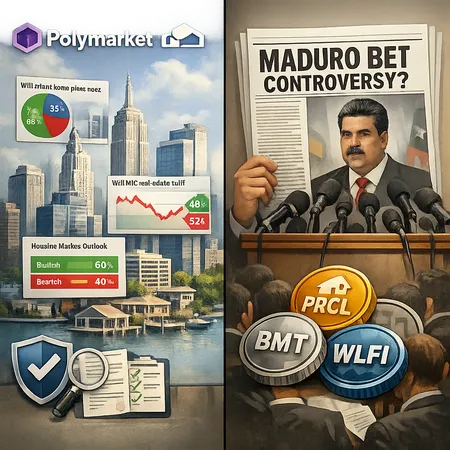
Polymarket’s Parcl partnership was announced as an effort to expand prediction markets into property and land events, creating new market categories and positioning the protocol to capture users who want to hedge macro property moves or local valuations. See the announcement for program specifics and positioning in real‑estate prediction primitives here.
For product leads this matters because it changes the risk model: predicting a political election differs materially from predicting the sale price of a private parcel or the closing status of a mortgage. Real‑world outcomes are often governed by institutional participants, regulatory filing windows, and off‑chain attestations — all of which raise governance and compliance questions that token‑native markets have only partially confronted so far.
The Maduro bet: what happened and why it matters
A separate but related risk vector emerged when a high‑profile market on Polymarket — a bet speculating about Nicolás Maduro — generated widespread media attention and accusations linking the winning account to political actors. Coverage of the controversy outlined reputational risks and questions about platform oversight and insider access; see the reporting and initial allegations here: BeInCrypto coverage of the Maduro bet controversy.
Within a short period, analytic firms and community researchers weighed in. Bubblemaps publicly pushed back on viral claims that the winning wallet had clear, politically connected ties, stressing the limits of chain‑based inference and showing alternative interpretations of wallet histories. Their rebuttal is summarized here: Bubblemaps pushback on insider claims.
Why the episode matters for risk teams is simple: even when forensic analysis mitigates an allegation, the initial news cycle can damage reputation, depress user confidence, and trigger regulatory curiosity. Quick, credible responses are essential — but so are built‑in controls that reduce both actual conflicts and the perception of them.
Token and market impacts: PRCL, BMT and WLFI as cautionary examples
Token economics and price sensitivity make prediction markets especially vulnerable to PR swings. The announcement and product news around the Parcl partnership were associated with positive market attention for projects tied to the launch — tokens such as PRCL experienced short‑term rallies as traders priced in potential adoption and liquidity. At the same time, controversy‑driven headlines around markets like the Maduro bet put tokens and platform reputations at risk, and related tickers (for example, the community‑discussed WLFI and analytics‑adjacent tokens like BMT) became focal points for speculation and narrative risk.
For compliance officers, the lesson is twofold: product rollouts can create meaningful token‑price feedback loops, and PR shocks can generate liquidity events that obscure whether trades were informationally fair or the result of privileged access. That’s why monitoring token flows, on‑chain provenance and exchange orderbook anomalies should be part of the launch playbook.
Designing controls: compliance, transparency and provenance checks
Prediction markets that touch real‑world assets must bake stronger controls into both product design and operational practice. Below are actionable controls to reduce insider‑trading accusations and improve market integrity:
Pre‑market conflict checks and disclosure: require market creators, proposers and privileged staff to disclose material relationships to the underlying real‑world asset or event. If Parcl or Polymarket staff have access to privileged property data, that must be explicit and time‑stamped.
KYC/AML tiers for sensitive markets: consider graduated KYC where high‑risk markets (e.g., private real‑estate outcomes) require identity verification for market makers or large liquidity providers. This reduces anonymous positions that look like wash or insider activity.
Provenance and wallet attestations: implement on‑chain attestations that show when admin wallets executed settlements or when oracle data was submitted. Publishing a tamper‑evident provenance trail (signed metadata and timestamps) helps independent investigators validate sequence of events.
Independent oracle and multisig resolution: use multisig, cross‑jurisdictional oracles and dispute agents for real‑world events so no single party controls finality. Combining on‑chain oracles with off‑chain attestations from licensed data providers reduces single‑point‑of‑failure accusations.
Surveillance and abnormal‑activity alerts: deploy automated surveillance that flags unusual pre‑resolution flows, sudden concentration in single wallets, or correlated trades across related tokens (including PRCL, BMT or WLFI). Integrated alerts should trigger manual review and, where warranted, temporary market pauses.
Trading blackout windows for insiders: enforce enforced blackout windows for project teams, oracle operators, and governance members during critical off‑chain events — similar to securities market insider rules.
Public dispute and remediation process: publish a clear, time‑bound dispute resolution playbook that covers evidence standards, appeals and remedial steps (refunds, bounty for forensics, or market nullification criteria).
Third‑party audits and analytics partnerships: partner with blockchain analytics firms and independent auditors for both pre‑launch reviews and post‑event investigations. While analytics can be noisy, a credible third‑party audit helps shape regulatory and community narratives.
Applying a mix of these safeguards will not eliminate all risk, but they materially raise the bar for anyone seeking to exploit privileged access and give compliance officers defensible processes to show regulators.
Governance lessons from the Maduro case and Bubblemaps pushback
The Maduro episode shows that reaction speed, source credibility and transparency are decisive. Two governance lessons stand out:
Prepare communications before controversy: platforms should have a rapid response protocol that combines legal review, forensic analysis and clear public messaging. When Bubblemaps pushed back on the viral chain‑analysis claims, the existence of rapid, methodical counter‑analysis helped prevent a single narrative from dominating indefinitely.
Invest in contested‑evidence processes: not all suspicious trades are illicit. Governance should enable fast, publicable forensic summaries that explain methodology and limits — and it should give neutral arbiters the tools to adjudicate disputes. This is especially important when markets involve named public figures or politically sensitive outcomes.
These lessons are operational: legal teams must be looped into token listings and market creation; product teams must document decision‑making and maintain immutable records; and governance bodies should have standing protocols for market pausing and remediation.
Regulatory outlook and implications for user trust
Prediction markets straddled gambling, derivatives and information‑market use cases. Moving into tangible real‑world sectors like real estate will increase regulatory interest for a few reasons:
- Markets tied to asset prices or transactional outcomes can be framed as derivatives or contracted instruments in many jurisdictions.
- Insider‑trading allegations — even if unproven — attract enforcement attention from securities regulators and gambling authorities alike.
- Consumer protection concerns rise when retail users can be exposed to markets influenced by institutional actors with privileged information.
Operators should expect closer scrutiny and should proactively engage with regulators to explain how market integrity is protected. Demonstrating programmatic controls — provenance records, KYC tiers, oracle decentralization and audit trails — will reduce friction and help sustain user trust.
User trust is equally practical. A prediction market’s product‑market fit depends on users believing outcomes will be fair and verifiable. Platforms that transparently show how outcomes were determined, who had privileged access and what remediation steps exist will enjoy a more durable user base. Bitlet.app and other P2P platforms should take note: as markets cross from pure crypto events into everyday economic events, trust and compliance must be product features, not afterthoughts.
Practical checklist for product leads, compliance officers and legal teams
- Catalog market types and assign risk tiers (low, medium, high) based on real‑world linkage.
- Require explicit disclosures and conflict declarations from market proposers and staff.
- Design KYC/AML thresholds tied to market risk and position size.
- Implement provenance chains: signed event metadata, oracle attestations and time‑stamped logs.
- Build surveillance tooling to detect pre‑resolution concentration, wash patterns and cross‑token correlations (PRCL, BMT, WLFI monitoring included).
- Predefine public communications and dispute procedures with legal sign‑off.
- Commission independent audits before major market category launches and after incidents.
- Engage regulators proactively in jurisdictions where markets touch on securities, derivatives or gambling laws.
Final takeaways
Prediction markets are evolving from crypto curiosities into utility products that can be used to hedge, speculate and price real‑world risk. Polymarket’s partnership with Parcl illustrates the strategic upside of that evolution — but the Maduro‑bet episode and its rapid spread of allegations show the downside: reputational damage, token volatility and regulatory escalation can follow quickly. Product teams that treat compliance, provenance and transparent governance as first‑class design requirements will both unlock new user segments and reduce the chance of damaging controversies.
Sources
- Polymarket expands prediction markets into real‑estate through Parcl partnership: https://thenewscrypto.com/polymarket-expands-prediction-markets-into-real-estate-through-parcl-partnership/?utm_source=snapi
- Coverage of the Maduro‑bet controversy and insider‑trading allegations: https://beincrypto.com/polymarket-maduro-bet-insider-trading-controversy/
- Bubblemaps pushback on viral WLFI insider claims: https://cryptopotato.com/maduro-bet-controversy-bubblemaps-pushes-back-on-viral-wlfi-insider-claims/