Is Ethereum’s January 2026 Breakout Sustainable? A Technical + Roadmap Assessment of ETH Re-Testing $3.6k–$4k
Summary
Executive summary
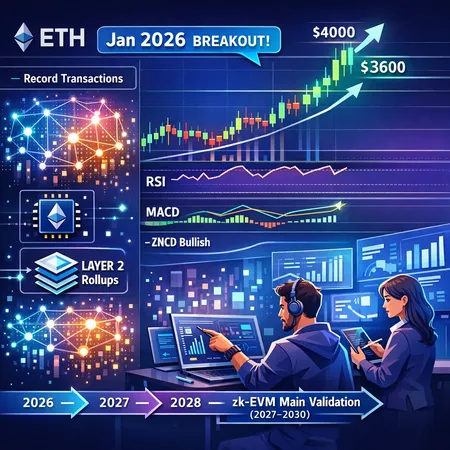
January 2026 brought a clean breakout in ETH price and a spike in network activity that’s hard to ignore. Short‑term technical models and market commentary have converged on a $3,600 target, while the longer game — driven by zk‑EVMs and layer‑2 evolution — could reshape how value accrues to ETH between 2027 and 2030. This article walks through the evidence: market momentum, technical indicators, on‑chain metrics, and the medium‑term roadmap centered on zk‑EVMs, finishing with practical positioning advice for developers and investors.
What happened in January 2026: breakout + record activity
The price move in early January was accompanied not just by rising candles but by a surge in transactions across the ecosystem. Reporting from Coinpaper captured the simultaneous breakout and a record for ecosystem transaction activity, suggesting the move had real on‑chain backing rather than being a purely macro or derivatives squeeze (Coinpaper report).
Two points stand out:
- Volume and active transactions climbed at the same time as price — a healthier signature than price rising on thin volume. Increased tx counts imply real usage: swaps, transfers, L2 settlement activity and NFT minting.
- Market commentary quickly turned bullish; short‑term price models and technical analysts pushed a $3,600 near‑term target into circulation, which in turn can become a self‑fulfilling level as stop‑losses and buy orders cluster (short‑term prediction).
Taken together, the January move looks like an on‑chain supported breakout rather than purely leverage clearing. That increases the probability of a clean re‑test of the $3.6k area in the weeks following the breakout.
Technical indicators: why $3,600 is the logical near‑term target
Technical traders triangulate targets from a mix of classical levels and momentum indicators. The most persuasive signals for a $3,600 target in the current context are:
- Resistance conversion: prior multi‑month supply zones near $3.6k act as natural targets once price breaks higher. A successful breakout typically re‑tests the breakout zone.
- Volume confirmation: rising volume during the breakout supports continuation; failure to sustain volume on a pullback would increase the odds of a false break.
- Momentum indicators: a bullish crossover in MACD plus RSI climbing from neutral to bullish band suggests momentum still has room to run before overextension.
Combine these with the short‑term models published by technical desks and commentary like the Blockchain.News piece projecting ETH to $3,600 within 4–6 weeks, and the $3,600 level is a reasonable near‑term objective (Blockchain.News analysis).
But technicals alone aren’t sufficient. Sustainability depends on whether the breakout is accompanied by persistent on‑chain demand — i.e., continued L2 settlements, DeFi flows, and real user growth.
On‑chain context: activity that matters
Not all transactions are equal. The January surge showed growth in fee‑bearing activity: DEX swipes, settlement batches from rollups, and inter‑L2 bridges. Those are the transactions that underpin durable fee revenue and utility.
Key on‑chain measures to watch:
- Active addresses and new smart contract creations (developer activity signal)
- L2 rollup settlement volumes and bridge flows (shows demand for scaling)
- Fees burned under EIP‑1559 vs fee revenue captured (impacts net issuance)
If these metrics remain elevated after the price re‑test, the case for a sustainable move toward $3.6k–$4k strengthens. If they cool quickly, the move risks being a leveraged, sentiment‑driven rally.
zk‑EVMs and the medium‑term narrative: why 2027–2030 matters
Longer term, Ethereum’s valuation story is tightly coupled to scaling architecture. Vitalik Buterin and other core contributors have publicly suggested that zk‑EVMs — zero‑knowledge proofs that validate rollup execution in a way compatible with the EVM — will become dominant for validation in the coming years. Coverage of Vitalik’s view places zk‑EVMs as the likely main validation method between 2027 and 2030 (Cryptopolitan coverage).
Why this matters for price and usage:
- zk‑EVMs can dramatically reduce the cost and latency of proving off‑chain execution back to the base layer, increasing throughput without sacrificing security.
- Better proofs mean more complex dApps can move to L2s while retaining composability and developer ergonomics similar to mainnet.
- If zk proofs become cheap and fast, base‑layer settlement becomes a cheaper coordination cost, lowering fees and changing how value accrues between L1 and L2.
That transition changes the primitives of ETH demand: demand for blockspace as a scarce good could shift, while demand for staking and fee‑burn mechanisms remains relevant.
How Layer‑2 and zk innovation affect valuation and on‑chain usage
Layer‑2s and zk‑EVM deployments will reallocate economic activity across the stack. Consider three channels where this reallocation impacts valuation:
Fee capture and burn dynamics
As more transactions settle on L2s, base‑layer transaction fees may fall, reducing direct fee revenue. However, EIP‑1559 burn still links base‑layer settlement to supply dynamics: large volumes of L2 settlements that settle on L1 could still burn ETH when included in blocks. The net effect depends on how settlement cadence and batching are priced by rollups.
Staking and security demand
Security remains a core value driver for ETH. If zk‑EVMs drive higher overall transaction volume and complex activity, demand to secure the network (and therefore the nominal value of staked ETH) could increase. Conversely, if most activity migrates off‑chain without sufficient settlement, the marginal security demand per user might decline.
Network effects and developer tooling
Composability — easy interoperability between contracts — is a key advantage for Ethereum. zk‑EVMs promise to preserve much of that composability across L2s. If developers continue to prefer the Ethereum stack, the platform retains its network effects, which supports a higher valuation multiple for ETH relative to alternative L1s.
These dynamics create a nuanced outcome: innovation may reduce direct fee capture for the base layer but increase total economic activity in the Ethereum ecosystem, which can still be bullish for ETH via staking demand, token utility and EIP‑1559 burn if settlement patterns are designed accordingly.
Risks and counterarguments
A disciplined assessment must weigh downside scenarios:
- Macro liquidity shock: a sharp risk‑off event could leave technical breakouts vulnerable regardless of on‑chain activity.
- Rollup fragmentation: divergent L2 designs and bridge failures could fragment liquidity and reduce composability, eroding Ethereum’s developer advantage.
- Execution risk on zk‑EVM timelines: if zk proofs don’t reach production speed/price thresholds quickly, optimism priced in for 2027–2030 could be premature.
- Regulatory pressure: unfavorable rulings affecting staking, exchanges or DeFi primitives could materially change demand for ETH.
Each risk lowers the odds that a near‑term re‑test sustainably transitions into a multi‑year higher valuation regime.
Positioning: what developers and investors should do
For developers
- Start integrating zk‑EVM compatibility: tooling that makes code portable between L1 and zk‑L2s will pay off as zk rollups proliferate.
- Design for optimistic settlement cadence: assume frequent L2→L1 batches and optimize for gas‑efficient verification.
- Track settlement models: different rollups will price security/settlement differently; architect dApps to be L2-agnostic when possible.
For investors/traders
- Short‑term traders can treat $3,600 as a proximate target but manage position sizing: watch volume, L2 settlement flows and BTC/macro correlation to judge sustainability.
- Medium‑term investors should consider ETH exposure as a bet on L2 adoption and zk‑EVM maturation. A staged dollar‑cost averaging approach reduces timing risk.
- Use dislocations: if on‑chain metrics diverge (price up, activity down), re‑assess conviction quickly.
If you use platform‑level tools for gradual accumulation, services like Bitlet.app make installment strategies easier — but always map allocations to risk tolerances and time horizons.
Verdict — sustainable re‑test or a short squeeze?
Near term: the January 2026 breakout, supported by record transaction activity, makes a re‑test of $3.6k highly plausible. Technical indicators and short‑term models back that target, and the presence of real on‑chain activity raises the bar for calling the move a pure squeeze.
Medium term (2027–2030): sustainability beyond $3.6k into the $4k band depends on broader adoption of zk‑EVMs and how L2 settlement economics evolve. If zk‑EVMs deliver cheaper, faster proofs and preserve composability — as Vitalik and others anticipate — Ethereum’s total addressable on‑chain activity could expand, supporting higher ETH valuations even if base‑layer fee capture per transaction declines (Vitalik on zk‑EVMs).
My balanced view: treat the near‑term breakout as a real opportunity but not an unconditional signal to overweight aggressively. The larger asymmetric upside comes from successful zk‑EVM adoption and developer retention over several years. Monitor L2 settlement volumes, fee‑burn metrics and zk proof economics — those will tell you if the $3.6k–$4k zone is the start of a new regime or a temporary peak.
Sources
- Ethereum breakout and record activity coverage: Coinpaper
- Short‑term price target analysis: Blockchain.News
- Vitalik Buterin on zk‑EVMs and future validation: Cryptopolitan
For further reading on developer tooling and layer‑2 economics, check ecosystem posts on Ethereum and DeFi.