BNB Chain’s 2025 Leap: 98% Fee Cuts, Sub‑1s Blocks — and the EVM Wallet Security Paradox
Summary
The crypto market is living two stories at once. On one side, BNB Chain’s 2025 upgrades delivered dramatic improvements in fees and latency that unlocked fresh user flows and product designs. On the other, a wave of small‑value wallet drains across multiple EVM chains is a reminder that higher throughput can amplify security gaps and attacker economics.
This article unpacks both sides: the measurable technical wins on BNB Chain, how new use cases like gasless stablecoin payments and memecoin micro‑trading raised throughput, and what the wallet‑drain incidents mean for builders and security‑conscious token projects choosing an EVM L1.
What changed in BNB Chain’s 2025 upgrade — numbers that matter
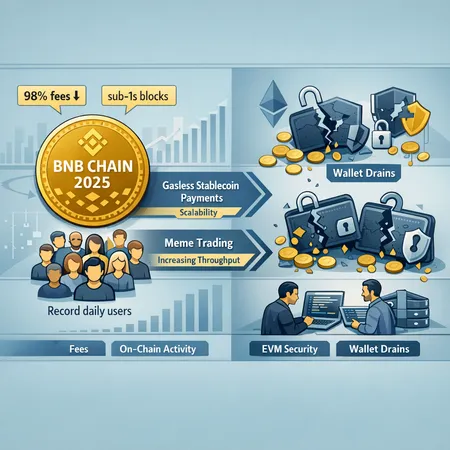
BNB Chain’s headline improvements are stark: reported upgrades that slash fees by about 98%, push toward sub‑1s block times, and coincide with record on‑chain activity — daily users reportedly hit roughly 4.8 million on peak days. These numbers are not cosmetic: they lower the cost to experiment and make UX competitive with centralized rails for many payment and micro‑transaction flows (Crypto.News report).
What that means in practice:
- Fees falling by orders of magnitude turns previously infeasible microtransactions into routine events (think stablecoin coffee‑payments or sub‑dollar meme trades).
- Sub‑1s blocks materially reduce user‑facing latency — confirmations feel near‑instant to end users, improving retention and conversion on web and mobile dApps.
- The combination increases transactions per active user: more tiny transactions, more contract calls, and more composable interactions across DeFi primitives.
Those are measurable shifts: higher daily users and transaction volumes are the immediate metrics, but the downstream effect is richer UX experiments — batched payments, streaming and gasless flows — that were previously gated by cost.
Technical levers behind the numbers
BNB Chain’s public roadmap credits a set of protocol and execution‑layer optimizations that together lower the effective gas cost per logical operation and increase throughput. The precise mix varies (consensus tweaks, execution optimizations, mempool and gas schedule changes), but the engineering theme is consistent: reduce per‑tx overhead and improve node efficiency so blocks can be produced faster with lower unit cost.
For product and infrastructure teams this translates to two actionable takeaways: first, latency and cost are now less of a blocker for creative UX; second, you must assume much higher transaction fan‑out when designing stateful systems (more callbacks, more indexer load, more events). That changes how you scale observability, retry logic and rate‑limiting.
How demand changed: gasless stablecoin payments and memecoin trading
Two demand drivers accelerated after the upgrades: gasless stablecoin payments and high‑frequency memecoin / meme‑token activity.
Gasless payments use meta‑transactions and paymaster designs (relayer models, ERC‑2771 patterns or specialized paymaster contracts) to let users send stablecoins without needing a native token balance for gas. When gas becomes cheap and fast, relayer economics improve — paymasters can subsidize or batch transactions cheaply, enabling flows like recurring micro‑payments, tipping, and in‑app purchases.
On the speculative side, memecoins thrive on low friction. Microtrades, tiny liquidity‑pool games, NFTs with microtransaction mechanics and social tipping all scale quickly when fees vanish. That increased throughput is visible in event streams: more approvals, frequent token transfers, and higher concurrency for decentralized order‑books or AMM interactions.
Together these demand factors change the shape of on‑chain traffic: more short‑lived wallets, more contract approvals, and a higher percentage of micro‑value operations — all of which have security implications discussed below.
The security paradox: rising on‑chain activity and wallet drains on EVMs
Higher throughput and cheap txs are a user‑experience win — but they alter attacker incentives. When fees are tiny, attackers can profitably run mass, low‑value extraction campaigns that would have been too expensive before. An investigative report cataloging drained wallets across EVM chains highlights this trend: hundreds of wallets across ETH and BNB ecosystems were hit, often for small sums but at scale (Cryptopolitan investigation).
This is the paradox: better scalability increases total value transacted and the number of vulnerable endpoints, making large numbers of small compromises economically worthwhile for adversaries.
Common attack vectors observed
From post‑incident analysis and on‑chain forensics, the most frequent root causes include:
- Compromised seed phrases or private keys (phishing, social engineering, malware).
- Malicious or careless contract approvals: users approve infinite or large allowances to unknown dApps and then get drained via malicious contracts.
- Exploited relayers/paymasters or compromised centralized relayer services that sign or forward malicious transactions.
- Malicious token contracts that invoke ERC‑20 callbacks or use deceptive token behavior to trick wallets.
- Third‑party wallet connectors and browser extension compromises that auto‑sign benign‑looking txs.
Some drains are low‑tech social attacks; others exploit UX and permission models that assume large‑value transactions rather than broad, high‑frequency microtransactions.
What builders must do to harden security
For L1 engineers and protocol teams building on an EVM, the response should be both architectural and operational.
- Reduce blast radius with least‑privilege patterns: design contracts and UX flows so users don’t need infinite allowances. Use permit patterns (EIP‑2612) but with clear approval scopes and expiry.
- Make approvals explicit and reversible: on‑chain allowance controllers or time‑locked approvals help recover or limit exposure if a third party is compromised.
- Provide safe defaults in SDKs and wallets: require per‑action confirmation, present human‑readable intent, and flag high‑risk operations.
- Harden relayer services and paymasters: require attestations, nonces and replay protections; monitor outbound flows and put rate limits on subsidized transactions.
- Instrument for early detection: real‑time monitoring for abnormal transfer patterns, spike detection in approvals, and automated alerts tied to on‑chain heuristics.
- Invest in audits and red‑team exercises that simulate mass small‑value drain scenarios: cheap txs change attacker economics; test for scale abuse.
- Educate integrations: projects that integrate wallets or third‑party connectors should publish clear UX guidance and provide revocation tooling.
What users and product teams should do
- Prefer hardware wallets for custody of long‑term holdings and use hot wallets only for active trading.
- Revoke unused allowances regularly (services exist that surface allowances across chains).
- Use contract wallets with recovery guardians or time‑delayed execution for significant balances.
- Limit exposure by splitting funds: keep small operational balances for active transactions, larger reserves in cold storage.
- Scrutinize wallet permissions and keep wallet software up to date; avoid approving transactions from unknown dApps.
These steps are practical and often low‑cost but stop many automated drain campaigns in their tracks.
Choosing an EVM L1: a practical checklist for engineers and product leads
When deciding whether to deploy on BNB Chain, ETH or another EVM, balance three axes: performance & UX, security & threat model, and ecosystem & integrations.
Checklist items:
- Throughput needs: Do you need high TPS and low latency for microtransactions or streaming payments? BNB Chain’s upgrades make it attractive for high‑freq flows.
- Fee sensitivity: If your product relies on sub‑dollar transactions (gasless stablecoin UX, memecoin microtrades, NFT micro‑interactions), prioritize chains with materially lower fee floors.
- Security model: Evaluate node decentralization, validator economics, and historic exploit vectors. Higher throughput doesn’t eliminate risk — it can amplify it.
- Wallet and UX integrations: Which wallet providers, custody solutions and paymaster ecosystems are mature on the chain? Stable, audited relayers matter.
- Observability & tooling: Is real‑time monitoring, indexer support and block explorer fidelity sufficient for forensic checks and alerting?
- Composability: Does the chain’s DeFi and NFT ecosystem offer the primitives you need (or will porting cost you integration debt)? Link to ecosystem pages where helpful, e.g., DeFi tooling availability.
- Operational readiness: Do you have a plan for emergency response, multisig governance, and suspected‑drain detection?
For many teams, a hybrid approach makes sense: route settlement or high‑value operations to more conservative L1s while using faster chains like BNBChain for UX‑sensitive microflows — but only with enhanced monitoring and wallet‑security practices.
Projects focused on installments, P2P exchange or recurring stablecoin flows (models similar to what services such as Bitlet.app explore) should weigh how gasless UX benefits product‑market fit versus the increased need for live security tooling and dedicated fraud detection.
Conclusion — faster rails, but not weaker locks
BNB Chain’s 2025 upgrades are a clear accelerant for creative product design: fees plummeting by ~98% and sub‑1s blocks turn microtransactions and gasless payment UX from theoretical into practical. But the rise in on‑chain activity has concurrently made mass, small‑value drains a profitable attack vector across EVM ecosystems.
For engineers and product leads, the right posture is to treat scalability and security as co‑equal design goals. Design UX assuming cheap fees, but instrument, limit and contain approvals and relayers as if funds can be exfiltrated at scale. That dual approach preserves the promise of high‑throughput chains while reducing the downside of the security paradox.
Sources
- Crypto.News — BNB Chain’s 2025 upgrades: https://crypto.news/bnb-chains-2025-upgrades-slash-fees-98-as-daily-users-hit-4-8m/
- Cryptopolitan — Wallets drained across EVM chains: https://www.cryptopolitan.com/wallets-across-evm-chains-eth-bnb-drained/