Solana into 2026: ETF Flows, Whale Moves, Upgrades, and a Q1 Trader Playbook
Summary
Executive snapshot
Solana begins 2026 as a conflicted but consequential layer-1: renewed institutional interest via spot ETFs coexists with concentrated on-chain holdings and outstanding questions about decentralization and resilience. For swing traders and allocators scanning layer-1s that could outperform in Q1 2026, the interplay between spot ETF flows (BSOL/TSOL), whale activity, and protocol upgrades will determine both upside potential and crash risk.
Spot ETF traction: numbers, nuance, and why BSOL matters
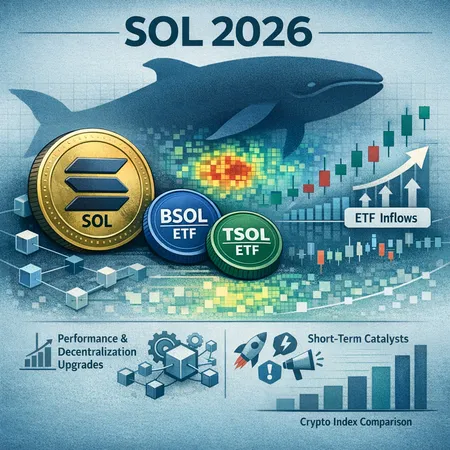
Institutional products have started to route measurable capital to Solana exposure. Recent reporting places total assets across Solana spot ETF wrappers close to $950 million, with BSOL accounting for notable fresh inflows (BSOL added roughly $2.29M in the latest update) — a signal that some institutional or cross-product flows are real and persistent (Blockonomi).
Why this matters for traders: tokenized spot ETF wrappers can compress circulating float, increase correlation between liquidity events (ETF rebalances, creations/redemptions) and price, and provide a quasi-institutional bid that wasn't present during past cycles. Products such as BSOL and related wrappers (TSOL-style tokenized-stake representations) act as both demand sinks and liquidity conduits — they blunt rapid sell-offs but can also concentrate risk around redemptions.
Whale activity and narrative signals: concentration, trackers, and what to watch
On-chain whale concentration on Solana remains a core structural risk and a narrative driver. Recent coverage of market narratives highlights whale movement as a recurring theme heading into 2026: large addresses, custodial flows, and on-chain position shifts have been picked up by trackers and market commentators as important signals for near-term price dynamics (Crypto.News).
Several practical observations from whale tracking:
- Large transfers to exchanges or custodians often precede volatility; watch for clusters of transfers rather than single small flows.
- Custodial inflows that convert SOL into tokenized products (BSOL/TSOL) can remove available sell-side supply from DEX orderbooks and create a smaller free float.
- Conversely, concentrated holdings mean a few large players can catalyze outsized moves — either bid squeezes or directional dumps.
For swing traders: treat whale signals as probabilistic — they increase event risk. Use on-chain alerts for large wallet movements, and consider tighter stops or scaled entries when whale concentration expands during low volatility windows.
Technical outlook and decentralization upgrades: catalysts that could restore traction
Solana's technical story for 2026 is twofold: performance-oriented upgrades that preserve its throughput advantage, and decentralization work aimed at improving validator distribution and resilience. Long-form analyses of potential SOL price catalysts enumerate protocol enhancements (transaction efficiency improvements, better validator economics, and tooling that reduces MEV centralization) that could re-attract builders and liquidity to the chain (U.Today).
What to watch on-chain and in releases:
- Decentralization upgrades: any meaningful shift in stake distribution (new incentive schemes, lower friction for small validators) reduces systemic risk and improves long-term sentiment. Traders should map upgrade timelines and community adoption metrics — announcements matter, but staggered rollouts and on-chain activation windows determine actual market effect.
- Performance and reliability: fixes that reduce downtime or speed recovery from congestive events materially change market-makers’ willingness to provide depth. Expect increased trading activity if reliability improves.
- Tokenized-staking dynamics (TSOL-style products): better staking wrappers that preserve liquidity without sacrificing security can attract yield-sensitive allocators — but they also interact with ETF flows and whale concentration.
Upgrades are necessary but not sufficient. Execution, timeline slippage, and UX adoption will dictate how much positive sentiment translates to price.
Price catalysts and short-term trading cues
Short-term SOL price catalysts for Q1 2026 will likely be a mix of: ETF rebalances and inflows, visible whale transfers, upgrade release milestones, and macro-driven risk-on/risk-off moves tied to broader crypto correlation with Bitcoin.
Actionable cues for swing traders:
- Track ETF AUM changes and daily inflows: step up exposure in measured increments when net inflows persist for multiple sessions.
- Monitor whale clusters on Solana block explorers and set alerts for transfers exceeding size thresholds relative to average daily volume.
- Trade upgrade news with a plan: use option-like sizing (smaller position, higher conviction near uncertain code releases) until mainnet adoption is proven.
- Pay attention to altcoin index performance as a leading indicator: when Solana leads gains in multi-asset alt indexes, momentum strategies tend to amplify moves (as seen in year-end index data) (The Currency Analytics).
Solana vs peers: index performance and how allocators should rethink positioning
Solana's recent outperformance in altcoin indexes suggests it can decouple from peers in short bursts — useful for tactical allocators. Index gains tend to draw CTA and quant attention and can produce self-reinforcing flows. That said, Solana still behaves as a high-beta layer-1: rapid upside magnifies drawdowns.
Framework for allocators:
- Tactical sleeve (5–10% of alt allocation): Add conditional exposure to SOL when ETF inflows are positive and whale movements are neutral/positive.
- Risk-off buffer: Keep exposure modest ahead of major protocol activations — upgrades can be celebrated or feared by markets.
- Use correlation hedges: if SOL's correlation with Bitcoin increases, hedge larger directional bets with BTC or inverse products rather than stablecoin cash alone.
Practical trade setups for Q1 2026
- Momentum swing: enter on daily close above a short-term moving resistance with size scaled to volatility; target first at 20–30% and trail stop to capture extended moves driven by ETF flows.
- News/upgrade play: smaller initial entry with a pivot add on confirmed mainnet activation and healthy on-chain metrics (tx throughput, lower failed txs).
- Range-reversion: if whale-driven spikes push VX right skew, look for fade opportunities once exchange inflows spike and on-chain exchange reserves rise.
Remember: centralized ETF demand can reduce volatility during accumulation, but when flows reverse, the concentrated float can exacerbate drawdowns.
Conclusion: probabilities, not certainties
Solana's positioning going into 2026 is constructive but conditional. Spot ETF traction — evident in near-$1B combined assets and steady BSOL inflows — gives a stronger bid than the chain enjoyed in previous cycles, but concentrated whale holdings and tokenized-stake dynamics keep event risk elevated. Meaningful decentralization and performance upgrades would materially improve the narrative, yet markets will reward delivered outcomes, not promises.
For swing traders and allocators targeting Q1 2026: favor disciplined, event-aware sizing; treat whale and ETF signals as core inputs; and use upgrade milestones as catalysts rather than guarantees. For those who prefer index-driven strategies, Solana's recent leadership in altcoin indices should be monitored as a short-term momentum signal, not a permanent re-rating.
Bitlet.app users evaluating allocations may find the interplay of ETF flows and on-chain signals a useful filter when building layered exposures.
Sources
- https://blockonomi.com/solana-spot-etf-update-total-assets-reach-950m-as-bsol-adds-2-29m/
- https://u.today/solana-sol-price-in-2026-possible-catalysts?utm_source=snapi
- https://thecurrencyanalytics.com/altcoins/solana-and-cronos-lead-gains-in-crypto-index-with-1-4-rise-232555
- https://crypto.news/bitcoin-narratives-solana-whales-nyc-politics-and-buffett-exit/