From Execution Layer to Financial Infrastructure: Ethereum’s Tokenization Playbook for 2026
Summary
Executive summary: a structural shift in how markets use Ethereum
Ethereum’s role is evolving. Once primarily an execution layer for smart contracts and DeFi primitives, it is now being re-conceived as a settlement and tokenization backbone for financial institutions and corporate treasuries. The argument that tokenization is putting Ethereum in a new financial spotlight captures a simple idea: when real-world assets migrate on-chain, they bring capital, counterparties, and regulatory scrutiny that change not just protocols but market structure and balance sheets. For many institutions this means reassessing ETH not only as a speculative asset but as a component of treasury strategy and settlement rails.
This report synthesizes the tokenization boom, the implications of record ETH futures activity, and the emergence of large staking treasuries like BitMNR, and then maps those forces to TVL and price dynamics into 2026.
What Ethereum tokenization actually means for real‑world asset flows
Tokenization, at its simplest, is the on-chain representation of off-chain value — from commercial real estate slices and invoices to funds and debt instruments. That representation can do three practical things that matter for treasuries:
- Enable near-instant settlement and atomic transfers between parties without moving the legal title immediately off-chain. This reduces reconciliation and counterparty risk.
- Create programmable cash flows: on-chain coupons, automated collateral triggers, and composable wrapped assets that can be reused in DeFi protocols.
- Offer fractionalization, which unlocks liquidity for traditionally illiquid assets and widens investor access.
But tokenization is not just “mint and trade.” It requires legal wrappers, custodial relationships, oracle integrity, and off-chain settlement conventions. Corporates must weigh whether a tokenized bond is truly fungible with a non-tokenized bond from a legal perspective, and whether on-chain liquidity aligns with the firm’s risk tolerance. The recent coverage arguing Ethereum’s tokenization boom is putting the chain in the financial spotlight is a reminder that regulatory and institutional plumbing will determine how deep these flows go (see the Cointribune analysis).
Institutional adoption, TVL surge forecasts, and what to expect by 2026
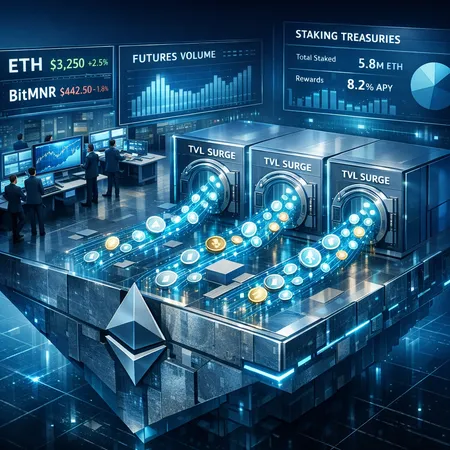
Institutional interest is the catalyst that converts theoretical tokenization into real TVL. Analysts who model institutional on-chain activity see room for substantial growth: one forecast suggests Ethereum TVL could materially increase as institutional adoption rises, potentially by double-digit percentages by 2026 under constructive adoption scenarios. That’s sensible—when mutual funds, corporate treasuries, and exchanges bring custody and settlement needs on-chain, the total value locked in protocols (lending, tokenized asset vaults, settlement rails) expands.
Two important caveats: first, not all tokenized flows translate into TVL in DeFi — some tokenization will be used for settlement only and never collateralized; second, the mix of token types matters. Tokenized short-term cash equivalents or tokenized treasuries that get rehypothecated will drive much more TVL than tokenized non-custodial certificates that are simply traded off-chain finality.
ETH futures volume and the synthetic leverage effect
In 2025 we observed record ETH futures volume on major exchanges, highlighting a bifurcation between spot demand and derivatives activity. Massive futures volumes can perform two roles simultaneously: they provide leverage and price discovery, and they create a derivatives basis that can pressure spot prices during deleveraging or forced liquidations.
For treasuries and DeFi strategists, this means that even if institutional spot flows are slowly building TVL, futures desks and market-makers can dominate short-term price action. High ETH futures volume increases market liquidity but also raises the chance that a negative funding-rate spiral or concentrated liquidations will trigger transient price stress. See Blockonomi’s reporting on the 2025 surge in ETH futures volume for a data point that underlines this dynamic.
Staking treasuries (BitMNR) — supply sink or governance player?
Large entities now treat staking as a treasury function. The recent BitMNR move to stake roughly 74,880 ETH is a bellwether: when giant treasuries choose to lock ETH in staking, they reduce effective circulating supply and anchor long-term yield expectations tied to staking rewards. That has two direct impacts:
- Reduced free float can support price if demand for ETH (for collateral or settlement) rises at the same time.
- Large stakers become governance and liquidity actors: how they manage rewards, sell-down schedules, and liquid staking choices affects market liquidity.
BitMNR’s stake — covered in the Coinpedia piece — signals that corporate-style treasury management is migrating to on-chain staking strategies. For balance-sheet managers, staking treasuries trade off immediate liquidity for yield and protocol alignment. The rise of liquid-staking derivatives further complicates the picture by converting illiquid staked ETH into tradable tokens, which can be rehypothecated in DeFi flows and thereby magnify TVL.
How these forces interact: a simple scenario framework for 2026
Think in three interacting levers: demand for tokenized assets (drives TVL), supply adjustments via staking (affects spot supply), and derivatives activity (affects short-term price dynamics).
Bull-ish institutional adoption scenario: steady onboarding of tokenized assets into lending and custody protocols plus continued staking by treasuries. TVL rises meaningfully by 2026; constrained supply and constructive demand push ETH higher. CryptoNews’ projection of TVL upside under institutional adoption maps to this scenario.
Mixed scenario: tokenization projects launch but with conservative custody/legal models that limit rehypothecation. TVL grows slower, but staking treasuries still constrict supply sporadically; futures desks create volatility but no sustained directional move.
Downside scenario: tokenization momentum stalls due to regulatory friction or weak real-world issuance; harsh derivatives deleveraging (exacerbated by concentrated whales and unrealized-loss positions) causes spot dips and delays institutional appetite. On-chain research highlights that a large portion of supply can sit in loss, and that whale accumulation patterns sometimes create opposing bets—this can precipitate short-term price pressure.
Risks to monitor: whales, unrealized losses, and short‑term pressure
On-chain evidence shows that whale behavior matters. Large holders with concentrated balances can shift from accumulation to distribution quickly, especially when a significant share of supply sits in unrealized loss. That creates asymmetric downside risk even as tokenization fundamentals improve. Derivatives amplify that risk: futures and leverage make it easier for price moves to cascade.
Operational risks are no less important. Tokenization introduces legal and custody risk (is the legal claim enforceable off-chain?), oracle and settlement risk (incorrect price feeds or failed settlement rails), and counterparty risk if tokenized assets are rehypothecated in fragile DeFi credit stacks.
Practical checklist for DeFi strategists and corporate treasuries
If you’re evaluating Ethereum as a settlement and tokenization layer, consider these practical steps:
- Legal alignment: ensure tokenized instruments have clear legal wrappers and enforceable rights in your jurisdiction.
- Custody model: choose custodians that support both cold custody and on-chain signing for settlement; evaluate multisig and MPC for operational resilience.
- Liquidity pathway: model whether tokenized assets will be rehypothecated and, if so, how that affects running exposure to liquid-staking derivatives.
- Staking treasury policy: define sell-down and reinvestment rules — large unilateral stakes (e.g., BitMNR’s) materially alter market supply assumptions.
- Derivatives exposure: monitor ETH futures volume and funding rates; stress-test treasury positions under scenarios with rapid basis moves.
- Integrations: confirm compatibility with major DeFi lending and settlement protocols to capture TVL benefits if that is a strategic goal.
Bitlet.app and similar service providers can play a role in integrating custody, settlement, and DeFi access into a single treasury workflow, but every treasury should perform independent legal and operational due diligence.
Conclusion — what to watch into 2026
Ethereum tokenization is not a click-and-trade upgrade; it is an institutional process that combines legal reform, custody innovation, and market structure shifts. If institutional adoption continues and tokenization standards mature, we should expect TVL to materially increase by 2026, supported by staking treasuries that reduce effective supply and by on-chain rails that enable faster settlement. But the path will be bumpy: ETH futures volume and concentrated whale positions can create short-term pressure that obscures long-term fundamentals.
For DeFi strategists and corporate treasuries, the opportunity is real but conditional. Prepare for composability — tokenized assets will interact with staking, derivatives, and lending — and plan treasury rules that quantify both liquidity needs and long-term protocol exposure.
Sources
- Tokenization boom puts Ethereum in the spotlight — Cointribune
- Ethereum TVL could surge with institutional adoption — CryptoNews
- Ethereum futures volume surges to record on Binance — Blockonomi
- Ethereum treasury giant BitMNR stakes $219M in ETH — Coinpedia
- Whales take opposing accumulation bets as 40% of supply stays in loss — TheNewsCrypto
For context on protocol-level developments and market indicators, see coverage on Ethereum and broader DeFi.