Why XRP’s Price Lagged Despite Network Wins: Anatomy of the 2025–2026 Disconnect
Summary
Executive overview: the paradox at a glance
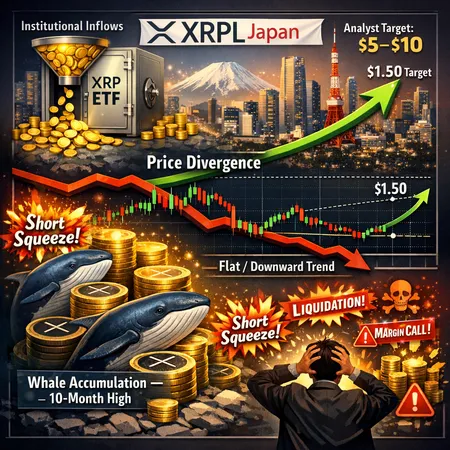
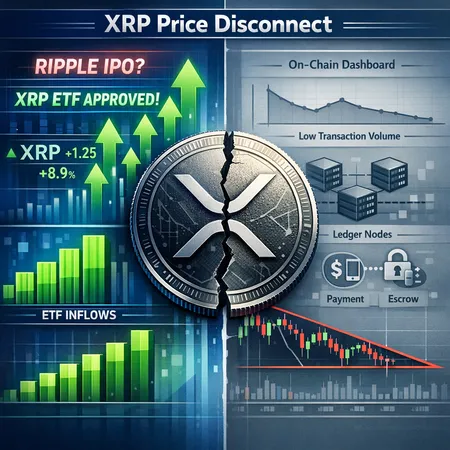
From late 2024 through early 2026, headlines around XRP looked bullish: favorable regulatory rulings reduced legal uncertainty, institutional ETF flows boosted demand for crypto broadly, and whispers of a potential Ripple IPO in 2026 added a corporate-finance narrative. Yet the market punished XRP — a price divergence that many traders called the “XRP price disconnect.” This piece unpacks why that happened, examining structural token economics, ETF dynamics versus real usage, technical setups like the symmetrical triangle, and what would need to change for a sustainable rally.
Why headlines don’t always move price: three structural reasons
1) Token utility vs payments business: different economics
Ripple the company and XRP the token occupy overlapping but distinct roles. Ripple’s payments products (xRapid, RippleNet, On-Demand Liquidity) are a commercial business that can grow revenues without requiring proportional token demand. XRP is a settlement asset and an optional liquidity rail — useful in certain corridors but not required to run Ripple’s software. That separation matters.
If Ripple signs banks or partners that prefer fiat rails or centralized liquidity pools, volumes and fees accrue to the company without meaningful on-chain XRP usage. In other words, corporate growth can coexist with stagnant on-chain metrics. Traders who expect a one-to-one relationship between Ripple’s business progress and XRP token demand misunderstand this structural decoupling.
2) ETF demand is not identical to usage demand
ETF inflows are real capital — but they represent a financial claim, often held by custodians, market makers, and long-only funds. ETFs typically buy and hold the underlying in cold storage or use derivatives, and the flows can be concentrated into a small number of custodial wallets. That creates price pressure but not the same continual volume, address growth, or transaction patterns associated with an actively used payments token.
During 2025 many ETFs and broad crypto allocation products absorbed capital that benefited large-cap coins generally. Yet these flows can also be transient: fund managers rotate, issuance mechanics change, and creation/redemption flows can mute price impact for mid-cap altcoins like XRP relative to headline inflows into the broader market.
3) Concentration, sell pressure and corporate overhang
Large XRP allocations sit with Ripple and early investors. Even with lockups and sales programs, the presence of concentrated supply creates ongoing sell pressure or at least the perception of it. Add to that the rumor cycle around a potential Ripple IPO — good news for equity investors — and you have a credible pathway for holders to monetize gains via share sales instead of token accumulation.
A planned IPO (or credible speculation of one) can paradoxically reduce token price upside if investors expect Ripple to extract value through equity markets rather than pushing token utility. See coverage suggesting Ripple may pursue a 2026 IPO and how the market positioned itself around that narrative in 2025 CoinPedia coverage of Ripple IPO prospects.
On-chain reality check: usage metrics that mattered
Active addresses, transaction volume, and ledger-based fees are more reliable signals of token utility than press releases. Throughout 2025 on-chain usage metrics for XRP showed modest, inconsistent growth. Analysts highlighted that ETF flows and corporate PR did not translate into sustained increases in unique addresses or real payment flows. That on-chain usage gap is core to the price disconnect.
Market mood improved at times — on-chain indicators and sentiment lifted in short windows — but these improvements lacked follow-through, consistent with analyst notes that improvements were tentative and could be reversed without structural change FXEmpire analysis on improving market mood.
Technicals: the triangle and short-term mechanics
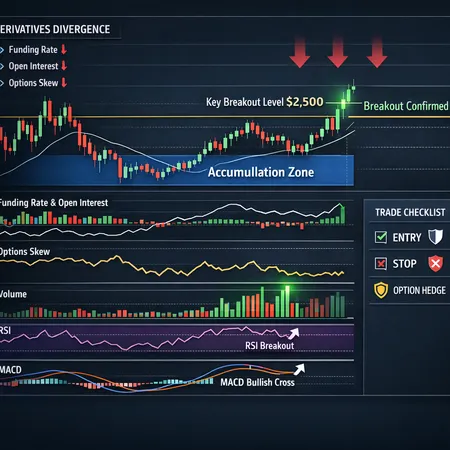
From a price-structure perspective, XRP formed a symmetrical triangle during the late-2025 to early-2026 period. Symmetrical triangles often denote consolidation: volatility compresses and a directional move of ~10% (or more) is common around a breakout. Short-term technical notes flagged a potential 10% swing depending on which way the triangle resolved NewsBTC on triangle potential.
Triangular consolidations in an otherwise weak market can produce false breakouts. For XRP, the technical pattern interacted with structural forces: reduced on-chain usage meant less conviction under a bullish breakout, while concentrated sell-side liquidity amplified moves to the downside when confidence faded.
How the news items actually played out in 2025
ETFs delivered headline flows for crypto, but evidence showed that XRP specifically struggled to capture a share of that enthusiasm; in some months XRP underperformed despite net ETF inflows into crypto instruments broadly CoinPedia on ETF inflows vs XRP price.
A sharp price drop (~25% in 2025) surprised many, triggering questions about whether regulatory wins and network improvements were priced in or simply insufficient to counter short-term sell dynamics. Analysts pointed to a mix of profit-taking, macro risk-off, and token-specific mechanics behind that crash Crypto.News explainer on the 2025 crash.
Meanwhile, chatter about a Ripple IPO added complexity: it improved the company’s corporate valuation narrative but did not automatically translate into token demand; equity monetization paths could reduce long-term selling pressure on token holders — or increase it near an IPO.
What needs to change for a sustainable rally
Sustainable rallies are rarely driven by headlines alone. For XRP to rally beyond short-lived squeezes, expect one or more of the following to materialize in measurable ways:
- Clear, persistent growth in on-chain usage: sustained rise in unique active addresses, higher settlement volumes tied to real-world corridors, and increasing ledger fees signaling economic activity.
- Supply-side shifts: transparent, credible lockups or token burns, and a meaningful decline in exchange-circulating supply that materially reduces selling pressure.
- ETF and institutional flows that convert to longer-term, accumulated holdings rather than transient trading positions — and evidence that custodians and market makers are not concentrated sellers during drawdowns.
- Concrete signs that Ripple’s commercial deals are being settled in XRP at scale rather than relying on fiat or off-chain liquidity — i.e., token utility being embedded in payment flows.
Absent these changes, headlines (including a Ripple IPO) may buoy sentiment episodically but won’t sustain a prolonged bull run.
Scenario-driven outlook (12–24 months)
Base case (50% probability)
Price action grinds sideways-to-slightly-up. Periodic rallies driven by macro risk-on and ETF rotations occur, but on-chain metrics improve only marginally. The symmetrical triangle resolves in a neutral to mildly bullish breakout (~10–30% gains), but follow-through is limited. Traders see range-bound opportunities with occasional volatility spikes.
Bull case (25% probability)
Meaningful lift in on-chain usage occurs as Ripple proves XRP’s value in specific corridors; exchange-circulating supply declines; ETF accumulation becomes persistent. A decisive triangle breakout occurs with a validated breakout volume profile, leading to a sustained multi-month rally. Positive regulatory clarity and a constructive IPO narrative elevate valuation multiples.
Bear case (25% probability)
Macro risk-off or a sudden sell program tied to an IPO equity monetization event triggers a heavy sell-off. The triangle breaks down, and XRP loses critical support, retracing 25% or more from consolidation highs. On-chain usage remains weak, and ETF flows reverse, creating liquidity vacuums.
Practical trade and risk rules for traders
Position sizing: limit any single XRP exposure to a small percentage of portfolio (e.g., 1–3% for diversified traders, smaller for leveraged positions). Concentration risk is real given supply overhang.
Entry rules: prefer confirmed breakouts with follow-through volume. For a bullish play, wait for a daily close above the triangle’s resistance + 1–2% with volume above the recent 20-day average. Avoid entering on the first impulsive move without confirmation.
Stops: set protective stops below recent structural support. For swing trades using the triangle, a conservative stop is a close below the triangle lower trendline or a fixed ATR-based stop (e.g., 1.5–2x ATR).
Risk management around news: treat Ripple IPO-related announcements as idiosyncratic liquidity events. Consider scaling out into large positive corporate headlines rather than pyramiding into them — the company can capture value outside the token.
Use on-chain checks: before adding exposure, confirm active address growth (>10% quarter-over-quarter) or a persistent increase in settlement volume. Tools that monitor ledger flows, custodial wallet behavior, and exchange inflows/outflows are valuable.
Alternative plays: if you like the narrative but distrust token mechanics, consider trading event windows (e.g., triangle resolution) with defined risk rather than long-term hold.
Separating narrative from reality: a checklist for analysts
- Ask if headlines imply token usage or corporate value extraction. If it’s the latter, value may accrue to equity holders, not token holders.
- Monitor concentration of supply and lockup schedules; compute the potential monthly sell pressure from corporate vesting plans.
- Watch custodial wallets tied to ETFs and large funds for creation/redemption patterns.
- Prioritize on-chain metrics (unique addresses, settlement volume) over press releases when forecasting sustainable demand.
For those building models or writing memos, platforms like Bitlet.app can help simulate different cash flow scenarios and sentiment shifts alongside technical triggers.
Final thoughts
The XRP price disconnect of 2025–early 2026 is a useful case study: modern crypto markets are multi-dimensional. Regulatory wins, ETF demand, and corporate milestones can all coexist with token price stagnation if the underlying token doesn’t see commensurate utility, if supply remains concentrated, or if flows are largely financial rather than usage-driven.
For traders and analysts, the path to profitable decisions runs through disciplined technical confirmation, on-chain verification, and careful risk sizing. Headlines will keep coming — but a sustainable rally needs measurable changes in how XRP is used on-chain, not just who talks about it.
Sources
- https://coinpedia.org/news/xrp-price-struggles-despite-1b-etf-inflows-analysts-explain-why/
- https://crypto.news/heres-why-the-xrp-price-crashed-by-25-in-2025/
- https://coinpedia.org/news/ripple-ipo-in-2026-analysts-rank-xrp-firm-among-top-50-billion-public-listing-candidates/
- https://www.newsbtc.com/xrp-news/xrp-triangle-potential-10-move-which-direction/
- https://www.fxempire.com/forecasts/article/xrp-news-today-market-mood-improves-as-2-reclaim-back-in-play-1569933