Zaporizhzhia and Bitcoin Mining: Geopolitics, Energy Economics, and Market Risks
Summary
Why Zaporizhzhia matters beyond headlines
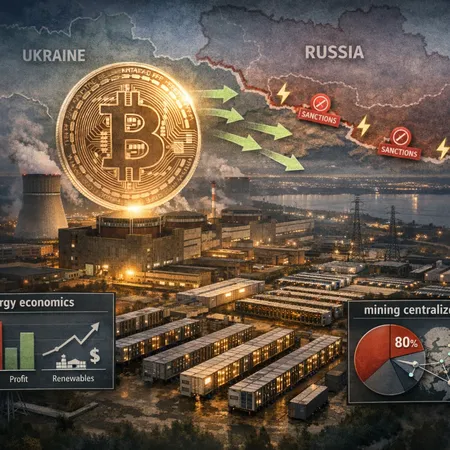
The idea of pairing Bitcoin mining with a nuclear power plant reads like a crypto era thought experiment: low-marginal-cost, continuous electricity for power-hungry ASICs. But Zaporizhzhia is not just any generator — it is one of Europe's largest nuclear facilities and a focal point of geopolitical friction. Reports that U.S. and Russian officials discussed mining at the site have therefore triggered a cross-disciplinary alarm that mixes energy economics, international law, and market risk for BTC stakeholders.
For context on how these reports surfaced, see initial reporting alleging talks in Kyiv and later Russian media amplification: Cryptonews reported on discussions held at sidelines of other meetings, while corroborating coverage summarized similar claims that the U.S. expressed interest in using electricity from Zaporizhzhia for mining in analyses such as Coinpedia's coverage. Russian outlets also framed the discussions as potential joint management and operations, which adds a layer of political narrative that merits careful parsing Cryptopolitan.
Timeline: reported discussions and media amplification
Early reports: Media outlets in late 2024–2025 carried claims that representatives from Russia and the U.S. had discussed the feasibility of locating mining operations near Zaporizhzhia. These initial stories largely stemmed from Russian media and second-hand accounts.
Corroboration and framing: Multiple outlets repeated similar details, but differences in sourcing and emphasis emerged — some described technical feasibility conversations, others framed the talks as strategic negotiations over electricity access.
Political context: The facility sits amid contested governance and international monitoring; any commercial use of its output engages not just utility economics but IAEA oversight, wartime sovereignty questions, and sanctions regimes.
This timeline matters because the narrative — not just the technical feasibility — shapes policy responses and market expectations for BTC. Institutional allocators watching energy-economic arbitrage must therefore treat the media trail as an early indicator of possible operational risk and of reputational contagion.
Technical feasibility: can a nuclear plant run large‑scale Bitcoin mining?
At a high level, yes — nuclear plants can power mining rigs. Nuclear generation offers continuous, high-capacity output and a low marginal cost per kWh once capital is sunk. Those attributes are attractive to ASIC operators accustomed to maximizing uptime and minimizing energy spend.
But the devil is in the details:
Grid interconnection and load profiles: Nuclear plants are designed for baseload, not rapid load swings. Mining loads are relatively predictable but can still require flexible distribution arrangements, transformer upgrades, and local switching infrastructure to isolate load without affecting grid stability.
On-site vs. grid export: Mining can be colocated (on-site data centers) or powered via the grid. On-site builds need cooling, physical security, and radiation-safe zoning compliance. Grid export requires long-term commercial access to specific circuits and priority dispatch agreements — legally and technically nontrivial in contested territories.
Thermal and cooling logistics: ASIC clusters need stable cooling systems. Depending on plant layout, waste-heat reuse for data center climate control is possible, but integrating systems at a nuclear site increases engineering complexity and regulatory oversight.
Safety and operations: Nuclear plants have strict operational protocols. Any commercial activity in proximity raises emergency planning and inspection questions that can introduce operational constraints.
Economically, nuclear-sourced kWh can be highly competitive for miners if access is reliable and contractual terms are favorable (low price per kWh, long-term certainty). But miners typically balance energy cost against capital cost, latency, and regulatory exposure; a low electricity price from a geopolitically risky source might be discounted heavily by institutional buyers.
Energy economics: pricing, marginal cost, and arbitrage
Bitcoin mining profitability depends on electricity price (cents/kWh), hashprice (BTC per TH/s), and capital/operational expenditure. Nuclear offers low marginal pricing potential because fuel costs are a smaller portion of total LCOE once the plant is built. That said:
Price transparency: State-run or disputed assets may price electricity differently, sometimes below market rates via subsidies or political pricing. Such opaque pricing can distort global competitive dynamics and invite regulatory scrutiny.
Opportunity cost: Power that goes to mining may displace other uses (industrial, civilian). In peacetime regulated markets, prioritizing mining over domestic demand would be politically fraught.
Long-term contracts and hedgeability: Institutional miners prize predictable power contracts. If agreements at Zaporizhzhia can be structured like traditional PPAs with legal recourse, they become more attractive; if not, price and counterparty risk will dominate valuation models.
These economics mean that even if nuclear-sourced mining appears cheaper on paper, institutional investors will factor political risk premiums and potential sanctions risk into any discounted cash flow models.
Legal, reputational, and sanctions risks
Legal and reputational exposure is arguably the most consequential vector for institutions. Using a contentious nuclear facility risks:
Sanctions breach: If the facility or the parties involved are subject to sanctions, downstream counterparties could face secondary sanctions. That risk is magnified for U.S.-dollar-denominated settlements and any U.S. or EU-based service providers.
IAEA and international law: The International Atomic Energy Agency's oversight duties and safety mandates could be implicated by commercial projects that change plant operations or introduce foreign personnel.
Reputational contagion: Funds or custodians with exposure to a miner operating at a controversial site could face client pushback or regulatory inquiries. ESG-focused allocators may be particularly sensitive, and trustees have fiduciary duties to avoid legal non-compliance.
These risks mean that even technically viable deals may be commercially uninsurable or excluded by institutional policies.
Mining geography and centralization: what changes?
A major, politically-backed move to site mining at large centralized generation sources could alter the geography of mining in important ways:
Increased centralization: Large, low-cost centralized power could draw a disproportionate share of hashpower to a few politically controlled sites, increasing the risk of network-level coordination or censorship.
Jurisdictional concentration: If major state actors pursue strategic mining facilities, hashpower concentration within specific jurisdictions could create single points of failure or leverage in geopolitical disputes.
Infrastructure coupling: Mining co-located with critical energy infrastructure creates mutual dependencies: attacks or sanctions targeting mining could have downstream impacts on energy operations and vice versa.
For BTC, centralization of hashpower is a governance and security concern because it raises the bar for coercive actions (51% risk, censorship of transactions) even if the practical risk remains nontrivial.
Market and policy scenarios: sanctions, contagion, and price reaction
Map three plausible scenarios and their implications for BTC and institutional exposures:
- Limited commercial deals (low political escalation)
- Outcome: A few miners secure bilateral agreements; operations are small relative to global hash rate.
- Market: Minor short-term volatility; sentiment risk but no systemic shock.
- Policy: Regulatory watchfulness; insurers selectively decline coverage.
- Strategic scale-up with joint management claims
- Outcome: Significant hashpower concentration; political framing escalates.
- Market: Heightened volatility; some funds reduce or divest exposure due to reputational risk.
- Policy: Targeted sanctions or restrictions on technology transfer; exchanges and service providers preemptively cut counterparties. This could materially impact miner revenue multiples and access to capital.
- Sanctions/containment and covert operations
- Outcome: Formal sanctions isolate facilities; mining persists through opaque intermediaries or third-country entities.
- Market: Sharp dislocations as liquidity and institutional participation fall; BTC spot and derivatives markets may see risk premia widen.
- Policy: Broader export controls on mining hardware and secondary sanctions increase compliance costs across the industry.
Institutional investors should stress-test portfolios for counterparty, custody, and operational exposures across these scenarios and consider hedges in derivatives markets or position limits.
Recommendations for institutional investors and policy analysts
Map exposures: Identify direct and indirect exposures to miners, data centers, and regional power PPAs that could be linked to politically sensitive energy sources.
Tighten counterparty due diligence: Validate electricity sources, contractual enforceability, and sanctions screening as part of KYC for mining-related counterparties.
Scenario planning: Build three-tier contingency plans that include legal triggers, market-hedge rules, and communication protocols for reputational events.
Engage energy experts: Because the intersection of nuclear operations and crypto is specialized, pair crypto due diligence with power-market modeling and legal counsel versed in sanctions and international energy law.
Monitor policy signals: Watch IAEA statements, export-control announcements, and major custodian/exchange policy updates. Services such as Bitlet.app and other platforms may adjust product offerings in response to regulatory shifts.
Closing assessment
The Zaporizhzhia discourse is less about immediate widescale deployment and more about precedent and signaling. Technically, nuclear power could be an attractive energy source for miners, but the political, legal, and reputational tail risks are large — and often underpriced by market participants focused exclusively on cents-per-kWh economics.
For institutional investors and policy analysts, the priority is not to opine on hypothetical profitability alone but to integrate geopolitics and energy-policy contingencies into risk models. That means pricing in sanction exposure, operational opacity, and the network-level implications of hashpower concentration.
Sources
- "Russia, US discuss Bitcoin mining at Zaporizhzhia nuclear power plant, sidelines Ukraine" — Cryptonews: https://cryptonews.com/news/russia-us-discuss-bitcoin-mining-at-zaporizhzhia-nuclear-power-plant-sidelines-ukraine/
- "Russia says U.S. interested in using nuclear power for Bitcoin mining" — Coinpedia: https://coinpedia.org/news/russia-says-u-s-interested-in-using-nuclear-power-for-bitcoin-mining/
- "Russia alleges U.S.-joint Bitcoin mining plant" — Cryptopolitan: https://www.cryptopolitan.com/russia-alleges-us-joint-bitcoin-mining-plant/
For further reading on market implications and mining dynamics, institutional readers may also track developments in Bitcoin coverage and how energy policy intersects with crypto on broader DeFi and mining policy pages.