XRP’s 2025 Forked Narrative: ETF Hoarding vs Price Weakness — Can Dilithium and AlphaNet Flip the Script?

Summary
The bifurcated story: heavy ETF accumulation vs a price pullback
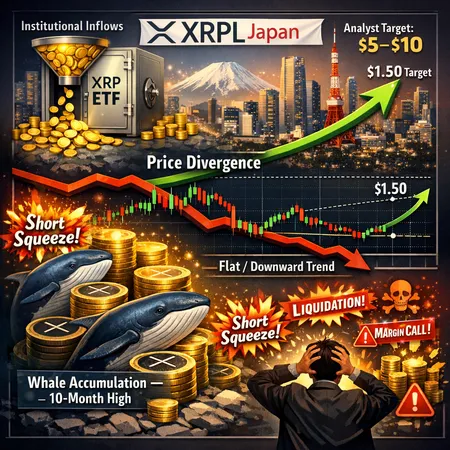
Late 2025 delivered a striking juxtaposition for XRP. On one hand, large institutional programs — most visibly Franklin Templeton’s XRP ETF — have been quietly accumulating millions of tokens, an on‑chain reality that matters for liquidity and market structure. According to reporting, Franklin Templeton’s XRP ETF crossed the 100 million XRP mark, a milestone that underlines steady institutional demand and the creation of a long-term holder base (Coinpaper).
On the other hand, XRP’s price underperformed into Q4: a technical sell-off and year‑end positioning left the token trailing broader crypto benchmarks and delivering a painful short-term narrative for traders (BeInCrypto). The result is a split story — inflows into institutional vehicles versus visible price weakness on charts and order books.
For many investors this creates a basic question: does ETF accumulation translate into durable support, or will the current price pressure swamp that effect? Later sections unpack mechanics and evidence.
What ETF flows actually do to on‑chain liquidity
ETF accumulation is not the same as retail HODL. Institutional ETFs typically source supply through authorized participants who buy in the spot market (or in some cases work with custodians) and deliver into an ETF basket. Two effects matter:
Net reduction in available float: When large blocks of XRP move into ETF custody, those tokens are effectively removed from the easily tradable pool. That can steepen order‑book depth and amplify price moves on lower-volume days. Franklin Templeton’s milestone — over 100 million XRP — is meaningful in this context because it represents a persistent balance held institutionally rather than traded intraday (Coinpaper).
Change in liquidity plumbing: ETFs tend to create a new on‑ramp for institutional demand (pensions, endowments, wealth managers). That demand is often steadier and more predictable than retail flows, but it also delegates trading to large custodians, which can increase concentrations of custody risk and change how liquidity is provisioned.
But ETFs are not a price-elixir. If broad market risk spikes — margin calls, macro shocks, or crypto-specific deleveraging — ETF shares can trade at premiums/discounts and authorized participants can redeem or create shares that temporarily increase selling pressure. In short: ETFs alter the shape and location of liquidity rather than eliminate price risk.
AlphaNet and Dilithium: why quantum resistance matters now
Parallel to the institutional story is a technical narrative: the XRP Ledger’s AlphaNet rollout of Dilithium-based cryptography. In December 2025 the XRP development community pushed a Dilithium implementation to AlphaNet as part of a roadmap toward quantum-resistant signatures and state transitions U.Today.
Why this matters strategically:
Long-term resilience: Quantum-resistant cryptography is increasingly part of institutional due diligence. Large custodians and compliance teams want assurance that a ledger’s signature scheme can withstand future threats. Demonstrating progress on Dilithium puts the XRP Ledger on a shorter list for forward‑looking custodial integration.
Differentiation vs peers: For some allocators, being early on post‑quantum upgrades becomes a tie‑breaker. The AlphaNet tests signal engineering maturity and reduce technical uncertainty — but AlphaNet is a test environment, not mainnet. Real-world security guarantees will depend on audit outcomes, community consensus, and careful migration planning.
Timing and rollout risk: A working AlphaNet proves feasibility; it does not instantly change network economics. Full integration into production requires coordinated client updates, signer migration paths, and potentially new hardware/software in custodial stacks. Expect months (or longer) between AlphaNet success and meaningful mainnet adoption.
Mentioning the technical upgrade alongside institutional flows helps explain why some investors remain constructive despite short-term price pressure: they’re buying optionality on a protocol that’s addressing a plausible long‑term threat vector.
The Q4 sell‑off: technicals, macro, and narrative fatigue
Q4’s price weakness wasn’t purely about XRP fundamentals. Several interacting forces pushed prices lower:
Technical unwind: Traders who participated in earlier rallies took profits. That rotation into fiat or into Bitcoin for perceived safe-haven flows increased sell volume.
Macro sensitivity: Risk-off moves in rates, equities, or liquidity can drive correlated selling across crypto, hitting altcoins harder than blue-chip tokens.
Overhang and sentiment: Even as ETFs accumulate, visible sell walls, exchange withdrawals, and short interest can create an impression of weak hands being flushed out — a self-fulfilling spiral. Analysts flagged that XRP ended the year with underperformance versus some expectations, underscoring the seasonal and structural pressures that can persist into Q1 (BeInCrypto).
These dynamics show why ETF demand and technical upgrades are necessary but not sufficient conditions for an immediate price rebound.
Can ETF demand offset broader market risk? — a measured answer
Short answer: it helps, but it’s not a guarantee.
Longer answer: ETF accumulation reduces available sellable supply and can provide a steady bid under certain conditions — especially when inflows are persistent and the ETF’s share creation mechanics are robust. Franklin Templeton’s build‑up is evidence that some money managers view XRP as allocable capital, and that matters (Coinpaper).
However, offsetting macro‑driven price pressure requires scale and diversification of buyers. ETF flows are one group; others include OTC desks, market makers, and protocol-level demand. If a broad deleveraging event occurs, ETFs will not be immune — authorized participants facilitate liquidity and can be vectors for large outflows or redemptions in stressed markets.
A useful analogy: ETFs are like institutional rainwater reservoirs. They collect and store capital, reducing how quickly pools of water evaporate. But a hurricane (macro shock) can still flood the landscape.
On‑chain indicators investors and analysts should watch
For practitioners weighing tech upgrades against price action, focus on signals that bridge on‑chain reality and market microstructure:
Exchange balances: Declining exchange reserves alongside ETF accumulation is a bullish structural sign. If custodial inflows exceed exchange outflows, market liquidity will tighten.
Large transfers to custodians: Watch big wallet movements labeled as custodial deposits. Franklin Templeton’s flows can be partially inferred from large transfers into known custody addresses or into cold storage.
Active accounts and payment volume on the XRP Ledger: Upgrades like Dilithium are strategic, but real adoption will show up as growing payment or issuance activity.
Open interest and funding rates in derivatives: These show how leveraged the market is. High leverage magnifies the risk of fast unwind.
ETF AUM and flow reports: Periodic disclosures about ETF holdings give direct insight into institutional demand trajectories (Coinpaper).
Combine these metrics rather than relying on any single data point.
Investment frameworks and risk management for 2026 positioning
If you’re an investor or on‑chain analyst deciding how to act, consider a layered approach:
Stage exposure: Use dollar‑cost averaging or installment purchase plans rather than lump sums. Platforms such as Bitlet.app have services that can help implement staged buys.
Hedge tail risk: Consider options, inverse ETFs, or macro hedges that protect against systemic crypto drawdowns.
Monitor upgrade milestones: Treat AlphaNet success as a positive signal but demand clear mainnet upgrade timelines and third‑party audits before increasing conviction on technical grounds (U.Today).
Watch liquidity metrics: If ETF holdings grow but exchange depth worsens, position sizing should be conservative to account for potential slippage.
Compare cross-asset opportunity: Always benchmark XRP vs alternatives like Bitcoin when considering allocation—different risk profiles and correlation behaviors affect portfolio construction (see broader comparisons in recent investor pieces on XRP vs Bitcoin) (The Motley Fool).
Conclusion — cautious optimism with active monitoring
XRP’s late‑2025 story is not a simple bull vs bear dichotomy. Franklin Templeton’s ETF accumulation is a meaningful structural development that reduces available float and signals institutional interest, while the XRP Ledger’s AlphaNet Dilithium tests strengthen the protocol’s long‑term technical case. Yet the short‑term Q4 sell‑off shows that market mechanics and macro risk can still exert powerful downward pressure.
For investors and on‑chain analysts the path forward is pragmatic: recognize the long‑term optionality that ETF flows and quantum‑resistant work provide, but respect the immediacy of order‑book dynamics and macro correlations. Use layered entry, monitor exchange and custody flows, and track AlphaNet’s migration steps to mainnet before treating the upgrade as a price catalyst.
Sources