Address Poisoning and Exchange Deposit Risks: A Practical Security Primer After the $50M USDT Theft
Summary
Why this matters now
Recent headlines about a near-$50 million USDT theft underline a simple but painful truth: attackers are exploiting routine wallet habits and exchange processes, not always complex cryptography. The incident reported by CoinGape shows how an address poisoning scheme can scale into institutional-sized losses when automated habits and insufficient operational controls collide with careless deposit flows. Understanding the mechanics and adopting concrete mitigations will reduce your exposure now, not next quarter.
What is address poisoning (mechanics and attack surface)
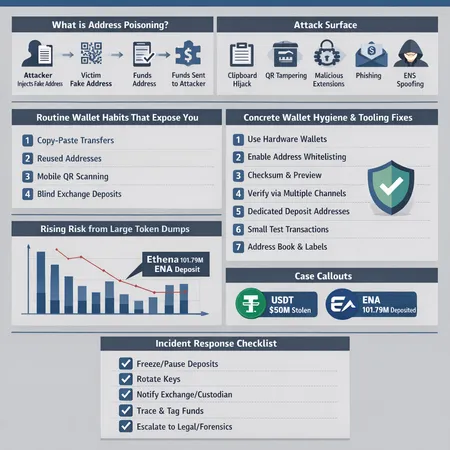
At a high level, address poisoning is any technique that causes a victim to use a malicious address instead of the intended one. Attackers can achieve this by manipulating the channels users rely on to select or paste addresses. The attack surface is broad: clipboard hijacks, compromised browser extensions, phishing pages that pre-fill address fields, typosquatted human-readable names (ENS/Unstoppable), and poisoned contact lists or token watchlists. The attacker goal is simple: replace the destination address with one they control so funds are stolen immediately after the user confirms a transaction.
Mechanically, common vectors include:
- Clipboard hijacking malware that replaces a copied address with an attacker address at paste time.
- Malicious or compromised browser extensions that intercept address inputs or modify content on popular wallet pages.
- Typosquatting and homoglyphs in human-readable names (ENS) where visual similarity fools quick verification.
- Pre-filled deposit pages or invoices from compromised services where the attacker replaces the true address with a poisoned one.
- Third-party integrations and widgets (chatbots, payment links) that propagate poisoned addresses into shared channels or contact lists.
Each vector looks different, but the common failure mode is trusting a source of an address without an independent verification step. That trust is what attackers weaponize.
How routine wallet habits expose users
Many crypto users and operations teams perform the same steps thousands of times: copy an address, paste into a wallet, confirm. That uniformity creates predictable opportunities for attackers.
- Copy/paste culture: People habitually copy addresses from emails, tweets, invoices, or explorer links and paste without verifying the full checksum or checking the hardware device’s display. A single clipboard swap is enough.
- Blind QR scanning: Quick scans at conferences, on websites, or from PDF invoices that aren’t validated on-device can redirect funds instantly.
- Unverified ENS handling: Sending to an ENS name without checking the resolved address and reverse lookup or assuming the text string equals the counterparty invites typosquatting risks.
- Over-reliance on third-party tools: Wallets that auto-fill addresses from browser history, token watchlists, or social channels can be poisoned if those tools are compromised.
- Reused addresses and automated scripts: Bots and scripts used by traders that push large or frequent transactions amplify impact — a single poisoned destination can drain high volumes.
This set of behaviors is common for both retail traders and institutional desks, which is what makes address poisoning a systemic problem rather than a marginal threat.
Concrete wallet hygiene and tooling fixes (practical, immediate)
Below are actionable controls for users, traders and security engineers. They span personal hygiene, tooling choices, and operational changes.
Foundations: tools and verification
- Use hardware wallets and always verify the full destination on-device. Hardware devices display and sign transactions independently; verify the address on the device screen instead of relying on the app UI.
- Avoid blind copy/paste. If you must paste, verify the first/last 6–8 characters and checksum (EIP-55 for Ethereum addresses). For ENS names, perform a reverse lookup to confirm ownership before sending.
- Use watch-only and address-book whitelists. Populate an address book only with addresses you’ve verified on-chain or via a secure, out-of-band channel.
- Prefer QR + device verification flows that require confirming the address on your hardware wallet screen.
Software and tooling controls
- Add clipboard monitoring on critical machines to detect address replacement. Lightweight local monitors can alert on rapid replacements during paste events.
- Use transaction simulators and mempool previews (e.g., Blocknative) for large or unusual transfers. Seeing a pending transaction summary can surface anomalous destination addresses.
- Limit ERC-20 approval exposure: use approval caps, single-use approvals, or the EIP-2612 permit where possible. Regularly run approval audits with tools like Revoke.cash.
- Enforce multisig or time-locked approvals for large transfers. Gnosis Safe and similar multisig systems require multiple signers and make poisoning at scale harder.
Operational hygiene for trading desks and custodians
- Maintain a robust deposit address policy. Never auto-credit large deposits below a manual review threshold and require additional confirmations for large or uncommon tokens.
- Build a token/address registry: canonical addresses for counterparties and cold-storage endpoints maintained off-line and signed by key operators.
- Use out-of-band confirmations for new counterparty addresses — for example, a signed message or direct voice confirmation with a known contact.
- Segregate hot and warm/cold wallets; keep exposure in hot wallets minimal and use vaulting for larger balances.
- Instrument analytics: integrate on-chain monitoring and Chainalysis-like tools to flag sudden address changes or large inbound flows that deviate from normal patterns.
The rising risk from large token dumps and exchange deposits (Ethena case)
An important parallel risk to address poisoning is the systemic impact of large, concentrated deposits to exchanges. In late-stage scenarios, an attacker or even a protocol team moving a large balance to exchanges can create liquidity shocks, rapid price moves, and operational stress that mask or exacerbate theft vectors.
A recent example: Ethena Labs deposited 101.79M ENA to exchanges, an event covered by AmbCrypto that illustrates how a single large deposit can depress price and provide opportunities for front-running or panic selling. Big deposits create windows where order books thin and slippage spikes — this is when both automated trading systems and humans make mistakes. In that turbulence, address-poisoning attackers can blend in, or threat actors can target less-observed deposit rails to siphon funds while ops focus on market stability.
From a custody perspective, large exchange-facing movements increase these risks:
- Liquidity stress: thin order books mean small sell-offs cause outsized price impact and can trigger margin calls elsewhere, causing cascading risks.
- Operational distraction: exchanges routing engineering and support resources to respond to volatility can slow fraud detection and manual reviews.
- Deposit address reuse: if large deposits are credited to shared or re-used accounts, tracing and recovery become more difficult.
Mitigations include instituting deposit caps that trigger manual review, delayed crediting for very large or unusual token deposits, pre-notification of planned large transfers, and segregated deposit addresses per counterparty.
Incident response checklist (for traders, custodians and exchanges)
Below is a concise, prioritized checklist to follow immediately after you suspect an address-poisoning event or large-exchange-deposit–triggered issue.
Immediate (first 15–60 minutes)
- Pause outbound transfers from impacted wallets and related hot keys. If you run wallet orchestration, flip to "manual" for any automated payouts.
- Capture all evidence: tx hashes, wallet addresses, screenshots, browser/extension versions, device logs, and any copy/paste history. Preserve volatile logs — they’ll help forensic teams.
- Check the on-chain status: confirm the transaction hash and trace whether funds moved to known exchange addresses or clustering tags using Etherscan, Arbiscan, or Chainalysis.
- Notify counterparties and exchanges immediately. If the funds were sent to an exchange deposit address, contact their security/ops team with full details.
Short term (1–24 hours)
- Escalate to legal and compliance — involve your in-house counsel or counsel experienced in crypto asset recovery and law enforcement notifications.
- If you’re a custodian or exchange, consider pausing deposits for the affected token or temporarily freezing inbound crediting for unreviewed deposits.
- Initiate trace and freeze requests with exchanges where funds landed. Provide transaction evidence and request chats with their security desk.
- Rotate keys for affected services if compromise is suspected at the key or device level. Bring in cold-storage to isolate unaffected funds.
Recovery & remediation (24 hours to weeks)
- Conduct a root-cause analysis: identify the vector (clipboard malware, extension, social channel, etc.) and remediate across all impacted systems.
- Revoke unnecessary approvals and reset operational processes: update deposit address policies, introduce mandatory manual review thresholds, and tighten approval limits.
- Improve detection and monitoring: deploy mempool watchers, on-chain analytics, and anomaly detection tuned to your normal transaction profiles.
- Communicate to stakeholders with a factual timeline and next steps. Transparency reduces panic and helps internal reconciliation.
Tools and vendors worth considering
- Hardware wallets: Ledger, Trezor (for address verification on-device).
- Multisig: Gnosis Safe for shared custody and time-delayed spending.
- Mempool and transaction monitoring: Blocknative and Tenderly for previews and simulations.
- Approval auditors and revokers: Revoke.cash and in-house periodic audits.
- On-chain analytics and tracing: Chainalysis, Nansen, and Etherscan for clustering and source tracing.
- Internal orchestration: hardened wallet management and key-rotation automation used by custody teams.
Platforms and services such as Bitlet.app are increasingly adding controls that let traders automate parts of these policies — but process and human verification remain essential.
Final thoughts: defenses are layered, not singular
Address poisoning preys on predictable human and operational patterns. The best defense is a layered approach: make it harder for attackers to replace addresses, reduce blast radius with policy and tooling, and ensure clear playbooks for detection and response. The ETH/USDT markets, memecoin cycles, and large token movements like Ethena’s ENA deposit are reminders that market behavior and security incidents are tightly coupled; you must prepare for both simultaneously.
For many traders, Bitcoin or a favorite DeFi pairing will be the daily focus — but it’s the mundane hygiene steps that stop the biggest losses. Build them into automation, train staff on on-device verification, and keep deposit processes conservative when large flows are involved.
Sources
- Nearly $50M in USDT Stolen After Address Poisoning Scam — CoinGape report on the central incident.
- Can Ethena Hold $0.20 After 101.79M ENA Flood Exchanges? — AmbCrypto coverage of Ethena’s 101.79M ENA deposit to exchanges.