Ethereum’s Paradox: Upgrades vs Falling On‑Chain Activity — Implications for ETH
Summary
The paradox in plain terms
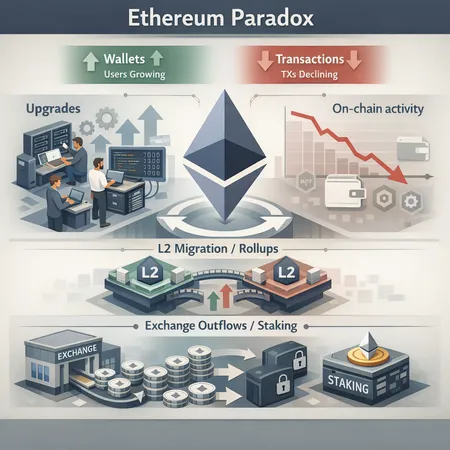
Ethereum is in an unusual moment: ambitious protocol work is underway, yet many surface-level on‑chain metrics are slipping. The roadmap emphasizes lower long‑term gas costs and a rollup‑centric future, but everyday activity on the base layer — transactions, fees, and some throughput metrics — appears muted. For many traders, Ethereum still functions as the ecosystem’s coordination layer, but what “activity” means is changing beneath our feet.
This piece balances engineering details, on‑chain flows, and the practical implications for ETH price and DeFi teams. It draws on recent reporting that outlines an intensified upgrade cadence while documenting falling base‑layer activity as well as data showing meaningful exchange outflows that market participants interpret as accumulation.
What the current engineering push actually entails
The engineering push isn’t just maintenance: it’s a deliberate pivot toward cheaper, more scalable rollups and better execution‑layer economics. That includes efforts such as proto‑danksharding (EIP‑4844) to make data availability for rollups far cheaper, execution‑client optimizations to improve node performance, and ongoing work around MEV mitigation and light clients. The goal is explicit: reduce long‑run gas barriers so Layer‑2s can host most user traffic while Ethereum remains the settlement and security layer.
Recent coverage captures this duality — upgrades are accelerating even as some on‑chain activity drops — signaling that developers and core teams are prioritizing structural throughput and long‑term UX over restoring short‑term fee income on layer‑1. See reporting that lays out the upgrade schedule and the paradoxical drop in on‑chain metrics for context (Coinspress reports on the upgrade acceleration alongside falling on‑chain activity).
Exchange outflows: accumulation or something else?
At the same time, exchange flow data shows a clear movement of ETH off centralized trading venues. On‑chain trackers have flagged large outflows — interpreted by many analysts as wallets being taken off exchanges for custody, staking, or long‑term holding rather than being available for quick selling. A recent on‑chain report quantified sizable ETH outflows, which market observers read as accumulation rather than distribution.
Flow dynamics matter because sustained net outflows reduce the liquid supply available for immediate sale, which can be supportive of price if demand returns. That observation doesn’t guarantee higher prices — but it changes the supply side of the equation and is one reason institutional stacking and staking narratives have gained traction (see NewsBTC coverage of significant exchange outflows).
Metrics: wallet growth versus falling base‑layer usage
The data picture is mixed. Wallet counts and unique addresses show long‑term growth: new wallet creation and wider distribution of ETH across addresses indicate increasing user and developer interest. At the same time, base‑layer usage metrics — transaction counts, base fees, and simple activity indicators — have declined in many periods. Analysts framing this split call it a usage‑value divergence: more wallets and more value, but fewer on‑chain transactions on L1.
An analysis comparing Ethereum to Bitcoin’s usage/value split highlights this dynamic — wallet growth can coexist with lower L1 transactional activity as users shift to off‑chain rails and Layer‑2 environments. That report helps explain why raw L1 activity is a less reliable gauge of underlying network health today than it was a few years ago (see Ambcrypto’s comparison of usage and value split between Ethereum and Bitcoin).
Why this divergence is happening: plausible explanations
1) Rollups and L2 migration
The single largest structural explanation is migration to rollups. Rollups bundle many user interactions off‑chain and post compressed data to L1, which reduces the number of native L1 transactions while increasing overall system throughput. As rollup UX and tooling improve, routine transfers, NFT sales, and many DeFi interactions move off the execution layer.
2) Batching, MEV changes and protocol efficiencies
More sophisticated batching, relay networks, and MEV‑aware middleware can compress what used to be many small transactions into fewer L1 footprints. EIP improvements aimed at making data cheaper and improving batch submission further reduce the visible L1 transaction count.
3) Staking and institutional stacking
A portion of ETH has migrated into staking‑accessible custody, long‑term wallets, and institutional treasuries. When ETH sits in staking contracts or cold storage it stops circulating on exchanges — exchange outflows reflect that behavior. This reduces immediate sell pressure and alters liquidity metrics.
4) Shifts in user behavior and off‑chain services
Wallet growth includes smart contracts and service‑wallets that serve off‑chain apps. Many consumer flows (payments, games) increasingly prefer sidechains or centralized solutions for UX reasons, which suppresses L1 transaction counts even as user counts grow.
5) Macroeconomic and market context
Lower speculative frenzy, tighter macro liquidity, or cyclical cooling of retail interest can also depress visible on‑chain activity without implying technical failure. In short: falling L1 transactions can be the result of healthier scaling, not just weaker demand.
What this means for ETH price: constructive, but conditional
The net effect on price is ambiguous but leans cautiously constructive if several conditions hold. Exchange outflows and staking accumulation shrink the marginal supply available to sell, which—combined with improving fundamentals from protocol upgrades—creates a scarcity narrative that could support the price when demand returns. If rollups deliver materially cheaper and better user experiences, that could bring new volumes and revenue opportunities back into the ecosystem, albeit mostly captured at the L2 layer.
Risk remains. If demand for crypto services does not recover, or if liquidity permanently consolidates on non‑Ethereum rails, then upgrades alone won’t create organic economic activity to justify higher valuations. Also, revenue capture shifts to rollups and L2 operators may leave L1 fee income permanently reduced; markets will price that reality.
Implications for DeFi builders and product teams
For product teams the headline is simple but stark: assume users will live on L2s. Builders must adapt UX, tooling, and tokenomics to a multi‑layer world. That means optimizing for cross‑rollup composability, considering new fee models (e.g., subscription or relayer fees), and rethinking liquidity strategies when base‑layer fees no longer fund operations as before.
Some actors will benefit: infrastructure providers, data‑availability vendors, and teams building cross‑rollup bridges. Others, especially protocols that relied on high L1 fee capture, must retool. DeFi composability is being reimagined: cross‑L2 composability and standardization will become competitive advantages.
Practical checklist: what intermediate investors and devs should watch
- Rollup TVL and active users: growing rollup metrics confirm migration and new demand. Track top rollups’ TVL and daily active users.
- Exchange flows: sustained net outflows indicate accumulation; sudden inflows may presage selling pressure. (See recent reports on large ETH outflows.)
- Fee market and base gas revenue: if fees stay low, L1 revenue models are changing; watch how much economic activity is captured by rollups versus L1.
- Upgrade milestones: proto‑danksharding and related EIPs materially affect rollup economics; delays or successful deployments change the outlook. Coinspress summarizes the acceleration of upgrades alongside dropping on‑chain activity.
- Wallet growth vs transaction counts: divergence persistence suggests structural change, not temporary noise (Ambcrypto’s analysis is useful here).
Final take: an optimistic but pragmatic view
Ethereum’s engineering sprint is purposeful and aimed at securing a rollup‑first future where the L1 provides security and settlement while L2s handle the heavy lifting. Exchange outflows and wallet growth provide bullish supply-side signals, but the real test is demand migrating back into the ecosystem in forms that create sustainable economics for both L1 and L2 stakeholders.
For intermediate investors: upgrades plus accumulation are supportive, but watch rollup adoption and liquidity dynamics. For developers: assume users will prefer L2s, double down on cross‑rollup tooling, and rethink how protocols capture value in a layered world. Platforms like Bitlet.app operate in this evolving landscape and reflect how services adapt as activity patterns shift.