Solana: Short-Term Legal Shock vs. Long-Term Institutional Tailwinds — A Trader’s Roadmap
Summary
Executive overview
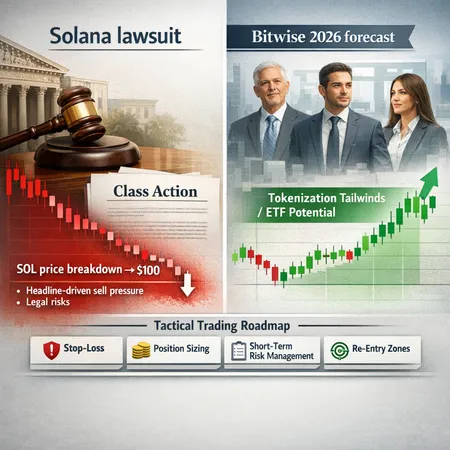
Solana’s price action is wrestling with two competing forces: legal headlines that can trigger abrupt sell pressure and institutional narratives that argue for higher long-term valuations. The recent U.S. court decision to expand a class action against actors tied to the Solana ecosystem has made the near-term risk profile more complicated. At the same time, firms like Bitwise have laid out bullish multi-year paths predicated on tokenization and increased ETF demand. This piece reconciles the short-term Solana lawsuit shock with the Bitwise forecast and offers a tactical roadmap for traders and allocators.
What changed: the class-action expansion and immediate market impact
In late coverage, a U.S. court expanded a class-action suit involving Solana‑related defendants, widening who can be held liable and increasing legal exposure for ecosystem participants. That ruling elevated headline risk and created an environment where uncertainty—rather than hard fundamentals—can drive selling. For market participants, this matters in three ways:
- Direct legal risk: extended litigation timelines, potential damages, and the chance of settlements that could drain developer funds or reduce incentive programs.
- Headline-driven volatility: markets hate uncertainty; expanded suits invite media attention and short-term leverage unwinds.
- Counterparty/credit effects: institutional counterparties may re-evaluate margin and custody exposure to SOL-linked products.
Immediate market reaction tends to be faster than legal realities. News coverage and social media amplification can produce outsized moves in one or two sessions. Traders should therefore separate legal probabilities (multi-quarter events) from price dynamics (often decided in days). For the court expansion report, see coverage that explains the broader implications and near‑term downside risk here.
Technical read: SOL price breakdown and a path toward $100
From a charting perspective, SOL recently violated several short‑term support bands and trendlines that many technical traders use as risk markers. A clean SOL price breakdown setup typically looks like this:
- Loss of momentum through mid-range moving averages (e.g., 50/100 MA on daily).
- Failure to defend prior structural support (multi-month horizontal levels).
- Rising distributed volume on down days—not just lower closes.
If these conditions persist, a downside trajectory toward ~$100 becomes plausible as stop clusters and liquidations cascade. That target is not a prediction but a technical magnet: it aligns with prior consolidation zones and psychologically important round numbers that often collect orders.
Key technical checkpoints to monitor:
- Immediate support zone: the recent lower wick area and short-term VWAP (watch intraday fills).
- Confirmed breakdown: close below the daily support with increased volume.
- Momentum invalidation: reclaiming the broken trendline and daily MAs on strong volume.
For traders, rules matter more than targets. If you’re short-term, treat a breakdown toward $100 as a scenario to trade with disciplined stops; if you’re a longer-term allocator, watch for capitulation signs and volume drying up before adding.
The long-term bull: Bitwise forecast and tokenization tailwinds
While the legal story is noisy, institutional frameworks paint a different picture. Bitwise’s research has suggested that SOL — alongside BTC and ETH — could reach new highs by 2026 as tokenization and ETF demand expand. Coverage of that bullish thesis and market expectations can be read via Bitwise reporting and market analysis pieces summarizing the forecast and its drivers (see reporting here and here).
Why tokenization tailwinds matter for Solana:
- Low transaction costs and high throughput make Solana an attractive settlement layer for tokenized assets (real estate, securities, stablecoins).
- An increase in tokenized asset issuance could create structural demand for SOL to pay fees, secure programs, and bootstrap liquidity.
- ETF and custody flows — if SOL becomes a component of broader tokenization-linked products — could attract longer-duration institutional capital.
The institutional case doesn’t erase legal risk; instead it provides the macro backdrop that could cushion or reverse declines once legal clarity improves. Long-term allocators may view present volatility as a discount window, conditional on legal outcomes and project fundamentals such as network health, developer activity, and on‑chain usage.
Tactical roadmap: reconciling legal risk with the long-term thesis
Below are pragmatic, scenario-driven strategies tailored for traders, swing participants, and portfolio managers.
Active traders (intraday / scalps)
- Trade price action, not narratives. Use smaller position sizes and tighter stops around liquidity pools and structure levels.
- If shorting a breakdown, set a stop above the nearest failed support and avoid holding through major legal headlines or court filings.
- Watch options and funding rates—short squeezes are real when retail and algos pile in.
Swing traders (days–weeks)
- Define clear invalidation levels (e.g., reclaim of a daily trendline or moving average).
- Use risk:reward rules—don’t risk >1–2% of capital on a single trade.
- Consider laddered entries: if you believe in a long-term recovery but expect more near-term volatility, scale into positions at multiple lower support levels.
Portfolio managers / allocators (months–years)
- Size exposure as a function of conviction and legal read: if you assign a moderate-to-high long-term probability, cap SOL exposure to a defined percentage of risk assets (e.g., 1–5% of liquid portfolio), increasing only after legal clarity.
- Use contingent add rules: add X% after clear legal resolution or when on‑chain metrics (active addresses, TVL) show sustained recovery.
- Consider hedging with inverses or options—buy protective puts or use correlated hedges to dampen tail risk.
Risk management playbook (concrete rules)
- Stop placement: technical invalidation point + slippage buffer (e.g., 2–4% above/below the level).
- Position sizing: risk per trade = portfolio * target risk% / (stop distance). Keep target risk small for headline-sensitive assets.
- Event risk avoidance: reduce intraday leverage around scheduled filings or court dates related to the class action.
- Liquidity hygiene: prefer liquid venues and avoid deeply discounted OTC fills during headline storms.
Putting it together: a balanced stance
Short-term, the Solana lawsuit headlines increase the odds of sharper downside and higher volatility; technically, a breakdown toward $100 is a credible scenario if volume and momentum confirm. Medium- to long-term, Bitwise’s forecast and tokenization tailwinds form a plausible recovery narrative — assuming legal outcomes are not crippling and on‑chain fundamentals remain active. Traders should treat the present moment as an environment for disciplined, event-aware tactics; allocators should size positions to reflect uncertainty while preserving upside optionality.
For many market participants, a mixed approach makes sense: smaller tactical trades around breakdowns and a modest strategic allocation that can be scaled up on legal clarity or sustained network improvements. Keep tabs on broader crypto market leadership — for example, Bitcoin moves tend to influence risk appetite — and on DeFi flows that signal real usage growth on Solana versus narrative-driven speculation.
I’ve used this framework when advising traders on headline-sensitive assets at institutions and platforms such as Bitlet.app; it emphasizes separation between legal probability and tradeable price action.
Conclusion
Legal developments like a class action expansion change the probability landscape but rarely write the final chapter. Use technical levels to manage short-term exposure, respect the possibility of a move toward $100 if the breakdown accelerates, and keep the longer-term institutional case in mind as a reason to consider measured, conditional allocations. Above all: plan entries, size positions, and hedge where appropriate.
Sources
- FXEmpire — Report on the expanded class-action and near-term downside risk: https://www.fxempire.com/forecasts/article/solana-breakdown-toward-100-begins-amid-pump-fun-fraud-lawsuit-1568339
- Crypto.News — Bitwise’s 2026 forecast and institutional drivers: https://crypto.news/bitwise-says-bitcoin-ethereum-and-solana-eye-new-highs-as-etf-demand-soars-by-2026/
- CoinGape — Coverage of Bitwise predicting new all-time highs for Solana: https://coingape.com/markets/bitwise-predicts-solana-price-will-hit-new-all-time-highs-in-2026/