Stablecoin Surge and the RWA Wave: RLUSD, XAUT, PYUSD and B3 Tokenization
Summary
Why the recent stablecoin surge matters
We are witnessing a structural inflection: monthly stablecoin adjusted volume now exceeds the transaction volume of major payments networks, and supply has been expanding rapidly year‑to‑date. That’s not just a headline — it changes how institutional treasuries think about on‑chain cash management and settlement risk.
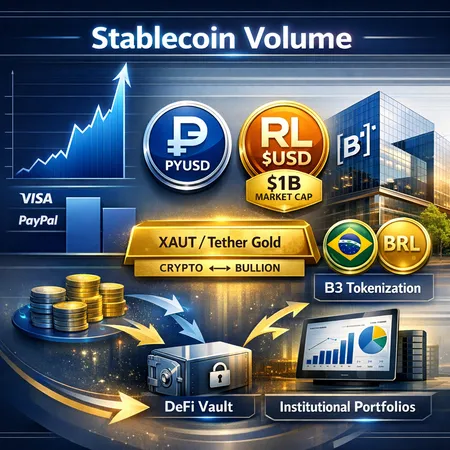
A recent market report documents that adjusted monthly stablecoin volume has surpassed giants like Visa and PayPal, while global stablecoin supply grew roughly 33% YTD, a scale signal that on‑chain dollars are being used for more than speculation — they’re becoming a parallel payments and liquidity rail for markets and institutions (Coinspeaker).
This growth isn’t evenly distributed. New entrants and product variants — notably issuer and product pairs such as PYUSD — are capturing flows by targeting merchant integration, treasury use cases, or regulatory-friendly features. For treasury teams evaluating on‑chain cash, Stablecoins now sit alongside bank deposits in shortlists for operational cash, if governance, custody and legal wrappers align.
RLUSD’s $1B milestone: why it’s more than a vanity metric
RLUSD hitting a $1 billion market cap in its first year is an indicator that demand exists for viable USD‑pegged alternatives to incumbents. The milestone suggests two things: first, product differentiation — whether through yield, collateral model, or issuance transparency — can win adoption quickly; second, the market will entertain multiple stablecoins simultaneously rather than coalescing around a single hegemon (Coinpaper).
For product leads, RLUSD’s rise is a reminder that composition matters. Some institutions prefer fully reserved, regulated issuers; others accept algorithmic or partially collateralized models if returns and composability are attractive. RLUSD’s early traction underlines how niche positioning — e.g., a tighter collateral bucket, a trusted issuer, or integration with specific DeFi rails — can create a new entrant that institutional desks watch closely.
Tokenized gold (XAUT): a bridge asset for risk and credibility
Tokenized precious metals like Tether Gold (XAUT) are emerging as bridge assets between legacy safe‑havens and on‑chain collateral. XAUT represents physical gold stored in a Swiss vault and tokenized for use on blockchains, offering a familiar store of value with blockchain settlement and programmability (Coinidol).
Why does this matter for institutions? Tokenized gold blends established investor comfort in physical assets with the efficiency of tokens: it can be used as collateral in lending markets, pair with stablecoins for hedged positions, or act as a liquidity anchor in multi‑asset treasury strategies. For risk teams skeptical of purely digital native collateral, XAUT and similar instruments provide a pragmatic step toward on‑chain allocation without abandoning traditional backing.
B3, BRL stablecoins and the RWA tokenization play in Brazil
Beyond dollar rails, national exchanges and clearinghouses are actively exploring tokenization. Brazil’s B3 has publicly discussed plans to tokenize real‑world assets (RWAs), introduce a BRL stablecoin, and integrate crypto options into stock‑market infrastructure — a significant signal that capital markets incumbents see tokenization as infrastructure rather than fringe innovation (crypto.news).
B3’s approach is instructive: when regulated market operators layer tokenization on top of existing clearing and custody frameworks, they reduce several execution and regulatory frictions for institutional participants. A BRL stablecoin issued or facilitated by a trusted market operator can speed FX settlement, improve cross‑border liquidity, and open local institutional flows to global DeFi pools while keeping compliance guardrails intact.
What RWA tokenization and stablecoin expansion mean for capital flows into DeFi and institutional portfolios
The interaction of expanding stablecoin volume, new USD alternatives like RLUSD, tokenized gold (XAUT), and national RWA initiatives means capital can move on‑chain in ways that look very different from retail flows. Institutional allocations will increasingly consider programmatic settlement, on‑chain collateral rehypothecation, and composable liquidity — but with an institutional lens on counterparty, legal recourse and custody.
Practically, larger monthly stablecoin volume translates to deeper on‑chain liquidity pools, tighter spreads for over‑the‑counter (OTC) conversions, and better execution for large trades. As RWAs are tokenized and bridged into lending and derivatives markets, treasuries can access short‑term yield on otherwise idle balances, use tokenized assets as cross‑border settlement instruments, or post RWA‑backed collateral in lending facilities.
This is already reshaping market design: DeFi protocols are integrating tokenized assets to diversify collateral baskets, and institutional participants are testing stablecoin rails for settlement and treasury optimization. For many teams, connecting existing treasury workflows to on‑chain liquidity is best done via regulated counterparties and custodians that provide legal certainty and operational hygiene. For those exploring integration, Bitlet.app and similar platforms show how tooling can present productized paths for treasury operations into DeFi rails.
Practical checklist for treasury teams, product leads and RWA strategists
- Governance and legal wrapper: Confirm the issuer’s legal domicile, redemption rights, and on‑chain governance model. Understand insolvency risk and the legal recourse path.
- Auditability and transparency: Verify reserve attestations, proof of custody for tokenized assets (e.g., XAUT’s vault arrangements), and on‑chain transparency tools.
- Liquidity and market depth: Assess monthly stablecoin volume and order book depth for the tokens you plan to use; large monthly volumes can reduce execution risk but confirm counterparty limits.
- Custody and settlement: Choose custody solutions that support tokenized RWAs and integrate with existing custodial networks and custodial insurance policies.
- Regulatory compliance: Map regulatory obligations for holding stablecoins and tokenized assets in your jurisdictions — some issuers pursue explicit bank or trust licenses that simplify compliance.
- Composability and counterparty risk: Model counterparty exposures when using stablecoins and tokenized assets as collateral in lending markets; consider segregation of assets and counterparty netting arrangements.
These operational checks are basic but essential when an institution contemplates moving even a small tranche of treasury balances on‑chain.
Conclusion — a coordinated evolution, not a replacement
The stablecoin market’s rapid growth — evidenced by surging volumes and new entrants such as PYUSD and RLUSD — coupled with tokenized RWAs and assets like XAUT, marks a coordinated evolution of institutional plumbing. It’s not about replacing bank deposits overnight; it’s about adding complementary rails that deliver programmability, cross‑border efficiency, and new collateral options.
For institutional stablecoins and RWA strategists, the question is timing and governance: when to pilot, how to limit risk, and how to stitch on‑chain liquidity into existing treasury frameworks. The coming 12–24 months will test whether these tokenized rails can deliver predictable, auditable value for large balance holders — and whether market infrastructure players like exchanges and custodians will make that adoption seamless.
Sources
- Stablecoin monthly adjusted volume surpasses Visa and PayPal: https://www.coinspeaker.com/stablecoin-monthly-adjusted-volume-surpasses-visa-and-paypal/
- RLUSD hits $1B market cap on its first anniversary: https://coinpaper.com/13188/from-launch-to-legend-rlusd-hits-1-b-market-cap-and-top-5-status-on-its-1st-anniversary?utm_source=snapi
- Tether Gold (XAUT) overview: https://coinidol.com/tether-gold-xaut/
- B3 tokenization, BRL stablecoin and RWA plans: https://crypto.news/bitcoin-bulls-test-b3s-tokenized-rwa-and-stablecoin-bet/