What the $457M Spot Bitcoin ETF Surge Means for Institutional Demand, Price Mechanics and Custody
Summary
The headline: $457M in one day — why it matters
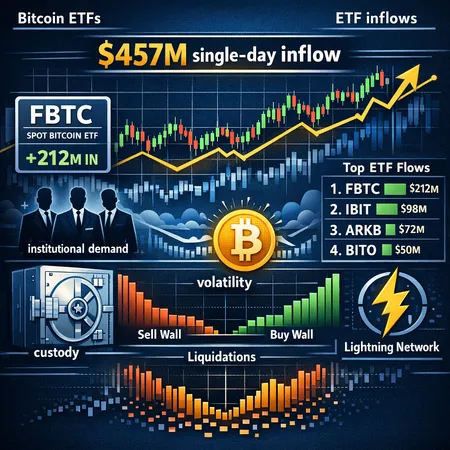
On the day markets briefly flirted with fresh highs, spot Bitcoin ETFs recorded a $457 million net inflow, a single‑day surge that reverberated through trading desks and the crypto press. Multiple outlets flagged the move: Invezz captured the headline figure and its timing ahead of inflation data, while CoinDesk highlighted that FBTC was among funds posting one of their largest inflow days in weeks. Cointelegraph framed the flows as early positioning tied to renewed institutional appetite.
This matters because ETF inflows are not just headline money — they are a visible, on‑book signal of demand from allocators who sit behind compliance walls, custody arrangements and balance‑sheet constraints. For intermediate and advanced traders, these flows change the marginal supply of BTC available to the market and therefore the short‑term microstructure around price discovery.
Who led the inflows and what funds moved the needle
ETF flow tables frequently show a concentrated picture: a handful of funds capture the bulk of net new money on any given day. On this occasion, CoinDesk noted FBTC among the top performers, reporting a top‑five inflow day for that product. That aligns with broader coverage pointing to large, cross‑product demand as institutions rotated back into spot exposure.
Why single out FBTC? Some allocators prefer particular issuers for fee structure, liquidity profile or custodian relationships. When a large allocator or multiple advisors favor a specific ticker, that fund’s creation baskets get populated first — and that immediate demand shows up in net inflows before it trickles into secondary market bids.
Why inflows matter now: macro re‑risking and market structure
The macro backdrop is a simple amplifier. With sticky inflation data, shifting rate expectations and a general appetite to re‑risk into risk assets, institutions re‑evaluating asset allocation can quickly tilt toward Bitcoin for diversification or tactical upside. Invezz explicitly connected the day’s flows to the run‑up into inflation prints, illustrating how macro events still drive short windows of concentrated ETF demand.
More structurally, increasing ETF flows alter the marginal supply curve for spot BTC. When ETF issuers create shares, authorized participants (APs) either deliver spot BTC to the fund (removing supply from the open market) or create via cash creations that require market makers to buy BTC to hedge. Both paths reduce readily available inventory and can compress order books at higher price levels, which helps explain why BTC realized volatility often ticks up around large net inflow days.
A notable side effect: ETF flows can raise BTC’s market dominance briefly. CoinDesk observed BTC dominance moving toward the 60% range during strong ETF windows — a reminder that ETF demand tends to be concentrated in the BTC market rather than across altcoins.
How ETF inflows interact with leveraged retail and liquidity dynamics
ETF inflows don’t happen in isolation. Leveraged retail positions are often tuned to funding rates, open interest and visible order book depth. When ETFs soak up spot BTC, the immediate result can be tighter offers and thinner ask liquidity for derivatives market makers hedging delta — a setup that frequently increases funding pressure on perpetuals and may precipitate liquidation cascades.
Mechanically, picture this: a large ETF creation requires market makers to buy spot. That buying lifts the spot price, pushing short positions toward margin calls and long‑levered positions into profit. If funding rates go positive and stay high, shorts facing rising mark‑to‑market losses get squeezed; add stop‑runs and you get concentrated volatility. Conversely, large redemptions inject supply and can trigger long liquidations.
That interplay explains why ETF flow days often coincide with heightened volatility despite the inflows being (nominally) bullish. Traders who ignore the friction between spot ETF mechanics and derivatives leverage do so at their peril.
Custody and settlement: qualified custody, Lightning and institutional plumbing
If ETF demand is institutional, custody becomes a gating factor. Qualified custody frameworks are no longer optional for large allocators: custodians must prove security, compliance and operational readiness to handle large, on‑chain flows tied to ETF creations and redemptions. This is where developments like BitGo adding Lightning Network support to its custody stack matter. BitGo’s integration — announced as part of expanding enterprise tooling — suggests institutions are preparing for faster, lower‑cost settlement rails and potential off‑chain payment or settlement flows.
Faster settlement can compress counterparty risk and lower the operational drag of moving BTC between exchanges, APs and custodians. For ETF mechanics, that can mean smoother creation/redemption cycles and fewer settlement mismatches that otherwise require temporary cash creations (which leave hedgers exposed). In practice, Lightning support won’t replace on‑chain custody for large transfers, but it offers settlement alternatives for smaller, high‑frequency operational flows or payments between institutional counterparties.
For allocators this matters: custody relationships, reconciliation timings and settlement windows directly affect execution slippage for large ETF allocations. Platforms such as Bitlet.app and qualified custodians are part of that ecosystem — but due diligence must still verify on‑chain proofs, insurance terms and settlement SLAs.
Price mechanics: arbitrage, creation/redemption risk and market impact
ETF arbitrage is the engine that keeps ETF secondary spreads tight: APs buy or sell spot to keep ETF price aligned with NAV. That process is generally stabilizing, but it has limits.
When flows are massive and concentrated, APs may face inventory constraints, capital limits or exchange settlement frictions that widen the bid/ask for the underlying. Two practical risks to watch:
- Creation slippage: If APs cannot source spot BTC quickly at quoted prices, cash creations may be used, which pushes the hedging cost onto market makers and can widen spreads.
- Redemption timing: Large redemptions may force APs to sell in imperfect liquidity windows, producing temporary price dislocations.
Advanced allocators need to model not only the headline ETF inflow number but also the path of that inflow — which tickers received money, whether it was AP‑facilitated in kind, and how quickly NAV and secondary prices diverged. Those micro details determine execution cost and slippage for sizable allocations.
Practical takeaways for institutional and advanced retail allocators
Position sizing and horizon
- Treat ETF inflows as a signal, not a guarantee. A concentrated inflow day like $457M suggests interest, but the persistence of that demand matters. Size positions with the timeframe in mind: shorter horizons require smaller notional and tighter stop rules.
Monitoring and tools
Track daily ETF flows, AP activity and NAV‑secondary spreads. Use flow reporters and exchange open‑interest data to see whether inflows translated into immediate spot buying or were paper rotations.
Watch funding rates and liquidation heatmaps on perpetuals: sudden positive funding coupled with ETF buy pressure is a setup for squeezes.
Arbitrage and execution risks
Be aware of creation/redemption mechanics of the specific ETF tickers you trade (e.g., FBTC). Different issuers have different AP networks and custodial arrangements that affect execution slippage.
If you run programmatic exposure, factor in potential cash creations (higher hedging cost) and temporary inventory shortfalls that widen transaction cost.
Custody and settlement checklist
For institutional allocators: insist on qualified custody with clear proof‑of‑reserve or reconciliation reports, fast settlement SLAs, and indemnities for operational errors.
Consider the role of newer settlement rails (Lightning for smaller flows) while demanding robust on‑chain custody for large movements. BitGo’s Lightning support is an example of how custody providers are evolving to meet settlement needs.
Risk management
Flex position sizing to account for liquidity risk: larger positions require longer time to unload without market impact.
Use layered exits: stagger redemption or secondary market sales to avoid one large block exacerbating temporary supply walls.
Outlook: volatility, dominance and the evolving institutional footprint
A single $457M day is a reminder that institutional demand still moves price and structure. Expect more of these pulses around macro prints, year‑end rebalancing and windows where rate trajectories become clearer. Those pulses elevate BTC dominance and concentrate liquidity into the largest, most liquid on‑ramps — namely spot ETFs.
For traders and allocators, the recipe is straightforward: read the flow, respect the microstructure, and size for settlement risk. The market is maturing — custody providers, AP networks and settlement rails are improving — but that maturation does not eliminate short‑term volatility born from the interplay of ETF creations and retail leverage.
For many desks, Bitcoin will remain the primary instrument to express macro views, while protocols and infrastructure in the broader DeFi stack will absorb much of the longer‑term innovation in settlement and yield. Keep a close watch on flows, custody readiness and the path from paper ETF dollars to real BTC on the order book.
Sources
- Invezz — Report of $457M net inflows into spot Bitcoin ETFs: https://invezz.com/news/2025/12/18/bitcoin-etfs-see-over-450m-in-inflows-as-btc-hovers-near-87k-ahead-of-inflation-data/?utm_source=snapi
- CoinDesk — Coverage confirming ETF inflows and FBTC’s top‑five inflow day: https://www.coindesk.com/markets/2025/12/18/u-s-bitcoin-etfs-see-strongest-inflows-for-over-a-month-as-btc-dominance-hits-60
- Cointelegraph — Piece on spot Bitcoin ETFs and early positioning: https://cointelegraph.com/news/spot-bitcoin-etfs-457m-inflows-early-positioning?utm_source=rss_feed&utm_medium=rss&utm_campaign=rss_partner_inbound
- Bitcoin.com — BitGo adds Lightning Network support to its custody platform: https://news.bitcoin.com/bitgo-adds-lightning-network-support-to-custody-platform/
(Note: This analysis references market events and infrastructure developments; always confirm execution details and custody terms directly with your prime broker and custodian. Bitlet.app provides tools for monitoring ETF flows and custody integrations as part of multi‑venue workflow solutions.)