Midnight’s NIGHT Token Explodes on Cardano: What It Means for Privacy Coins and DeFi
Summary
Night’s breakout: the facts and immediate context
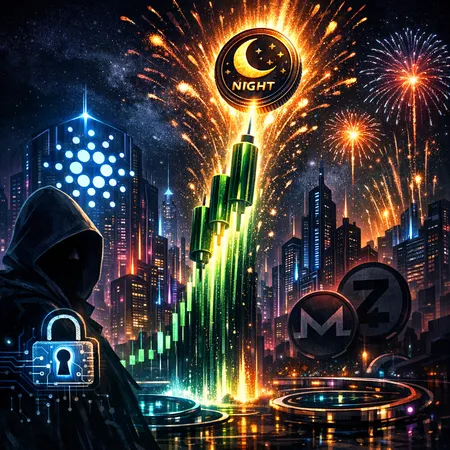
Reports in mid‑December showed Midnight’s NIGHT token rocketing into the crypto market’s top‑10 by market cap while recording more than $1 billion in 24‑hour volume, a level that drew instant attention and debate among investors and exchanges (U.Today report). The raw numbers are headline‑grabbing: rapid accumulation of on‑chain liquidity, significant trading activity, and overnight narrative momentum around privacy-focused tokens.
What makes this different from a typical memecoin pump is the explicit privacy framing: NIGHT is being positioned as a privacy-centric asset on Cardano, a chain not previously associated with high‑volume privacy token launches. That combination — high volume, privacy narrative, and a less‑expected host chain — is what’s forcing market participants to ask whether this is an isolated token frenzy or the start of a broader structural shift.
How to read the on‑chain signals
High 24‑hour volume can mean genuine retail and institutional demand, but it can also mask liquidity concentration, bots and wash trading. For product managers and investors, the key on‑chain signals to parse are token distribution (who holds the supply), DEX pool composition (is liquidity single or multi‑sided?), and cross‑exchange flows (are funds moving on‑chain between centralized venues?). Those metrics help distinguish organic adoption from manufactured volume.
Why Cardano? Protocol features and ecosystem mechanics
Cardano didn’t become a hotspot by accident. Several protocol and ecosystem features make it a plausible host for a high‑volume privacy token launch:
- Native asset support and the eUTXO model let teams issue tokens without complex smart‑contract wrappers, which reduces friction at launch and gas exposure.
- Low and predictable fees (relative to some L1s) reduce the cost of trading and onboarding new users, which can amplify short‑term volume spikes.
- Growing on‑chain liquidity: Cardano’s DEXs and liquidity providers have matured enough to host meaningful pools and swaps; that on‑chain depth matters when a token wants to hit big numbers quickly.
Those technical advantages sit alongside a cultural and market reality: Cardano has an engaged developer base and a renewed appetite for novel dApps and token experiments. For many observers, Cardano is entering a phase where the network effect of native tokens and DeFi primitives can produce outsized token events.
Ecosystem effects and network externalities
When a token like NIGHT posts huge volume, it’s not just the token team that benefits. LP providers, DEX aggregators, market‑making desks, and wallet providers all see increased activity. That activity can produce a virtuous cycle: more trades -> more fees -> more incentives to provide liquidity -> deeper markets for new launches. This is why product managers should watch not just the token data but related on‑chain primitives and user flows.
Privacy coins renaissance: how NIGHT sits next to Monero and Zcash
Privacy tokens have been in the headlines again. Monero (XMR) has shown renewed momentum, driven by developer activity and a parabolic trend that some analyses suggest could push XMR toward an 80% rally range relative to earlier levels (crypto.news analysis). Zcash (ZEC), meanwhile, occupies a different niche: privacy is optional and the protocol has positioned itself to survive regulatory headwinds, with commentary suggesting ZEC could prove resilient among privacy offerings (The Motley Fool analysis).
NIGHT’s arrival on Cardano adds a new data point to this landscape. Technically, Monero is privacy‑by‑default with mature on‑chain obfuscation primitives, while Zcash offers optional shielded transactions under a different trust and compliance posture. A privacy token on Cardano — where the base layer doesn’t natively offer XMR‑style privacy — highlights two trends:
- Investors are hungry for privacy narratives beyond the traditional privacy coins.
- Architects are experimenting with layered privacy solutions (smart‑contract‑level privacy, zk approaches, or application‑layer obfuscation) on chains historically seen as ‘transparent.’
That experimentation could increase the diversity of privacy offerings, but it also raises technical and regulatory questions. Privacy implementations on smart‑contract platforms often rely on newer cryptography (zk proofs, mixers, off‑chain relays), and they face different risk profiles than native privacy coins.
Short‑term risks: liquidity, wash trading, and regulation
The NIGHT event surfaces immediate risks every investor and product manager should weigh:
- Liquidity concentration: If a small number of wallets provide most of the on‑chain liquidity, price discovery is fragile. Large sellers can cause outsized slippage.
- Wash trading and manufactured volume: Extremely high 24‑hour volumes can be inflated by automated market operations and circular trades. On‑chain forensic checks and cross‑exchange orderbook analysis are essential.
- Exchange delisting and compliance: Privacy‑branded assets attract regulator attention. Even established privacy coins have faced scrutiny; ZEC’s path shows how regulatory realities can shape token availability and adoption (The Motley Fool).
- Technical risk: If privacy features are implemented at the application level, audit quality, key management, and cryptographic assumptions matter. Bugs or centralization points can break privacy guarantees.
Short term, volatility is likely to remain high. That is both a trading opportunity and a capital‑preservation risk. For product managers building exposure, a staged allocation and robust risk controls (stop losses, liquidity thresholds, multi‑custody arrangements) are prudent.
Long‑term implications for Cardano: TVL, dApps and developer interest
If NIGHT’s surge represents genuine product‑market fit for privacy use‑cases on Cardano, the long‑term implications are substantial:
- Attracting privacy developers: Demonstrable demand for privacy tokens can convince teams to prototype and deploy privacy dApps on Cardano, increasing developer mindshare and tooling investment.
- Higher TVL and more sophisticated DeFi stacks: Sustained volume and utility can raise total value locked as LPs and yield strategies emerge around privacy primitives and derivatives.
- Ecosystem diversification: Cardano could move beyond its earlier narratives (governance, academic rigor, NFTs) into a broader DeFi and privacy‑aware ecosystem, creating new user segments.
However, those upside scenarios depend on three things: responsible tokenomics (transparent distribution), exchanges and custodians tolerating these projects under compliance regimes, and technical privacy models that withstand audit and adversarial testing. The path isn’t guaranteed; regulatory friction or large‑scale exploits could slow developer enthusiasm.
Actionable takeaways for investors and product managers
- Do on‑chain homework first: Before allocating capital, analyze token distribution, liquidity pool composition, and cross‑chain flows. High volume alone is not proof of organic demand.
- Assess privacy technology and audit trail: Understand whether privacy is native or layered; verify audits and threat models if the token uses zk proofs or mixers.
- Plan for regulatory scenarios: Create exit strategies for delisting risks and compliance shock. Consider custody partners' policies toward privacy assets.
- Consider Cardano exposure as a differentiated bet: If you believe Cardano’s ecosystem can support scalable privacy dApps, exposure via ADA and carefully selected projects could capture asymmetric upside as TVL and DeFi primitives mature. Platforms like Bitlet.app will be watching liquidity and product innovation closely to see where demand consolidates.
- Stagger allocations and use active risk management: Given volatility, use phased entry, liquidity‑aware sizing, and clear stop loss rules.
Final assessment
NIGHT’s breakout is a signal — not a verdict. It proves there is intense demand for privacy narratives and that Cardano can, under the right conditions, host large token events. Whether this becomes a sustained wave that lifts Cardano’s DeFi and privacy stack or a single high‑water mark driven by speculative flows depends on tokenomics transparency, developer follow‑through, and regulatory responses.
For investors and product teams, the sensible approach is cautious curiosity: study the on‑chain facts, stress‑test the privacy claims, and build operational blocks that assume volatility and compliance pressure. If the underlying market support and technical robustness are real, Cardano’s next chapter could include more sophisticated privacy dApps and higher TVL — but that journey will be uneven.
Sources
- U.Today — "New ADA Breaks Into Top 10 By Volume: Cardano Creator Reacts To Incredible Success" https://u.today/new-ada-breaks-into-top-10-by-volume-cardano-creator-reacts-to-incredible-success?utm_source=snapi
- The Motley Fool — "Prediction: Zcash Will Prove to Be the Best Privacy..." https://www.fool.com/investing/2025/12/18/prediction-zcash-will-prove-to-be-the-best-privacy/
- Crypto.News — "Monero bulls eye 80% rally as two‑year parabolic trend nears all‑time highs" https://crypto.news/monero-bulls-eye-80-rally-as-two-year-parabolic-trend-nears-all-time-highs/