Can PYTH’s New Reserve and Cardano Integration Trigger a Chainlink‑Style Re‑Rating?
Summary
Why oracles matter — and why value capture is under the microscope
Oracles are the bridge between off‑chain information and on‑chain logic. For DeFi developers building automated markets, lending platforms, or derivatives, oracle quality and economic incentives determine whether a protocol is secure and cheap enough to run complex logic. Traders and investors watch oracle narratives closely because an oracle protocol that captures value — converting usage into token demand or permanent sinks — can justify a price re‑rating.
Chainlink has long been the reference point: a widely adopted oracle network whose token economics, staking roadmap, and vast market share have framed expectations for how oracle projects can monetize data and accrue value. The recent announcements from PYTH Network — a pivot toward a revenue‑backed reserve — plus Cardano’s move to integrate PYTH oracles (the so‑called first pentad) put PYTH back in the spotlight. For many DeFi architects, DeFi protocols need to ask: can PYTH convert consumption into token value the way Chainlink aspires to?
What PYTH announced: the Reserve shift in plain language
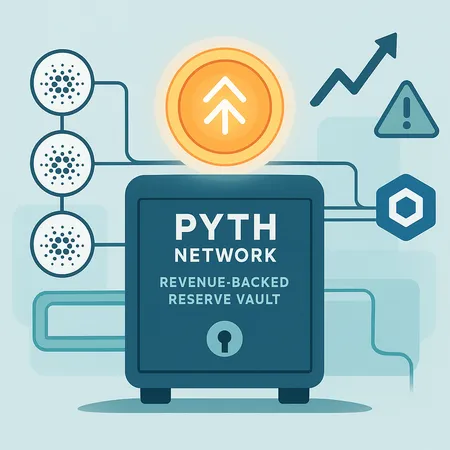
PYTH’s latest public move repositions elements of the protocol’s economic plumbing toward revenue capture. In short:
- PYTH is signaling a reserve model that collects fees or a portion of data revenue and accumulates them in a protocol reserve rather than simply routing payments to node operators. CoinPedia summarized this as a shift toward a more revenue‑backed model that could change how value is perceived in the market (CoinPedia analysis).
- The mechanics aren’t fully identical to payment flows in other networks: the reserve can be structured as a buffer, a buyback engine, or as backing for token‑linked incentives depending on governance decisions.
Technically, this usually entails three pieces:
- Fee capture — an on‑chain or off‑chain mechanism by which consumers (protocols, apps) pay for feeds. That could be denominated in the consumer chain’s native asset, stablecoins, or in PYTH tokens depending on integrations.
- Reserve accumulation — a contract or multisig that collects those fees instead of forwarding them straight to node operators.
- Reserve utility — governance policies that determine whether reserves pay node operators, buy back and burn tokens, stake on behalf of holders, or distribute dividends.
The key implication: if revenues are credibly earmarked to support token‑linked economics (buybacks, staking rewards, or other token sinks), the token becomes a nearer‑term lever for price appreciation because network usage creates real demand or supply reduction.
Cardano’s integration — why the "first pentad" matters
Cardano’s integration of PYTH oracles — described in reporting as the first pentad — is meaningful for two reasons: cross‑chain demand and the nature of Cardano’s smart contract market. The integration signals that PYTH is not just an Ethereum‑centric feed provider but is being adopted across multiple chains, which amplifies total addressable demand for its data.
The Bitcoinist report that covered the Cardano integration frames it as a step toward broader multi‑chain footprint, and specifically highlights the technical work required to make PYTH feeds usable in Cardano’s environment (Bitcoinist report). For DeFi developers building on Cardano (ADA), native access to high‑frequency, tamper‑resistant price oracles reduces engineering friction and can accelerate product launches.
Cross‑chain adoption matters economically: each new consumer chain potentially increases call volume, either producing fee revenue or increasing the scale at which a reserve can operate. But adoption alone is not value capture — the protocol must convert that consumption into token demand or supply reductions.
Governance, wrappers, and the tricky transition from usage to token value
A reserve is only as credible as governance and enforcement. The following governance and engineering levers determine whether a reserve model can actually support a token re‑rating:
- Governance clarity: Who decides how the reserve is used — a multisig, a core team, or a DAO? If governance is centralized, market participants may discount the reserve’s economic credibility.
- Enforceable flows: Are fees denominated in PYTH? Is there an automated buyback mechanism? Or could revenues be swept out by manual action? The more automated and on‑chain the flows, the more investors can model forward revenue capture.
- Wrapper design: Wrappers (small contracts that present PYTH data in chain‑native formats) let non‑native chains consume feeds without changing the core oracle. How wrappers handle pricing denominators, fee payments, and dispute resolution matters — they’re the engineering glue between raw data and economic value.
In practice, if the reserve relies on manual governance to sell assets and buy tokens, that introduces execution and credibility risk. Conversely, a well‑designed on‑chain mechanism that automatically buys PYTH tokens with a portion of fees or allocates yield to stakers creates a straightforward financial link between usage and token demand.
How this compares to Chainlink’s model
Chainlink’s narrative has emphasized decentralized node operators, economic security through staking, and fee accrual by nodes when consumers pay for data. Chainlink’s value capture story has several parts:
- Staking: Node operators will stake LINK to provide economic security and earn rewards — this creates demand for LINK and locks supply.
- Fees: Consumers pay for data and those payments are denominated in LINK or paid to node operators who may have incentives to hold.
- Integration externalities: A broad installed base makes Chainlink the default choice, reinforcing network effects.
PYTH’s reserve model attempts to accelerate the conversion of usage into value by creating a pooled economic vehicle. Where Chainlink’s capture depends heavily on staking and node economics, PYTH’s approach leans on centralized accrual of revenue that can be programmatically used to benefit token holders or to underwrite the network.
Which is superior? It’s not binary. Chainlink’s gradualist, decentralized approach may score higher on security assurances, while a revenue‑backed reserve can deliver a clearer and faster mapping from fees to token economics — if governance and enforcement are credible.
Short‑term catalysts that could re‑rate PYTH (and in what order of likelihood)
- Clear tokenomics update: A detailed, on‑chain rulebook describing how reserve revenues are converted into PYTH buybacks, staking rewards, or distributions. This is the single most important catalyst.
- High‑profile integration announcements: More chains or major protocols (e.g., a top DEX or major lending protocol) committing to pay for PYTH feeds can spike demand; Cardano’s pentad is a positive signal here.
- First revenue flows visible on‑chain: Transparency — seeing actual fees flowing into a reserve and automatic buybacks — would materially change market expectations.
- Partnerships with consumer projects: Long‑dated contracts or premium‑tier service agreements create predictable revenue streams.
For traders and investors, these are measurable events. Developers should watch SDK releases and wrapper contracts to gauge how easy it will be to consume paid feeds.
Medium‑term drivers and structural tests
- Sustained cross‑chain demand: One or two integrations don’t prove product‑market fit; persistent usage across chains does.
- Automated token sinks: A mechanism that continuously converts a fraction of fees into permanent supply reduction (burns) or meaningful staking locks changes token supply dynamics.
- Robust governance: A well‑distributed governance system that commits to long‑term reserve policy helps de‑risk the model.
- Security track record: Oracles live or die by accuracy and uptime; repeated outages or price‑manipulation events would crush confidence.
If these components align, PYTH could attract multiple multiple re‑rating scenarios: an initial speculative uplift on headlines followed by a slower, more durable revaluation as predictable cash flows emerge.
Risks and realistic downsides
- Governance capture: If the reserve is controlled by insiders or a small multisig, the market may discount the reserve as a genuine tokenomics improvement.
- Denomination mismatch: If fees are paid in a chain’s native asset or stablecoins and the protocol lacks an automatic conversion to PYTH, capture is weak.
- Competitive pressure: Chainlink, Band, and native chain oracles can compete on price, latency, or bundling. Market share matters.
- Technical and economic attacks: Oracles are targeted systems; manipulation of underlying feeds, oracle downtime, or oracle routing exploits could all reverse sentiment quickly.
- Regulatory and macro risk: Broader crypto market drawdowns or regulatory action around tokenized revenue flows could mute any re‑rating.
Practical checklist for developers and investors
For DeFi developers evaluating PYTH feeds or a token investor sizing the re‑rating probability, here are practical diagnostics:
- Does the protocol publish an on‑chain flow diagram of fee capture and reserve use?
- Are wrappers audited and easy to integrate into your target chain (e.g., Cardano/ADA)?
- Is the governance model transparent and decentralized enough for you to model long‑term rules?
- Are there visible, verifiable revenue flows happening now (not just promises)?
- How does the fee denominator work — are consumers required or incentivized to pay in PYTH?
Developers building applications on Bitlet.app or other platforms should especially weigh integration costs vs. the resilience and latency characteristics of the feed.
Bottom line — can PYTH re‑rate like Chainlink?
Short answer: possible, but far from guaranteed.
A revenue‑backed reserve and growing cross‑chain adoption (e.g., Cardano’s pentad integration) materially improve PYTH’s narrative. The difference between a speculative pump and a sustainable re‑rating rests on three factors:
- Credible, enforceable flows that convert consumption into token demand or permanent sinks.
- Transparent governance that reduces the risk of capture or discretionary misuse of reserves.
- Sustained adoption across multiple, high‑volume consumer chains and applications.
If PYTH’s team and community can demonstrate those three in sequence — clear tokenomics, visible revenues, and lasting adoption — then a Chainlink‑like re‑rating becomes plausible. Without those, the reserve is a promising PR narrative rather than a guaranteed economic lever.
For investors and developers, the optimal stance is to watch for measurable, on‑chain evidence of revenue capture and to focus on integrations that produce predictable, recurring data demand.
Sources
- CoinPedia — analysis of PYTH's new reserve and revenue model: https://coinpedia.org/price-analysis/will-the-new-pyth-network-reserve-trigger-a-chainlink-style-80-price-rally/
- Bitcoinist — Cardano integrates PYTH oracles (first pentad): https://bitcoinist.com/cardano-pyth-oracles-first-pentad-integration/
(For broader reading on oracle economics and tokenomics, compare the Chainlink roadmap and staking literature.)