Ethereum’s Record-Low Exchange Balances: Is a Supply Squeeze Brewing for ETH?
Summary
Why exchange balances matter for ETH
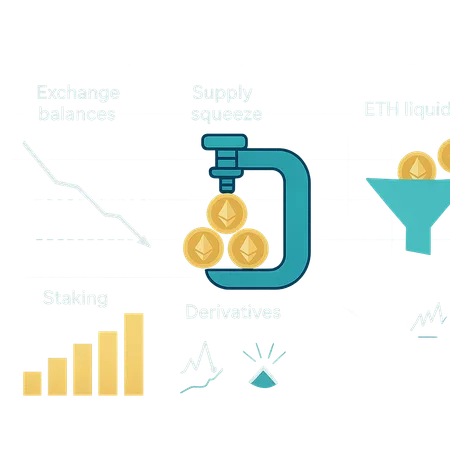
Exchange balances are a simple but powerful proxy for available ETH liquidity. When large amounts of ETH leave centralized exchange wallets, that ETH is effectively removed from the pool of tokens easily tradable on spot venues — whether it's being staked, locked in custody, moved to long-term cold storage, or routed to DeFi protocols.
Recently, multiple outlets reported that Ether held on centralized exchanges fell to all-time lows. This is not a subtle shift; it is a structural change in where ETH lives and how quickly it can be converted to cash or margin. For many traders, Ethereum remains the primary market bellwether, so a sustained drop in exchange reserves shifts the microstructure beneath price discovery.
On-chain evidence: exchange outflows, staking and custody
Two clear threads explain the decline in exchange balances: (1) steady flows into staking and long-term custody, and (2) accumulation by whales and institutions. Journalistic and on-chain analyses have flagged that Ether on exchanges has fallen to historic lows, with coverage noting a pronounced shift into staking contracts and custodial services. For context, CryptoNews reported the record-low exchange holdings and Cointelegraph confirmed unprecedentedly low exchange balances while linking the trend to staking and custody flows.
These flows look different from one-off large withdrawals. Instead, they are persistent: recurring staking inflows, sustained deposits into institutional custody, and fewer sellers turning to exchanges when they want liquidity. Investment analysts are taking notice too — some bullish research pieces frame a tightening supply as a medium-term demand tailwind for ETH (see commentary in The Motley Fool's recent write-up on ETH's ecosystem strength).
What the on-chain data is telling us
- Exchange reserves down: The absolute number of ETH on centralized exchange addresses has fallen to the lowest level on record — a direct liquidity metric.
- Staking growth: A larger fraction of the circulating supply is now staked in consensus contracts or with staking providers, reducing freely transferable ETH.
- Custody & long-term wallets: Growth in custodial balances and accumulation in large non-exchange wallets suggests less retail or short-term selling pressure.
Together, these data points build a simple narrative: less ETH available on-ramps for immediate selling means thinner books and the potential for sharper price moves when demand re-emerges.
Key on-chain metrics to monitor
If you trade or manage ETH exposure, build a dashboard tracking these metrics in near real-time:
- Exchange ETH balance (absolute & % of supply) — primary signal.
- Staked ETH totals and the inflow/outflow rates to major staking contracts (Lido, Rocket Pool, consensus deposit contract).
- Top-100 wallet concentration and movement into/out of exchange addresses.
- Futures open interest & cash-futures basis (spot vs. perpetual funding) — to detect leverage imbalances.
- Perpetual funding rates — sustained positive funding often precedes squeezes.
- stETH/ETH peg and liquid staking spreads — stress in staking derivatives shows up here first.
- DEX ETH liquidity — liquidity depth on major AMMs for ETH pairs.
Tools like on-chain analytics providers (Glassnode, Nansen) and derivatives dashboards will surface these signals. A coordinated push in these metrics is a stronger indicator than any single line.
Historic parallels and why ETH may be different
Markets have seen supply squeezes before. Bitcoin’s cycles — where exchange reserves trended lower as long-term wallets and custody demand grew — provide a loose parallel: supply withdrawing from exchanges made the market more susceptible to demand shocks and sharp rallies.
ETH has similar mechanics but different plumbing. The post-merge world introduced meaningful staking demand that permanently changes the liquid supply profile: staking consumes ETH for long periods (and while liquid staking derivatives offer synthetic liquidity, they are distinct from native, spot ETH). That structural shift makes the ETH case arguably more persistent than many short-term exchange outflows seen in other assets.
However, ETH also has ecosystem-specific feedbacks. DeFi protocols, liquidation engines, and stablecoin peg mechanics are all ETH-native and can amplify or dampen squeezes in ways that differ from Bitcoin. Staking derivatives (e.g., liquid staking tokens) create an on-chain circularity between staked capital and DeFi collateral that traders must respect.
How a supply squeeze could affect derivatives, spot volatility and DeFi liquidity
A tightening of available ETH can ripple through markets via several channels:
Spot liquidity & order-book depth: With fewer ETH on exchanges, order books can thin, increasing slippage for large market buys or sells. Price moves that would normally be absorbed by liquidity may now cascade.
Futures basis & funding: Reduced spot supply tends to widen the cash-futures basis and push perpetual funding rates higher. That makes levered long positions more expensive and raises the risk of funding squeezes where shorts must rebuy to cover.
Options & implied volatility: A supply squeeze elevates the probability of large spot moves, so implied volatility especially on out-of-the-money calls can rise. Options markets may price in larger tail risk, boosting premium for both calls and puts in a bid-ask feedback loop.
DeFi liquidity and lending: ETH is collateral in numerous lending pools and AMMs. If spot ETH becomes scarce, collateral constraints can tighten borrowing capacity, widen borrow rates, and push liquidations in stressed markets.
Staking derivative spreads: When staking demand grows, liquid staking tokens (stETH, rETH, etc.) can trade at a premium or discount to native ETH depending on demand, liquidity and redemption mechanics — a source of basis risk and arbitrage opportunity.
Mechanically, squeezes can trigger short squeezes in perpetuals, spike realized volatility, and create episodic dislocations across spot, futures, and DeFi. Markets that rely on ETH as settlement or collateral are most exposed to knock-on effects.
Tradeable scenarios for portfolio managers and active traders
Below are structured scenarios and tactic ideas — each paired with the drivers you should watch and the risks involved.
1) Directional long — Accumulate ETH on weakness
- Why: If you believe exchange reserves will stay low and demand remains steady or grows, long spot exposure benefits from positive supply shocks.
- How: Build a phased accumulation plan to avoid chasing short-term spikes; complement spot buys with dollar-cost averaging or buy-limits off key liquidity levels.
- Risks: Rapid deleveraging or regulatory news can cause violent corrections. Keep size discipline and stop-loss rules.
2) Basis trades — Long spot, short futures (calendar plays)
- Why: If funding rates move higher due to tight spot supply, being long the spot and short the near-term futures can earn carry when the basis compresses.
- How: Hedge delta with futures while collecting the basis, but monitor margin and roll risk.
- Risks: Basis can blow out further if leverage flows intensify; ensure capital for margin calls.
3) Options — Buy convexity, sell time decay selectively
- Why: A supply squeeze increases tail risk and implied volatility; buying call spreads or strangles can profit from large upside moves with controlled capital.
- How: Use verticals to limit premium outlay, or buy long-dated calls (LEAPs) as directional asymmetric bets. Alternatively, implement calendar spreads to play rising near-term vol while shorting farther-dated premium.
- Risks: Options are sensitive to theta and IV compression; incorrect timing can erode value quickly.
4) Volatility trading — Long implied vol vs realized
- Why: If you expect episodic spikes in realized volatility, a long volatility posture (straddle/strangle, or buying variance swaps where available) can capture surprise moves.
- How: Size carefully — vol trades can be expensive during already elevated IV.
- Risks: Extended periods of calm will bleed premium.
5) Staking & liquid staking play
- Why: For investors comfortable with lock-up mechanics and custody risk, staking can provide yield and reduce circulating supply further.
- How: Direct staking or using wrapped/liquid staking tokens lets you earn yield while retaining DeFi exposure. Understand counterparty and peg risks for staked tokens.
- Risks: Slashing, validator outages, and staked-derivative depegs.
6) DeFi LP strategies with hedges
- Why: Provide liquidity in ETH-stable pools to earn fees while hedging directional exposure through futures or options.
- How: Delta-hedge LP exposure with futures; keep an eye on impermanent loss vs earned fees.
- Risks: Large price moves in a thin market can create severe impermanent loss and localized liquidity crunches.
7) Arbitrage — stETH/ETH and synthetic spreads
- Why: Dislocations between liquid staking tokens and native ETH are likely during squeeze episodes.
- How: Use flash or levered arbitrage where possible, minding collateral and redemption mechanics.
- Risks: Peg breaks, settlement delays, and Wrapped-token custody risk.
Across all scenarios, size positions for margin friction, funding cost, and the potential for abrupt liquidity evaporation.
Monitoring framework and risk checklist
Set rule-based alerts and cadence for portfolio reviews:
- Weekly checks: exchange reserves, staking inflows, futures OI and funding, stETH/ETH spread.
- Pre-trade checklist: liquidity depth at expected entry size, funding accruals, option IV skew.
- Event triggers: major custody inflow announcements, ETF approvals or denials, protocol upgrades, macro liquidity shocks.
- Risk limits: max leverage, margin buffers, stop-loss levels, and scenario-based drawdown estimates.
For trade execution and custody choices, professionals increasingly use platforms combining custody, staking and execution — keep platforms like Bitlet.app in your due-diligence set when evaluating integrated services.
Conclusion
The fall in ETH held on exchanges is a measurable, structural shift that tightens immediate sell-side liquidity. Paired with rising staking and institutional custody, the environment creates a plausible supply-squeeze backdrop that can amplify spot rallies, skew derivatives markets and stress DeFi liquidity.
For portfolio managers and active traders, the right approach is preparation: monitor on-chain indicators, stress test convex trades, and size positions to survive episodic liquidity shocks. Whether you trade the squeeze directly with directional exposure, harvest carry via basis trades, or play volatility and staking spreads, clear rules and on-chain vigilance will be decisive.