What Solana's First US ETF and Revolut's Native SOL Payments Mean for Adoption and Staking
Summary
Executive summary
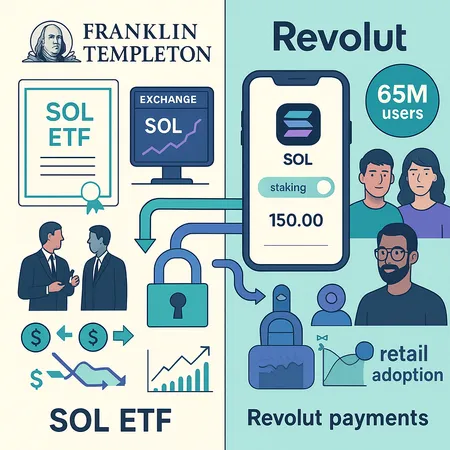
Two complementary developments in late-stage crypto infrastructure are converging on Solana (SOL): an institutional entry point with Franklin Templeton’s approval to list a Solana ETF on NYSE Arca, and a massive retail rails expansion as Revolut rolls out native SOL payments, transfers and staking to roughly 65 million users. Each on its own is meaningful; together they change who holds SOL, how it's used, and the tokenomics tradeoffs between liquid supply and staked supply.
This piece unpacks the ETF listing mechanics, what Revolut’s product integration implies for native usage and retail adoption, and how the two could jointly influence SOL liquidity, staking rates, and correlation with the wider crypto market. It’s written for product managers shaping rails and token strategies, and investors calibrating exposure to adoption catalysts.
The Franklin Templeton NYSE Arca approval: what it actually does
Franklin Templeton’s green light to list a Solana ETF on NYSE Arca is more than a press release headline — it establishes a regulated, exchange-traded vehicle that lets institutions and retail brokers buy SOL exposure through standard brokerage accounts. The approval creates institutional plumbing: licensed trading on NYSE Arca, authorized participants (APs) who create and redeem shares, and the arbitrage mechanism that ties ETF price to the underlying NAV. For a quick report on the approval and its framing as an institutional on‑ramp, see this coverage.
Why that matters in practice: creation/redemption means that large buyers don’t have to buy SOL on spot markets directly; they can acquire ETF shares that are created when APs deliver SOL (or cash, depending on structure) to the custodian. That can funnel meaningful amounts of SOL into custody arrangements that sit off the exchange order books — increasing institutional demand without necessarily translating to immediate exchange trading volatility. But it also enables large sellers to redeem into SOL, which can add supply pressure back to markets if those SOL are sold.
Importantly, ETF listing also changes market access: pension funds, endowments, and wealth desks that prefer listed products get a clean, custody-backed instrument. That typically reduces friction and compliance headaches compared with direct custody arrangements, and it often enlarges the potential buyer base.
Revolut’s native SOL payments and staking: retail rails at scale
Revolut’s rollout of native Solana payments, transfers and staking to its global user base (around 65 million customers) is a direct retail distribution event. The Finbold write-up documents how Revolut has embedded native SOL rails for payments and staking across its ecosystem, which places SOL within everyday consumer workflows — not just trading apps.
That shift matters on two levels. First, native payments increase utility demand: users who can pay, transfer, or receive value in SOL are more likely to hold some on-device or in custodied balances for short-term usage, rather than constantly converting to fiat. Second, built-in staking lowers the friction to participate in network security and earn rewards, turning otherwise idle retail balances into staked capital with a different behavioral profile.
For consumer product folks, this is the sort of distribution that changes onboarding funnels: acquisition costs, KYC flows, and product messaging all shift when crypto becomes a payment primitive inside a mainstream finance app. Companies such as Bitlet.app stand to gain from clearer on-ramps and increasing retail familiarity with staking and native tokens.
How these rails change on‑ramp liquidity dynamics
The ETF and Revolut rails each influence liquidity in distinct — and sometimes opposing — ways. Consider three channels:
- Institutional channel (ETF): creation/redemption with APs can add SOL to custodial vaults (reducing exchange float) when demand is strong, or release SOL back to markets when redemptions occur. ETFs tend to amplify large directional flows while smoothing execution costs for big buyers.
- Retail channel (Revolut): native payments and staking can increase off-exchange retail balances (users hold SOL for payments/staking) and reduce intraday exchange churn. That lowers circulating exchange supply and can create a longer-term holder cohort.
- Net effect on exchanges: if both rails pull supply off exchanges (ETF custody + Revolut wallets), available on-exchange liquidity can tighten, increasing price sensitivity to large market orders and potentially raising realized volatility on order books. Conversely, ETF redemptions can inject liquidity quickly.
For investors and PMs, that means watching on-chain and exchange metrics closely: exchange balances, deposits/withdrawals correlated with ETF AP activity, and Revolut-linked wallet inflows (where observable). Changes in available float often matter as much as headline AUM numbers.
Staking economics — how behavior and rates can shift
Solana’s staking model distributes inflationary rewards to stakers; the per-staker yield depends on the total stake participation. Two countervailing forces are at work: more staking reduces the proportion of liquid supply (which can support price), but it also spreads rewards across more staked SOL (pressuring nominal APYs).
Scenario analysis:
- High retail staking (Revolut gains traction): if a meaningful slice of Revolut’s users elect to stake, the total locked stake percentage rises. That reduces the per-unit staking yield, because the reward pool is shared among more staked SOL. Nominal APR may fall, but the market could interpret increased staking as supply discipline that supports price.
- ETF behavior (custodial staking optional): ETF providers can choose to stake underlying SOL (to enhance returns) or keep assets non-staked for liquidity and custody simplicity. If major ETF custodians stake, that removes liquid supply similarly to retail staking, but with predictable institutional behavior. If they don’t stake, ETF inflows increase demand without reducing liquid supply as much (since ETF shares are tradable).
Net implications: growth in staking participation tends to compress staking yields over time, particularly if the protocol adjusts inflation or reward schedules to maintain target security incentives. Investors should monitor the effective staking rate (the network’s total staked share) and the realized APR rather than nominal advertised yields. Product managers designing staking UX must balance APY messaging with education about how more stakers generally means lower per-stake yields.
Will SOL decouple from or track the broader crypto market more closely?
Institutional listing via ETFs often increases an asset’s correlation with macro and broad crypto indices because it brings in the same investor bases and mandate-driven flows that move other listed crypto ETFs. In practice, if large allocators treat a SOL ETF similarly to a Bitcoin or Ether ETF, short-term price moves may be more synchronized with market-wide risk-on/risk-off dynamics. For example, ETF inflows driven by risk appetite or liquidity windows could lift SOL together with other major tokens.
However, Revolut’s payments rails introduce idiosyncratic demand: real transactional usage and retail staking can create demand drivers independent of macro risk. If Revolut drives genuine payments volume — merchants accepting SOL, in-app transfers, payroll use cases — SOL could accumulate a portion of demand that’s less correlated with speculative market swings.
Most likely outcome: a blended behavior. Over short horizons, SOL will likely move more in step with broader crypto as ETF flows dominate headlines and AUM shifts. Over longer horizons, sustained native usage and on-chain activity from consumer rails can create a structural base of demand that mutes some speculative correlations. Monitoring rolling correlations with Bitcoin and on-chain adoption metrics will show whether idiosyncratic demand grows.
Practical signals to monitor (for PMs and investors)
If you’re evaluating adoption catalysts or adjusting product strategy, track these metrics:
- Exchange reserves and net inflows/outflows (short-term liquidity pressure).
- ETF AUM and authorized-participant creation/redemption activity (watch SEC filings and custodian statements).
- Total staked percentage of SOL and its change rate; realized staking APRs.
- Revolut adoption signals: wallet top-ups, merchant acceptance, and staking opt-in rates (public metrics or proxy signals).
- Rolling correlation between SOL and major crypto indices or Bitcoin over 30–90 day windows.
For product managers: consider building UX that anticipates more users who hold SOL for payments and staking — lower friction for small nominal stakes, clearer tax/receipt flows, and UX that explains staking yield dynamics. For investors: prepare for two-way liquidity regimes — periods of tight float and high volatility, punctuated by ETF-driven rebalancings.
Risk cases and open questions
- ETF redemptions during market stress could flood spot markets with SOL, pressuring prices.
- Revolut’s payments features could increase custodial concentration (if most retail SOL sits in Revolut custody), raising counterparty risk and regulatory scrutiny.
Open questions that deserve monitoring: will ETF custodians stake underlying SOL? What percentage of Revolut’s user base will opt into staking vs hold for payments? How quickly will merchant acceptance and on-chain payments volume grow? Answers to these determine whether the dominant effect is liquidity tightening or increased velocity.
Conclusion: a new layer of adoption, but not an overnight guarantee of stability
Franklin Templeton’s NYSE Arca approval and Revolut’s native SOL rails are complementary: one unlocks institutional channels and trading convenience, the other embeds SOL into everyday consumer flows. Together they can materially change the composition of SOL holders and the balance between liquid and staked supply. That can support price discovery in the medium term, but it also introduces new dynamics — tighter on-exchange float, changing staking yields, and potentially higher short-term sensitivity to macro flows.
Product teams should prepare for a more diverse user base and shift UX toward payments and simple staking experiences. Investors should watch custody flows, staking participation, and shifting correlations to decide whether SOL’s narrative is moving from speculative asset to a hybrid of monetary speculation and native utility.
For fast operational use, teams building integrations or custody products (including firms like Bitlet.app) will need to model both ETF creation/redemption scenarios and retail staking opt-in rates to forecast liquidity and revenue outcomes.
Sources
- Franklin Templeton Solana ETF approval on NYSE Arca: Cryptopolitan coverage
- Revolut brings native Solana payments, transfers and staking to users: Finbold report