Cardano’s Stability Test: From a Rare Mainnet Partition to Recovery and Lessons Learned

Summary
Executive overview
In late 2025 Cardano suffered a short but meaningful stability test: a mainnet partition driven by a rare network bug. Nodes on different parts of the network briefly disagreed on chain state, forcing an operational response from Input Output Global (IOG), fast client upgrades and coordinated messaging from leadership. IOG published an initial report on the partition and pushed node updates; Charles Hoskinson publicly urged unity and rejected narratives blaming experimental development practices. The episode matters now because it highlights how consensus and governance credibility are as important as protocol features — especially when projects are minting large token supplies, as Midnight did with its 24 billion NIGHT distribution.
For engineers, validators, exchanges and product leads this post gives a concise technical post‑mortem, explains how node upgrades resolved the issue, and provides an operational checklist and PR/governance lessons you can apply immediately.
What happened: a short technical timeline
Symptom: nodes on the Cardano mainnet began diverging and producing different forks of history — a mainnet partition rather than a simple client crash. Observers reported unusual block propagation and inconsistent tip selection across multiple peer groups.
Scope: the disruption was brief and did not permanently orphan large portions of value, but it created uncertainty about finality and transaction acceptance during the window of divergence. Early coverage flagged the unusual nature of the incident and raised investor concerns about network reliability coverage here.
IOG response: within hours IOG issued a first report describing the partition and recommended rapid node upgrades. That report clarified the team’s understanding of the fault surface and outlined remediation steps being deployed to re‑establish a single canonical chain IOG’s report summary.
Leadership messaging: Charles Hoskinson addressed the community, calling for unity and emphasizing coordinated recovery actions while denying claims that so‑called ‘vibe coding’ (an informal term used by critics) had halted the network Hoskinson’s refutation.
Timing sensitivity: the incident overlapped with token distribution activity elsewhere in the ecosystem; for example, Midnight completed a large NIGHT mint during the broader period of heightened scrutiny, underscoring timing risks for token issuers Midnight mint report.
Technical summary: what a mainnet partition looks like (and likely root causes)
A mainnet partition occurs when subsets of nodes cannot reach consensus on the canonical chain tip. That can happen for reasons including: divergent local state due to a software bug, asymmetric peer connectivity, or unexpected interactions between chain selection rules and network transport behavior. In plain terms, some validators and full nodes were following one chain of blocks while others followed a different chain — both believing they were correct.
From what IOG’s initial report and public statements indicate, the incident was triggered by a rare bug in the node software stack that affected block propagation and tip selection under specific conditions. The immediate operational danger of a partition is not only stalled transactions; it is the risk of inconsistent ledger state across services (exchanges, custodians, dApps) that assume a single canonical ledger.
Why this matters technically:
- Finality becomes ambiguous during the split: wallets and custodians may not correctly reflect confirmed balances.
- Reorg complexity: reconciling divergent histories often requires careful client behavior to avoid double‑spend windows or lost transactions.
- Tooling assumptions break: orchestration, indexers, explorers and smart contract monitoring systems typically assume a single chain and can behave unpredictably when that assumption fails.
How node upgrades resolved the issue
IOG’s practical fix path followed a familiar blueprint: identify the causal patch, build a hotfix release, and coordinate staged rollouts to regain a single canonical chain.
Key operational moves:
- Patch and release: developers produced a targeted node update addressing the bug that allowed divergence in specific states or network conditions.
- Forced reconvergence: by upgrading a sufficient fraction of stake pool operators and relay nodes, the network’s peer graph and chain selection heuristics favored the corrected node implementation and allowed nodes to resync to a common tip.
- Monitoring and validation: the team monitored chain metrics (propagation latencies, orphan rate, tip age) to confirm re‑established consensus; additional sanity checks were run on transactions and balances.
The case shows that for proof‑of‑stake networks with many independent validators, the quickest path to recovery is not only a technical fix but fast coordinated deployments by operators. IOG’s report and subsequent communications document that sequence and the upgrades that restored normal operation IOG’s report link.
Communications and governance: rebuilding confidence
When a chain blinks, the technical answer must be paired with credible communications. IOG and Hoskinson prioritized three messages:
- Technical transparency — publish an incident report outlining root causes, patches and recommended operator actions. IOG’s initial report served that role.
- Rapid coordination — ask stake pool operators to upgrade to the fixed node release and provide step‑by‑step instructions.
- Narrative management — address rumors. Hoskinson publicly denied that ‘vibe coding’ (a pejorative suggesting undisciplined or playful development) was responsible, stressing disciplined engineering and community cooperation Hoskinson’s statement.
This combination helped reduce panic and signaled to exchanges, custodians and institutional users that the incident was being handled with both engineering rigor and leadership visibility.
Why it matters now: token mints, launches and timing risks
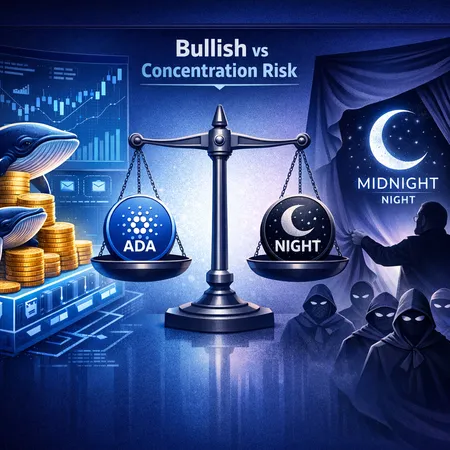
The importance of this particular stability test is amplified by on‑chain events happening at the same time. Projects that mint or distribute tokens need absolute confidence in network stability. Midnight’s completion of a 24 billion NIGHT mint demonstrates how a large token distribution can coincide with network turbulence and create reputational or operational exposure for both the issuer and the underlying chain Midnight mint coverage.
Specific risks for token mints and launches:
- Timing mismatch: if a mint occurs during a partition, different parts of the network may record the mint differently, complicating snapshot‑based distributions or downstream accounting.
- Custodian risk: exchanges and custodians accepting deposits during a split may credit balances prematurely or misattribute tokens.
- UX/regulatory fallout: user complaints and regulatory scrutiny increase if users experience failed, delayed, or inconsistent balances.
Project teams should treat major token operations as infrastructure events that require the same operational discipline as node upgrades or hard forks.
Operational implications and immediate actions for developers, validators and exchanges
For builders and validators:
- Delay critical mints under any sign of network instability. If block propagation or orphan rates spike, pause distribution jobs until the network is confirmed healthy.
- Coordinate upgrades: stake pool operators must have documented upgrade procedures and a tested cadence for rolling updates. Maintain a clear communications channel (SPO mailing lists, Discord, or an ops Slack) with IOG and other operators.
- Harden monitoring: implement multi‑layer observability (node metrics, peer health, block lag, tip discrepancy alarms) and integrate alerts into on‑call playbooks.
For exchanges and custodians:
- Implement conservative confirmation policies that can be tightened during stress windows. Consider increasing required confirmations temporarily during or after an incident.
- Use multiple independent node endpoints and redundant indexers to cross‑validate state; avoid single‑point reliability on a single RPC provider.
- Communicate proactively with users: transparently announce deposit/withdrawal holds and expected timelines rather than waiting for community speculation.
For product managers:
- Treat token mints as coordinated infrastructure events: include stakeholders (validators, custodians, community liaisons) in a pre‑launch readiness review.
- Rehearse rollbacks or contingency flows when token minting depends on on‑chain finality or snapshot integrity.
- Build incident playbooks that cover both technical and communication actions; test them via tabletop exercises.
Mentioning tools and platforms: custody and hot‑wallet services and marketplaces (including platforms like Bitlet.app) should factor these operational checks into onboarding and release schedules.
Risk mitigation checklist (practical, actionable)
For validators and node operators:
- Keep nodes patched: adopt a policy of prompt upgrades for critical releases; test releases in a staging environment first.
- Run a relay topology with diverse peers; avoid excessive reliance on a small set of supernodes.
- Maintain accessible upgrade documentation and rollback procedures.
- Run continuous integration for node binaries and deterministic builds where possible.
For exchanges, custodians and dApp teams:
- Use multi‑node, multi‑provider RPC strategies and cross‑check balances across indexers.
- Increase confirmations for high‑value transactions during anomalies.
- Pause automated token distributions if network health metrics exceed thresholds.
- Keep legal/compliance teams in the loop; have customer support scripts ready for outages.
For projects launching tokens or NFTs:
- Schedule mints during low‑stress windows and after a period of confirmed network stability.
- Publish a post‑mint reconciliation plan: how you will handle a discovered discrepancy.
- Consider delayed minting mechanics (off‑chain authorization followed by on‑chain settlement) when immediate finality is critical.
PR and governance lessons for proof‑of‑stake ecosystems
Several governance and communications lessons surface from this incident:
- Fast, factual disclosures beat silence. An early technical report from the core team helps anchor narratives and reduces speculative noise.
- Coordinate across the ecosystem: validators, exchanges, dApp teams and the core dev team must have pre‑agreed escalation paths.
- Avoid blaming rhetoric. Hoskinson’s public denial of fringe narratives — while blunt — aimed to reframe discourse around engineering fixes rather than rumor see refutation.
- Codify a governance playbook for incidents: who communicates what, how quickly, and which stakeholders are notified first.
These practices preserve credibility and make it easier for the community to accept short outages when they are accompanied by transparent remediation and a path forward.
Checklist for immediate post‑incident reviews
- Run a technical post‑mortem covering the causal chain, fix, and mitigations.
- Publish a concise report for operators and the wider community showing what changed and why.
- Validate upgrades across a representative set of nodes (different hardware, OS versions, cloud providers, etc.).
- Rehearse the next incident with tabletop exercises involving exchanges and large stakeholders.
Conclusion
Cardano’s brief mainnet partition was a reminder that even mature, decentralized protocols can be exposed to rare bugs. The incident was resolved through targeted node upgrades and rapid coordination, and IOG’s initial report plus leadership communications helped restore confidence. But the episode should prompt a rethink about how token issuers, validators and custodians plan major operations. Treat mints, large distributions and critical releases as infrastructure events: coordinate, monitor, and build contingency plans.
The ecosystem can emerge stronger if teams apply the technical, operational and governance lessons above and codify them into day‑to‑day practices.
Sources
- IOG’s first report and timeline: https://coinpaper.com/12552/cardano-issues-first-report-on-mainnet-partition-as-hoskinson-calls-for-unity?utm_source=snapi
- Early incident coverage and investor reaction: https://ambcrypto.com/what-happened-after-cardano-was-taken-down-by-a-kid-mapping-investor-confidence/
- Hoskinson’s rebuttal of 'vibe coding' narratives: https://u.today/cardano-founder-refutes-narrative-about-vibe-coding-halting-network?utm_source=snapi
- Midnight’s NIGHT mint and timing considerations: https://thecurrencyanalytics.com/altcoins/midnight-mints-full-24b-night-supply-on-cardano-for-just-0-80-ada-217106
Additional internal reference: For ecosystem context and tagging, see Cardano and discussions on DeFi integrations where applicable.