Bitcoin Under Strain: ETF Outflows, Cratering Hashprice, and What Comes Next
Summary
Executive snapshot
The Bitcoin market is under renewed stress: one of the largest weekly ETF outflows in months, a sharp price roll‑off from recent highs, and hashprice printing an all‑time low below $35/PH/s. Those three dynamics — ETF liquidity, macro/positioning, and mining economics — are not isolated. They interact, and together they create feedback loops that can amplify volatility and reshape on‑chain supply dynamics.
For many market participants, including those tracking exchange flows on institutional platforms or using analytics tools like Bitlet.app, the headline numbers are the starting point. But the mechanics under the hood matter for how this stress unfolds and what can stop it.
What changed — the facts on flows, price and hashprice
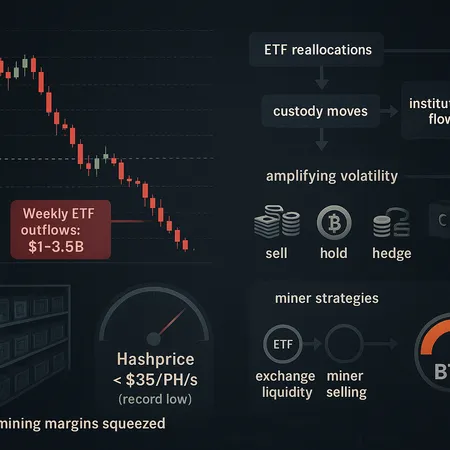
ETF flows: This week saw one of the largest ETF outflows, with coverage noting a third‑largest weekly withdrawal of roughly $1.2B despite a late-Friday rebound and other reports signaling even larger weekly outflows in the $1–3.5B range. See detailed reporting from CryptoNews and analysis of heavy outflows at CoinTribune's market summary.
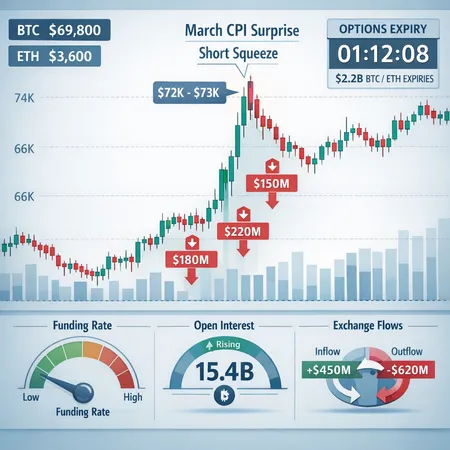
Price action: Bitcoin retreated sharply from recent highs, igniting a debate about whether the market is consolidating on its way up or entering a deeper correction. Analysts are split between more conservative targets and those arguing for higher re‑accumulation levels; a recent piece summarized the clash between $75K and $130K scenarios as part of the broader debate about next directions.
Hashprice: Perhaps the most structural data point — Bitcoin's hashprice fell to an all‑time low under $35/PH/s according to a mining economics write‑up, signaling that revenue per unit of hashpower has plunged and miner profitability is under strain.
Each of those items matters on its own; combined, they create a system where liquidity, leverage and operating economics can interact in nonlinear ways.
ETF flow mechanics — why $1–3.5B weekly outflows are meaningful
ETF flows are the plumbing of institutional cash into and out of BTC exposure. Authorized Participants (APs) create and redeem ETF shares by transacting with the underlying — either delivering BTC to the fund (creation) or removing BTC (redemption) — and they hedge these trades in derivatives or cash markets. Large net outflows require APs or the fund to source BTC liquidity, which puts direct pressure on price.
A $1–3.5B weekly outflow is material for several reasons:
- Scale versus liquidity: Spot liquidity can be thin at times. Large redemptions force sizable blocks into OTC desks or exchanges, widening spreads and increasing market impact.
- Amplification through hedges: APs and market‑makers hedge by selling futures or delta‑hedging options, which can depress futures basis and funding rates, further pressuring spot through cash‑and‑carry unwind dynamics.
- Investor psychology: Big outflows change narrative — retail and quant flows often follow headline institutional moves, increasing the probability of stop cascades.
Recent reporting runs through this tranche of outflows and their market psychology effects: see CoinTribune’s coverage of massive ETF outflows and CryptoNews’s flow breakdown. The short version: when ETF flows flip from persistent inflows to large outflows, a previously reliable institutional bid becomes a source of supply.
Hashprice and mining economics — why sub‑$35/PH/s matters
Hashprice is the expected daily revenue per unit of hashpower (usually measured per PH/s). It aggregates block rewards, fees and the prevailing BTC price, normalized for network difficulty and hashrate. When hashprice falls, miner gross revenue per chip drops — and when that revenue drops below electricity and capital costs, miners must decide how to respond.
A print below $35/PH/s means several practical consequences:
- Thinner margins: Older, less efficient rigs become unprofitable, accelerating idling or selling of hardware and, crucially, BTC reserves to cover operating costs or debt service.
- Short‑term liquidity needs: Miners facing debt covenants or immediate power bills may sell coin into weak markets, adding to spot supply.
- Long‑term capex deferral: Lower hashprice reduces appetite for new rigs, which has implications for future network dynamics but provides little relief in the short term.
Bitcoin.com’s analysis of the hashprice slump highlights the immediacy of mining pressure. When mining economics compress, the risk is not just miner capitulation — it's the timing of sales. Compressed economics can force some miners to sell at the worst possible moment, creating additional downside pressure.
Miner balance sheets and on‑chain supply
Miners hold BTC as inventory, use it to fund operations, and in many cases borrow against reserves. Their strategies vary:
- HODL and gradual sell: Larger, better capitalized miners often retain BTC, selling programmatically into volatility to smooth income.
- Bridge financing: Miners tap lines of credit or issuance to cover operating shortfalls rather than sell coin at depressed prices.
- Distressed sales and spot dumping: Smaller or highly leveraged miners may be forced to liquidate reserves quickly.
The net effect on exchange supply depends on how miners choose among these options. If many miners switch from HODL to aggressive selling, exchange inflows will spike and liquidity will be tested — creating a self‑reinforcing loop with ETF outflows.
Institutional products and volatility amplification
Institutional products do not only buy or sell BTC; they change the structure of where liquidity sits. Custodial moves, ETF rebalancing, and large block re‑allocations can compress available spot liquidity and increase slippage for large trades.
A few amplification channels:
- ETF redemptions force underlying purchases or sales — and the timing can be lumpy.
- Custody re‑allocations (on/offboarding of large wallets) can generate observable on‑chain flows that trigger algos.
- Derivative dealers hedging ETF exposures can create cross‑market pressure that feeds back into spot.
Reporting on average ETF investors being underwater highlights how reallocations and liquidations in institutional products can disproportionately affect market dynamics when sentiment shifts.
Scenarios for BTC price: levels, MVRV and probabilities
Use MVRV (Market‑Value‑to‑Realized‑Value) cautiously: it's a mean‑reversion indicator that gauges whether long‑term holders are in profit and how stretched valuations are relative to historical realized cost. When MVRV compresses, realized pain increases and distribution tends to rise.
Three plausible scenarios:
- Recovery (30–40% probability): Markets absorb outflows, hashprice stabilizes with a modest rebound in BTC price, ETF buyers return, and MVRV rebounds toward neutral. Technical path: reclaim prior resistance in the $60–75K range, then grind higher.
- Consolidation (40–50% probability): ETF outflows persist but slow, miners hedge or reduce sales; BTC trades sideways with supports tested around the mid‑$40K area and $30K acting as a strong psychological and technical backstop.
- Deeper correction (10–30% probability): ETF redemptions keep pressuring spot, miners choose selling over financing, and MVRV compresses further, opening a path toward $30K or lower in rapid drawdowns as liquidity evaporates.
These are not predictions but frameworks. CoinPaper’s discussion of a sharp slide and the ensuing debate between $75K and $130K scenarios is a useful reminder of how varying assumptions — liquidity, ETF flows, miner behavior — produce very different outcomes.
Hedging and mitigation — what miners and institutions can do
Miners
- Use derivatives: forward sales, futures and options collars can lock in prices and reduce the need for spot sells when cash is tight.
- Renegotiate power contracts: temporary curtailments or renegotiated rates can buy time when hashprice is low.
- Balance sheet management: secure credit lines against equipment, not coin; stagger debt maturities.
Institutions and ETFs
- Smooth redemptions with OTC execution: large fills via OTC desks reduce market impact compared with exchange dumps.
- Use cross‑market hedging: coordinate futures and spot hedges to minimize unintended directional exposure.
- Investor communication: clarity on creation/redemption mechanics and liquidity backstops can limit panic flows.
For traders
- Monitor basis, funding, and institutional flows in real time; use options to express view with limited downside.
- Watch miner‑specific metrics (hashprice, miner reserves, exchange inflows) in addition to macro indicators.
What to watch next — a practical checklist
- ETF daily net flows and AP activity (watch for persistent flow changes)
- Hashprice and hashrate trends (new lows in hashprice matter more than transient moves)
- Exchange inflows from miner addresses and known custodians
- Futures basis, open interest and funding rates (where derivatives lead, spot often follows)
- MVRV and realized‑value trends to gauge holder pain and distribution likelihood
Conclusion
ETF outflows, collapsing hashprice and shifting institutional positioning have combined to create a higher‑risk regime for Bitcoin. The mechanisms are straightforward: ETF redemptions remove a reliable institutional bid; a sub‑$35/PH/s hashprice squeezes miner economics and raises the chance of forced sales; and derivative hedging and custody moves amplify short‑term volatility.
That does not mean a permanent bearish verdict. Markets adjust — miners can hedge, APs can smooth execution, and patient capital may re‑enter once liquidity normalizes. But for institutional crypto analysts and serious traders, the current setup demands vigilance: watch flows, mining metrics and derivatives; stress test balance‑sheet assumptions; and keep flexible hedges ready.
For deeper, tradeable signals, integrate ETF flow trackers with mining dashboards and options market data — and remember that narrative shifts among institutions can be as market‑moving as macro news.
Sources
- Massive Bitcoin ETF outflows shake market (CoinTribune)
- Bitcoin ETFs see third‑largest weekly outflow at $1.2B (CryptoNews)
- Bitcoin hashprice falls to record low (Bitcoin.com)
- Bitcoin’s sharp slide and debate over next moves (CoinPaper)
- Fresh Bitcoin sell‑off leaves average ETF investors underwater (TheCurrencyAnalytics)
For context on on‑chain flows and tools, analysts often combine these sources with platform analytics (e.g., Bitlet.app) and OTC desk color to form execution plans.
Related tags: Bitcoin and cross‑market liquidity considerations tied into DeFi ecosystems when institutional capital reallocates between products.