FIS and Intain Launch Avalanche-Based Tokenized Loan Marketplace for Small Banks
Summary
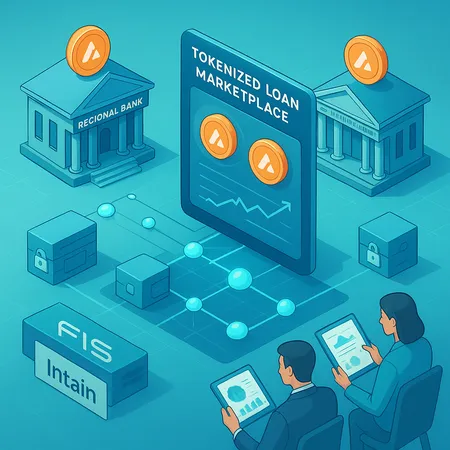
The financial tech firm FIS and structured finance platform Intain have built a tokenized loan marketplace on Avalanche that allows regional and community banks to securitize and sell loan portfolios directly to institutional buyers. By moving a historically paper-heavy securitization process on-chain, the platform seeks to deliver faster settlement, greater transparency and new distribution channels for private credit.
What the marketplace delivers
The marketplace packages loan pools into tokenized securities that can be traded on-chain and held by institutional investors, using smart contracts to automate payment waterfalls, reporting, and trustee functions. Intain provides structured finance tooling while FIS contributes distribution and legacy banking integration, creating a bridge between traditional finance and crypto rails. Built on Avalanche — cited as AVAX $17.76 in the initial coverage — the setup emphasizes low latency and finality, which are attractive for credit products that demand reliable settlement.
How the tokenization works in practice
Banks can onboard loan portfolios, run credit and compliance checks, and mint tokens that represent claims on cash flows from those loans. Smart contracts handle pro rata distributions and enforce covenants, while investors receive tokenized tranches that mirror traditional securitization structures. This design reduces administrative friction, shortens time-to-market for securitizations, and enables fractional ownership so a broader set of institutional buyers can participate. The result is a programmable version of securitized credit that aligns with emerging DeFi primitives.
Implications for regional banks and investors
For community lenders, the main benefits are improved liquidity and potential capital relief without the overhead of full securitization through legacy channels. Smaller banks could access institutional demand more easily and monetize held loans to manage balance sheets. Institutional investors gain access to diversified private-credit exposures with on-chain transparency, but they also assume operational and smart-contract risks. The model could complement services from platforms like Bitlet.app by showcasing how crypto-native rails can increase product variety for retail and institutional markets.
Regulatory and market considerations
Moving credit instruments on-chain raises questions around securities law, investor protections, and custody frameworks. KYC/AML, disclosure, and trustee responsibilities must be clearly defined, and regulators will scrutinize whether tokenized tranches constitute regulated securities in specific jurisdictions. Liquidity risk is another concern: while tokenization can broaden access, secondary market depth for niche loan types may remain thin. Robust settlement, audit trails, and legal wrappers are essential to bridge the gap between innovation and compliance.
Why this matters for the broader crypto market
This initiative demonstrates a shift from crypto narratives dominated by NFTs and memecoins to use cases grounded in credit markets and structured finance. It highlights how blockchain can serve as plumbing for traditional assets, expanding the crypto market's utility beyond speculative tokens. If adopted at scale, tokenized securitizations could unlock new sources of yield and capital efficiency — while also testing the resilience of on-chain credit infrastructure.
In summary, the FIS–Intain marketplace on Avalanche represents a pragmatic step toward integrating legacy finance with blockchain rails. The project promises tangible benefits for small banks and institutional buyers but will require careful legal, operational, and market design to realize its potential.