Quantum Threat to Bitcoin: A Practical Roadmap for Custodians and Exchanges
Summary
Why senior custodians should care now
Quantum computing is moving from academic curiosity to a strategic security consideration. High‑profile warnings from investors and technologists have pushed the conversation beyond theory into boardrooms and war rooms. While a fully fault‑tolerant quantum computer capable of running Shor’s algorithm at scale remains an engineering challenge, the combination of accelerating research, commercial investment, and geopolitical incentives means custodians, exchanges, and institutional node operators must plan for post‑quantum migration today rather than treat it as a distant hypothetical. For many institutional teams, Bitcoin is the primary asset under discussion and will likely influence broader crypto‑infrastructure priorities such as key custody, multi-party computation, and policy for network upgrades like soft forks.
Concrete, pragmatic planning reduces both custodial risk and operational surprise if quantum capability arrives sooner than some forecasts suggest.
Recent signals that elevated the threat
Public statements and reporting have pushed the quantum threat into mainstream crypto risk analysis. Venture capitalists and prominent investors have warned that non‑state actors may view crypto networks as high‑value “honeypots” for quantum-enabled attacks, amplifying urgency around custodial defenses and strategic migration VC warnings about quantum honeypots. Research summaries and commentary in the crypto press have also framed specific attack scenarios and quantified timelines, which prompted broader attention to the operational steps required to harden Bitcoin against quantum risks urgent framing and research summary. Market sensitivity to geopolitical and technological developments has already shown up in price and positioning around BTC when quantum or geopolitical stories trend, reinforcing how security narratives and macro events interact quantum risk and market context.
These announcements do not change the underlying cryptographic facts overnight, but they do accelerate operational timelines for regulated institutions that must demonstrate risk management and contingency planning.
The technical distinction: theoretical vs. practical quantum risk
Understanding the difference between a mathematical breakthrough and a deployable attack is critical for prioritization.
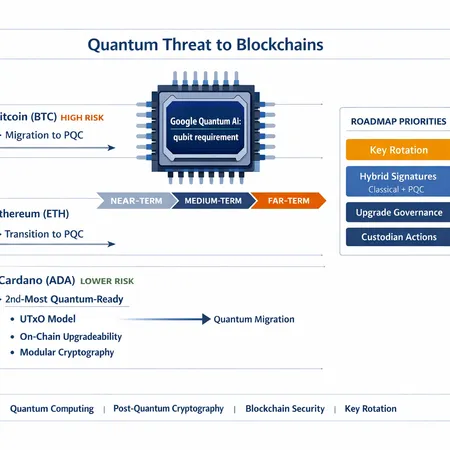
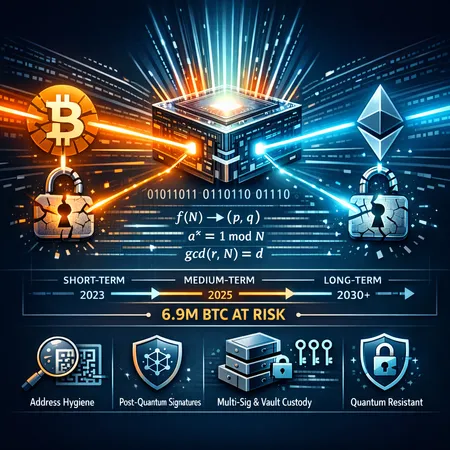
Theoretical risk: Shor’s algorithm shows that if a sufficiently large, low‑error quantum computer exists, it can factor integers and solve discrete logarithms—thereby breaking elliptic‑curve cryptography used in BTC (secp256k1). This is a mathematical certainty under the algorithmic model.
Practical risk: Building a fault‑tolerant machine with millions of physical qubits (or thousands of logical qubits after error correction) and sufficiently low noise remains a major engineering hurdle. Estimates vary widely; some academic and industry projections put practical capability decades away, others warn it could be earlier with rapid breakthroughs and intense funding.
For custodians, the risk calculus must account for both the uncertain technical timeline and the economic incentive for nation‑state or well‑funded non‑state actors to accelerate development. That means preparing for a range of arrival windows rather than betting on a single date.
Likely attack vectors against Bitcoin infrastructure
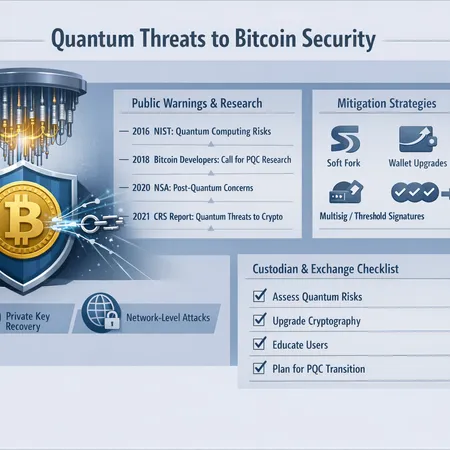
Two attack classes matter in practice: private‑key recovery and network‑level attacks. They have different requirements, probabilities, and mitigations.
Private key recovery (the primary near‑term vector)
This is the most direct and credible threat: a quantum adversary recovers private keys corresponding to UTXOs and then creates valid signatures to move funds. Two operational subtleties change exposure:
Public‑key exposure: Bitcoin addresses that have exposed public keys (or will expose them when spent) are vulnerable once a quantum adversary can compute the private key. Address types and reuse habits determine how much of a custodian’s book is exposed immediately versus only upon spend.
Harvest‑now, decrypt‑later: An adversary can record on‑chain public data now and break keys later when quantum resources exist, enabling retroactive theft of keys that were revealed earlier. This makes historical public key exposure a real long‑term risk.
Short‑term likelihood: Moderate to low today, rising with the development of practical quantum hardware.
Network‑level attacks (secondary, but high-impact)
These require broader capability: a quantum actor that can both derive keys and manipulate consensus—e.g., forging multiple blocks by signing with stolen keys or attacking multisig schemes. Network‑level attacks are possible but need more resources (control over many keys, block production power, or exploiting signing schemes across many participants). The attack surface grows if many high‑value custodians share homogenous key families or signing infrastructure.
Short‑term likelihood: Low, but potential impact is systemic, especially if combined with geopolitical motives.
Short‑term mitigations (operational hygiene you should do now)
These measures reduce exposure quickly and are low‑cost relative to lost funds.
Inventory and classification: Identify addresses by type (P2PKH, P2PK, P2SH, P2TR) and note where public keys are already revealed. Flag outputs that will reveal public keys on spend. Maintain a prioritized list of high‑value UTXOs and their key exposure status.
Address hygiene and avoid reuse: Stop address reuse across custodial services. Prefer address schemes that minimize premature public‑key exposure. For instance, avoid legacy P2PK addresses that reveal the public key at creation.
Key rotation and staged migration for hot wallets: Rotate hot‑wallet keys more frequently, move long‑tail balances to cold storage, and avoid keeping large balance hot for prolonged periods.
Strong multisig and threshold signatures: Implement diverse multisig (geographically and technically) and consider threshold signatures (MPC or threshold Schnorr/ECDSA) to remove single points of failure. An attacker that recovers one key will not gain control if a threshold scheme requires multiple compromised shares.
Offline key ceremony and hardware wallet hardening: Use hardened key‑ceremony processes, air‑gapped signing, and hardware modules that can be swiftly updated.
Record retention and detection: Log and monitor for unusual reads of public keys/addresses and unusual network scanning that could indicate targeted reconnaissance.
These steps buy time and lower immediate custodial risk while the industry develops technical migration paths.
Medium‑ to long‑term technical mitigations
Defending Bitcoin cryptography at the protocol level is harder because changes must preserve decentralization and compatibility. Consider these approaches and their tradeoffs.
Hybrid (dual) signatures via soft fork or script ops
A pragmatic transitional approach is to require hybrid signatures that combine a classical ECDSA/Schnorr signature and a post‑quantum signature; both must validate for spends. That provides a safety net: even if one scheme is broken, the other maintains security. Implemented as a new script opcode or a new address version, hybrid schemes can be introduced via a soft fork.
Pros: Backwards‑compatible for legacy validation rules, strong security during the transition window.
Cons: Larger on‑chain footprint (signature size), higher validation cost, and increased wallet complexity.
Native post‑quantum signature schemes
Switching to a quantum‑resistant signature scheme (e.g., lattice‑based or hash‑based schemes emerging from NIST standardization efforts) as native keys would close the cryptographic gap. However, block weight and verification cost are the main challenges: many PQ schemes have bigger signatures and slower verification.
Pros: Long‑term security.
Cons: Consensus coordination, higher resource use, and the need to settle on a vetted PQ algorithm (NIST standardization is ongoing but advancing).
Threshold signatures and MPC with PQ algorithms
Threshold and MPC constructions reduce single‑key risk: funds are controlled by a distributed protocol across parties who hold key shares. Combining threshold schemes with post‑quantum primitives or using hybrid signatures within threshold setups multiplies security.
Pros: Operationally flexible, reduces custodial surface.
Cons: Implementation complexity, interoperability and recovery planning required.
Migration strategies and staged rollout
A sensible migration is phased: pilots (hybrid + threshold) → soft‑fork deployment enabling hybrid scripts → wide wallet support and tooling → bulk migrations off vulnerable addresses. Each stage must include audits, compatibility testing, and user experience updates for custody clients.
Governance and network upgrades: how to coordinate a soft fork
A soft fork to enable hybrid signature validation or new opcodes requires clear governance, developer engagement, and miner/validator signaling. Institutional actors should:
- Join standards efforts and working groups to define hybrid script semantics and validation rules.
- Run client and node testnets with the new opcodes early.
- Plan for a transition window where both legacy and hybrid addresses are accepted, and clearly communicate migration requirements to customers.
Soft forks are feasible as an upgrade model, but they demand careful engineering to avoid unintended consensus splits or centralization pressures.
Practical tradeoffs: cost, complexity, and UX
Post‑quantum migration is not purely a cryptographic decision—signature size, verification time, and UX matter for exchanges and asset managers. Larger signatures increase on‑chain fees and node resource use; complex threshold schemes can lengthen recovery times. Balancing these tradeoffs requires pilots with realistic load and stress tests.
Bitlet.app and other custody platforms will need to evaluate these tradeoffs when designing wallet interfaces and migration flows; building crypto‑agility into product roadmaps is essential.
Actionable checklist for custodians and exchanges (prioritized)
Immediate (0–3 months)
- Inventory all keys and UTXOs; classify by address type and public‑key exposure.
- Stop address reuse and enforce strict address hygiene.
- Harden key ceremonies, rotate hot keys, and move cold reserves to minimally exposed storage.
- Establish a cross‑functional quantum readiness team (security, ops, legal, compliance).
Short term (3–12 months)
- Pilot multisig and threshold‑signature configurations with diverse key custodians and device vendors.
- Prototype hybrid signing in a testnet environment.
- Update SLA and incident playbooks for quantum‑related compromise scenarios.
- Engage with peers, standards groups, and wallet makers to align on migration paths.
Medium term (12–36 months)
- Implement soft‑fork‑ready code and run full node tests for hybrid script behavior.
- Migrate high‑value cold reserves to hybrid/post‑quantum address types as software and hardware support matures.
- Conduct third‑party audits and regulatory notifications where required.
Long term (36+ months or as capability emerges)
- Complete migration of customer balances off legacy‑exposed addresses.
- Remove or deprecate legacy signing paths as the ecosystem converges on PQ standards.
- Maintain crypto‑agility plans for future algorithmic updates.
Operational playbook: what to do if a credible quantum attack materializes
- Freeze withdrawals for exposed hot wallets and flag affected UTXOs.
- Communicate immediately with regulators and counterparties.
- Execute key rotation and mass migrate funds from any addresses that reveal public keys.
- Use pre‑tested emergency multisig recovery procedures.
- Coordinate with miners and node operators to deploy urgent soft‑fork fixes if available.
Testing these steps in tabletop exercises today will drastically reduce response time under real pressure.
Timeline guidance and realistic expectations
No precise public date exists for a break of secp256k1 by quantum computers. Industry estimates range from a decade to multiple decades depending on breakthroughs, error‑correction advances, and funding. Despite this uncertainty, the asymmetric nature of the risk—where adversaries can harvest public data now and exploit it later—means that planning should accelerate now. Following the staged checklist above lets teams balance cost with security: quick operational wins today, protocol and tooling changes tomorrow, and total migration over a multi‑year horizon tied to technical indicators rather than calendar dates.
Final recommendations for senior asset managers and security leads
- Treat the quantum threat as a strategic operational risk, not merely a cryptographic research question.
- Prioritize inventory, address hygiene, and multisig/threshold deployments now.
- Sponsor hybrid signature pilots and contribute to soft‑fork design discussions so upgrades reflect operational realities.
- Build crypto‑agility into procurement and product roadmaps—hardware wallets, HSM vendors, and signing libraries must be updatable.
- Maintain offensive‑defensive intelligence: monitor public quantum development signals, research papers, and statements from credible sources to adjust timelines.
Proactive effort today will protect BTC holdings from a credible long‑term risk while avoiding unnecessary disruption to operations or customers.
Sources
- Venture capital warnings on quantum threats and honeypots: VC warnings about quantum honeypots.
- Research framing and urgency on the quantum threat to Bitcoin: Bitcoin faces quantum computing threat — 9‑minute attack.
- Context on market reactions and geopolitical tensions intersecting with quantum risk: Quantum threat and market context.